This is Day 7 of the semi-lockdown in Singapore in response to Covid-19 and the 6th day of my cat, Grace’s passing.
This morning on a piece of blue bandana I assembled some of the items that have supported Grace in the past few months as her health deteriorated.
Nebulizer kit for breathing, syringe for hydration and flower essences to comfort.
The nebuliser kit that helped to unblock her nasal congestion so that she could breathe, the eye drops that moisturized her eyes so that she could blink comfortably and the syringe that delivered liquid to her mouth to quench her thirst were duly thanked as I visualised the Medicine Buddha through the fire of a blue butter lamp.
Her little turtle neck of blue & white argyle that protected her from chills and cushioned her as she lay in her cat condo on days she needed to rest was also blessed.
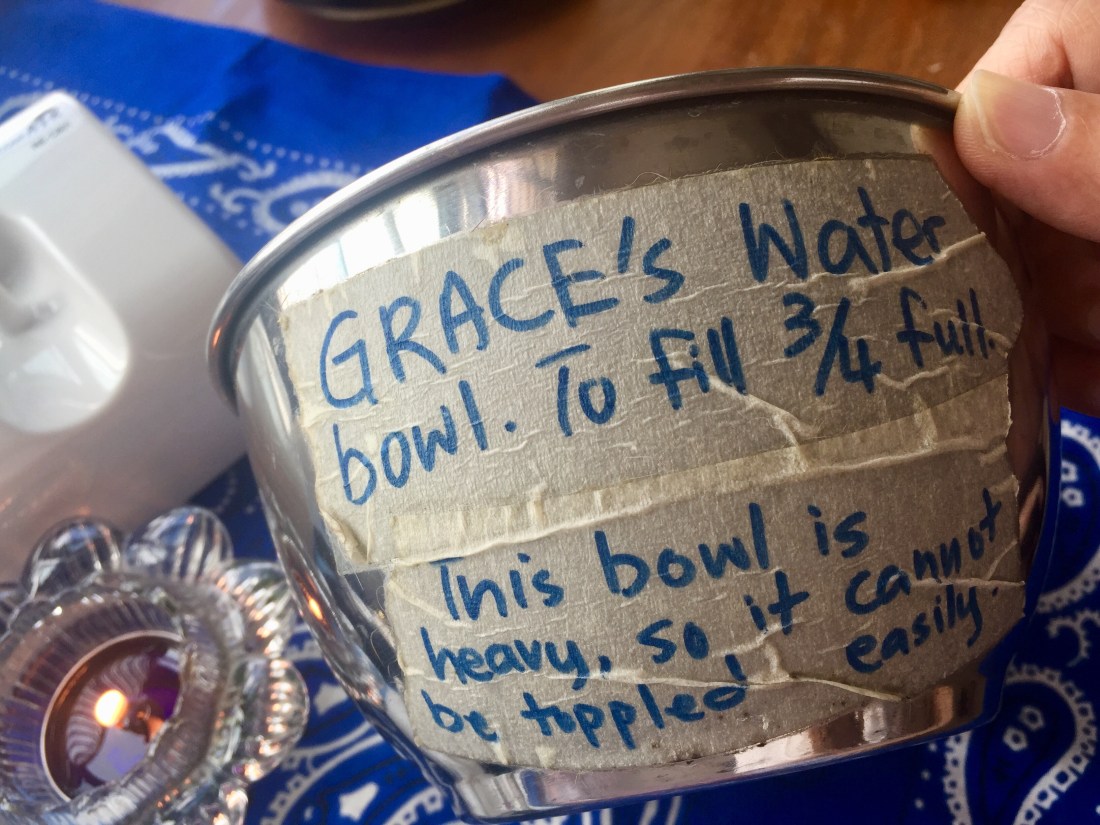
There were other important containers such as her stainless steel water bowl that had to be of a certain weight and depth so that it wouldn’t topple over when she accidentally walked into it and the carrier that served as a nebuliser chamber.
Then there were the flower essences and comforting oils that calmed both of us down as her end drew near.
Every birth has an end. And every end is an invitation to practise grace.
My cat has given me 13 years’ worth of lesson on grace, the quality from which all good springs from.
On the night of her passing, when it was evident that all the external tools were no longer required, I recited “Gate Gate Paragate Parasamgate Bodhi Soha,” to help her to cross to the other shore.
And today, by looking at the tools that facilitated her exit with gratitude and affection instead of dread and fear, I hope this little ritual will invoke grace to come & stabilise the hearts of all healthcare professionals and we who are now learning to walk in the shadow of Covid-19.
As covid-19 brings the world to a standstill, First Tutee is developing an interest in books because he spends more time at home these days.
Having zero access to television, limited exposure to social media, and supervised play, print media seems to appeal to him.
The other day he asked me why I gave away my collection of books by Roald Dahl and didn’t save any for him. I told him he wasn’t even born when I did that.
He was quiet for a while. Then he asked if I could let him know first before giving away any books from now on.
I pointed out that he hadn’t even started reading the book I got him from Nepal. It was called “Namastay.”
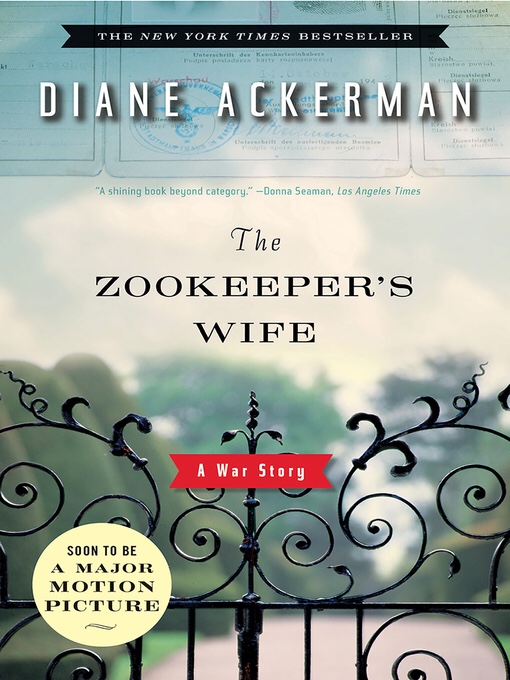
In “The Zoo Keeper’s Wife” by Diane Ackerman, there was a very disturbing account of nazi soldiers coming into a small zoo and shooting the animals one by one in their cages.
The zoo keeper’s wife, fearful for her own life as well, couldn’t do much to save the animals that she and her husband had lovingly tended to over the years.
As gun shots rang painfully outside their living quarters, the zoo keeper’s wife could only hold her young son close, and read to him to prevent him from asking questions about his animal friends being used for target practice.
This contrast of unspeakable violence by uniformed youth of supposedly superior stock against a mother reading to her child to protect him from life’s incomprehensible heartbreaks remains for me a very potent symbol of how at our most vulnerable moments, we seek refuge in words.
Perhaps First Tutee, and many children the world over will find life’s many unexplained questions in books as they wisely stay home to let the virus passover, while adults outside continue to bicker and blame like tempestuous toddlers.
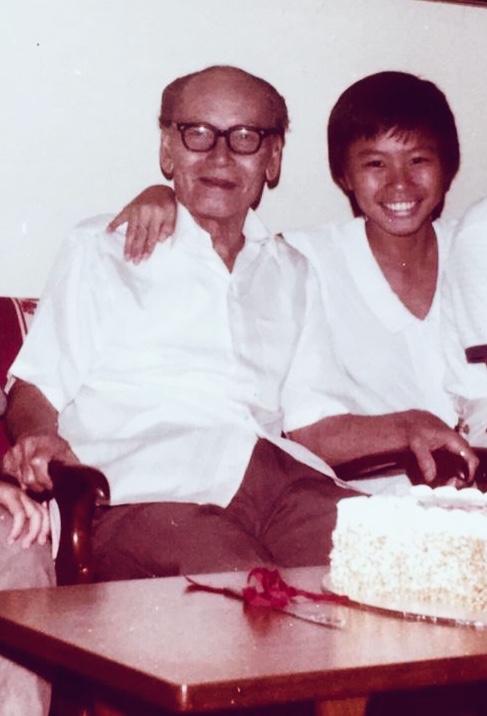
As a young girl with my own goggled grandpa on his birthday.
On the recent New Moon, Ron & I chatted outside the supermarket while El popped in to get my groceries.
We were exchanging news & thoughts about the covid-19 situation at home and abroad.
An old man who was seated near us became unusually interested in our conversation. At the mere mention of the word, “lockdown,” he sat straight up from his crumpled position and peered at us from behind spectacles too big for his wizened face. Just to be sure, I used the word a couple more times, and he did the same.
So he might have heard bits of our exchange that sounded like this, “Lockdown…blah blah blah…food supplies…blah blah blah…quarantine… infections…lockdown …blah blah blah.”
If I was even remotely right about what Goggled Grandpa was hearing, what a frightening world it must be for him!
His thick glasses coupled with his sunken cheeks and the birdlike way in which he titled his head to “eavesdrop” was both pitiful & endearing.
I decided to stop talking so as not to confuse or scare him.
I’m a goggled auntie myself now.
Now & then at supermarkets elderly folks ask me to read out the small prints on the price tags of cling wrapped groceries for them. $3.25 & $32.5 are too challenging for old eyes.
Sometimes at the pharmacy I see the hesitation and even unease, in the eyes of older folks reading & comparing details on bottles of supplements they are thinking of buying. Most likely they are struggling with pre-existing medical issues and have come to the pharmacy because someone has told them such-and-such superfoods can help them or even cure them of their ailments.
I used to ask where are their children when I see old folks managing on their own. But getting on in years myself, I also realise this kind of isolation may not be for lack of physical companionship or care, but is brought on by the gradual & inevitable deterioration of one’s own 5 senses.
When our eye sight fails we don’t trust what we see. So what if there’s someone who loves me standing right next to me?
When our hearing wanes, we’re unable to participate fully in conversations or worst still, we listen selectively and mix up our own mangled narratives with that of others. So what if I’m guaranteed a place at gatherings?
When our gustatory and olfactory faculties weaken, we may need more than permissible doses of flavorings to entice us to eat. So what if a 10 course feast is placed before me?
Perhaps these are what make aging so frightening, because no amount of external support can compensate for the loss which is internal.
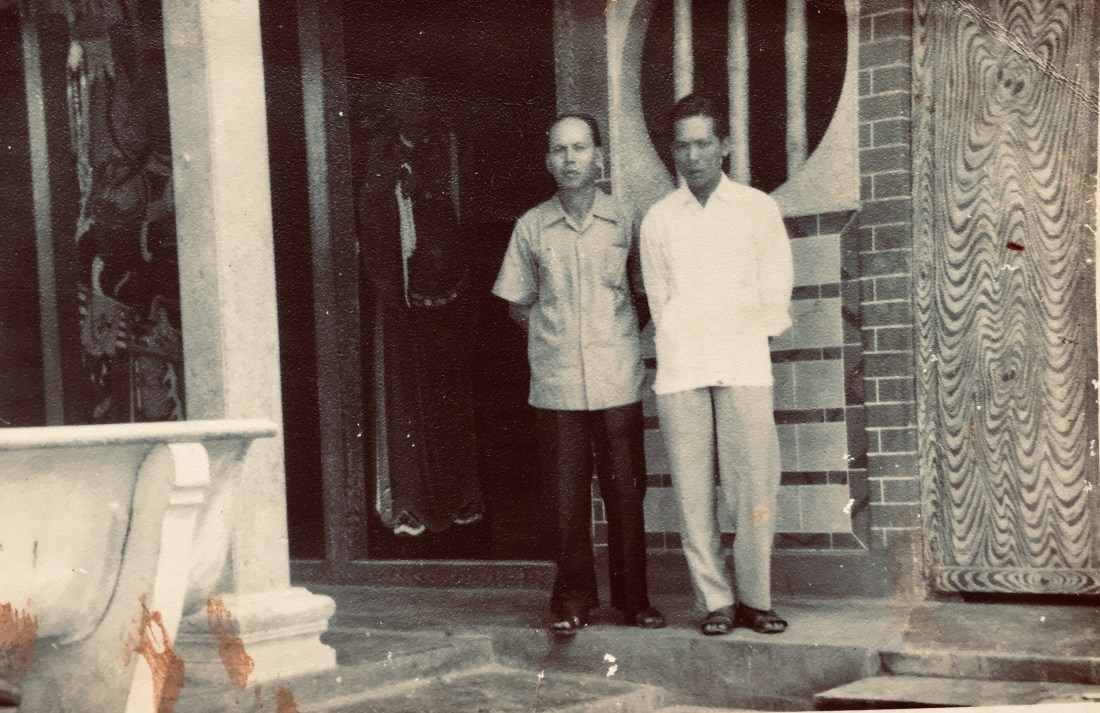
My grandpa (left) had taken care of this temple at Leng Kee Rd from the time he stopped pig rearing to the end of his life.
This morning I recalled my grandpa silently going about tidying the temple altars, folding up paper offerings with his arthritic fingers and making sure the temple cats had been fed before he locked up for the night.
I realised in the end no matter how popular or powerful we are, it’s just us and our personal memories, thoughts and practices that will keep us company and grant us some peace in the midst of all that fluidity.
Maybe the current situation of physical isolation through quarantine and stay home notices can help us to accept our own company first, and make peace with who we really are. Only then we can purify our fears of Covid-19 lockdown and rehearse for the ultimate lockdown that awaits every single living being when it happens.
In 1964, I spent 3 months in one of the buildings in the CDC at Moulmein Rd. I was 10 month old.
Physical isolation was imposed on me at babyhood. Two months before I turned one year old, I contracted poliomyelitis. What followed was a 3 month hospitalization at the Centre for Communicable Diseases in Moulmein Road.
My young dad at 27 years old was devastated by the thought of his baby girl crying alone in a ward full of similarly afflicted older children under quarantine care.
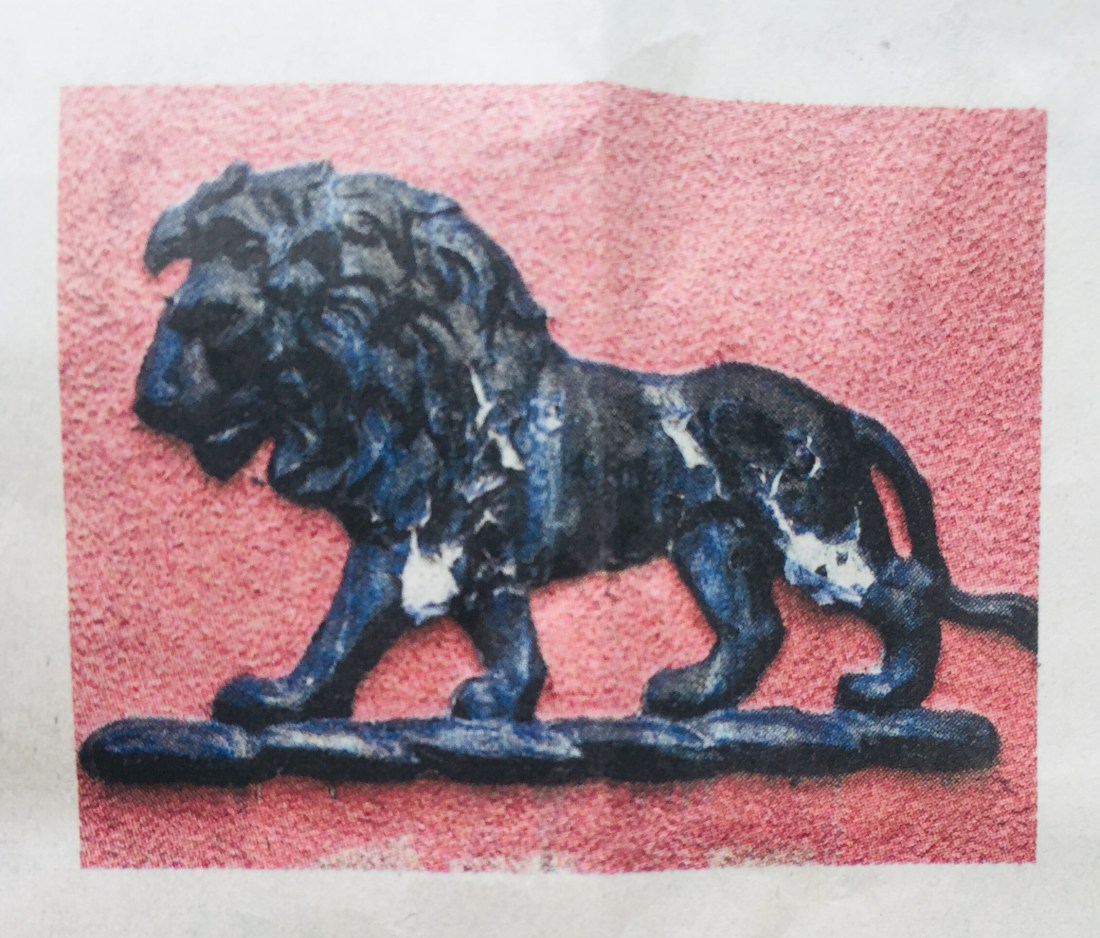
The Black Lion emblem of the CDC. A lion lives in a pride but each individual has separate destinies.
During his era, hospital compound wasn’t so secure like it is these days. He was thus able to sneak in and watch me from a distance through a window. Everyday.
When I got better, visitors were still not allowed. But he somehow managed to drop by to feed me grapes by throwing them through the window like I was in a zoo! 😄
It was the only way a labourer knew how to comfort his 10month old child.
Of course he was duly chastised by the ward nurses each time for his illegal feeding acts. But my dad’s love was beyond logic and gave him the ability to tolerate all kinds of hardship & humiliation. He would often eat just a slice of fried sweet potato for lunch so that he could save up for the bus fare that would take him from our village in Zion Road to Moulmein Rd. Somedays he had to walk.
When he was finally allowed to visit me, he quickly found out who were the kids closest to my bed. Among the young recovering patients, there was a teenage caucasian girl who was very kind.
Despite the language barrier, my dad somehow was able to make her understand that if she could comfort me when I cried, he would get her gifts.
So my dad saved up even more and bought my Caucasian Angel snacks each time he visited.
My grandma used to tell me that my Caucasian Angel was on crutches, but she was very beautiful. And she worried who would marry her.
Towards my discharge from the CDC, my dad bought my protector a portable transistor radio which was an expensive gift in the 60s, and especially so for someone in my dad’s economic situation. But my dad knew he would never be able to pay her enough for those months of companionship she gave me.
So I recovered from poliomyelitis with a limp that would set me apart from others in physical appearance, impose further financial challenges & restrictions on my family in my growing years, and come to dominate all later decisions I would make in my adult life.
I will always be several steps behind others in movement. And this is nowhere more obvious than during fire drill or building lock down exercises. I can never gather in time like able-bodied people at reporting point to mark safe.
One time after the whole school building had been vacated during a fire drill practice, I found myself still struggling down 4 flights of stairs, as the classroom I was teaching in was on the 5th story.
It moved me so much when a young athlete who was training for her SEA Games in sports school at that time came running up the steps to hold my hands so that I needn’t have to walk alone.
Thus unable to alter my speed, I continue to plod on among panic shoppers with their trolleys filled to the brim to face covid-19, while carrying my one daiso shopping bag of groceries that my physical condition has permitted me.
But often in my solo marketing journeys, I meet supermarket staff and even perfect strangers asking if I need help.
Social distancing for now is necessary to break the spread of viral transmission, but my own childhood affliction that has set me permanently apart from others also assures me that being apart doesn’t mean being alone.
And so I wish for all my friends that whatever sets us apart, may we also recognise that with compassion & wisdom we are never truly alone.
May the loss of physical freedom that we face now facilitate the liberation of our spirit & mind, like the way having his little girl under quarantine builds in a young father the qualities of resilience, humility, ingenuity and trust. ♥️ 🙏
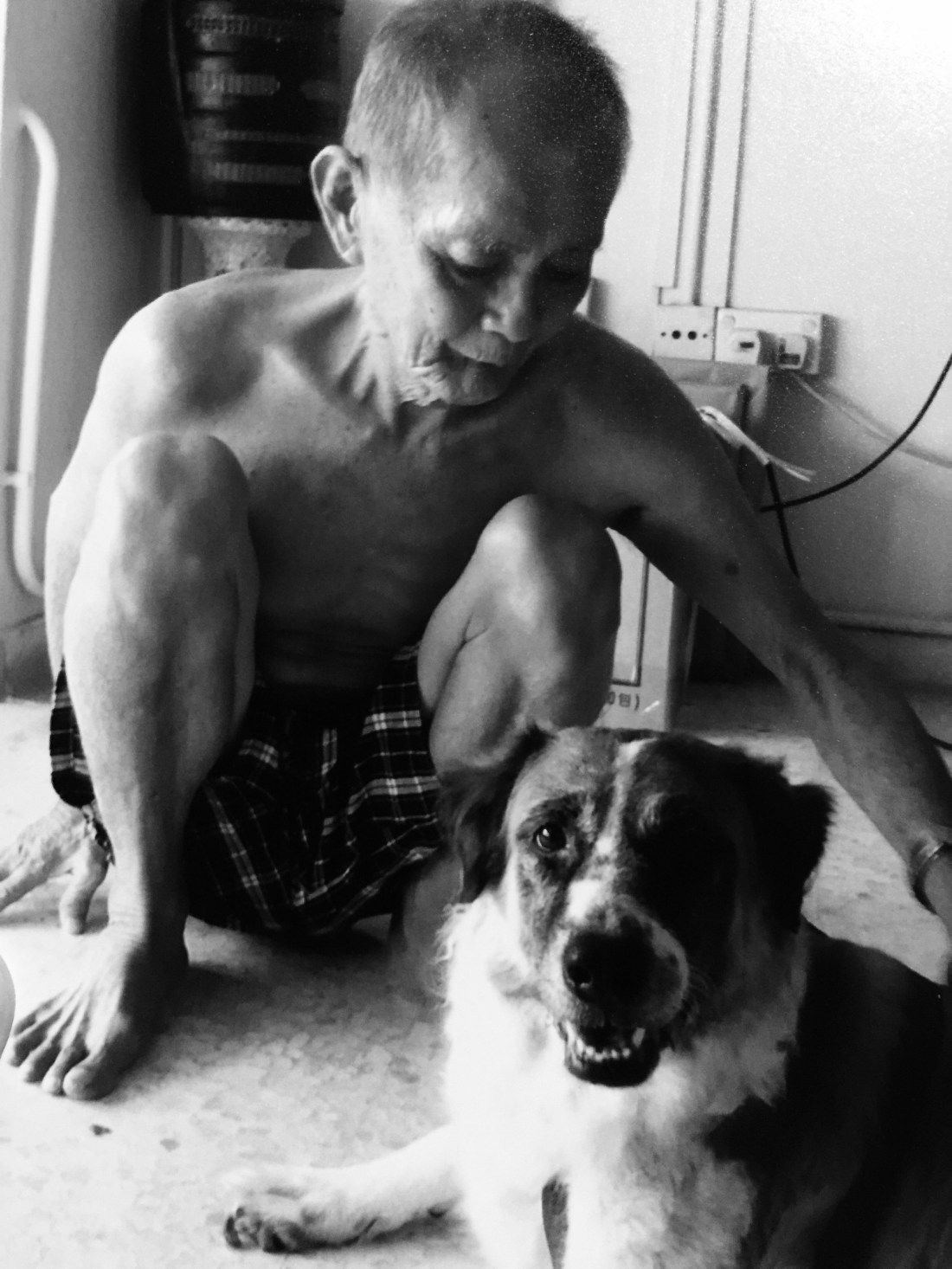
My dad in his old age enjoying the company of my dog, Shoya. My dad left in 12 Sept 2009 and Shoya left in 8 Aug 2014. We’re apart now, but always in touch.
Ollie, my own cat, approves of my shelter work. I hope many cats at shelters will have access to bigger spaces.
The skinny Girl Cat hurried towards me, pressing her bony face against the wire mesh, seeking comfort.
She’s been on medicines to manage diarrhoea. Meanwhile her beddings were soiled and her fur were unkempt from the runs.
My friend, with clean beddings in hand bravely entered Girl Cat’s enclosure. She had to remove the dirty ones from their aerial bed frames before putting on the fresh ones, while trying not to inhale the smells.
Prayerfully, I wiped down Girl Cat’s body with donated good quality wet wipes and removed as much stains from her fur as possible. Her tail was crusty.
Like all children, Girl Cat received the cleaning of snot and tear stains on her face with a bit of protest, but was generally grateful for the human touch.
Admittedly, the handling of bodily fluids or wastes of another creature is not a task to be taken lightly. So we wear gloves and masks for protection & to create a psychological buffer for peace of mind. But the heart is a store house of emotions.
And even as we flinched at the sight of a sickly cat and her mess, the awareness of how her tummy must have hurt, and how sore her lower body must have felt, gave us the power to overcome our personal misgivings and get on with the cleaning.
Girl Cat would need time to respond to her medications. Till then she would continue to soil herself and her beddings. Till then she would need help in keeping clean. She was hand raised from birth, and now in sickness, continues to be cared for at the shelter, the only home she has ever known.
But in her sickness, Girl Cat has cured us of our fears of bodily wastes & reminded us how wonderful it is to be alive and to be able to offer up our breaths, our strengths and our sensibilities for the mitigation of misery in others.
For my friend who was born and raised in comfort & cleanliness all her life, making her rounds of litter box cleaning and bedding changes for 100 plus cats at the shelter the whole afternoon afternoon had successfully freed her from her scatological anxieties.
Today is Girls’ Day in Japan. Also known as Hinamatsuri or Dolls’ Day, Japanese families with daughters display dolls and make special dishes to celebrate daughters.
Daughters who study & play.
Since ancient times across cultures, daughters have played pivotal roles in securing the economic survival of families and the political stability of countries, despite not receiving the same respect as sons in many asian households.
There are all kinds of daughters.
Daughters who love animals.
Daughters who study, daughters who dance, daughters who dare, daughters who heal and daughters who work and daughters who are traded to supplement family incomes and so on.
Daughters who represent the nation.
So here’s wishing all human & animal daughters, regardless of contributions & situations, good health, joy and kindness!
Daughters who rescue & heal.
May the female energy be duly honoured so that daughters who smile will bring forth greater abundance, constant creativity and deep healing for all sentient beings.
Little Gymnast and Big Boy were working on their synthesis and transformation skills.
They are both 10 years old.
Little Gymnast was in a lilac t-shirt and cobalt blue shorts. Long haired and light-footed, she resembled a garden imp.
“Fat people are not funny!” Big Boy blurted out in a huff. He was looking at a sentence about keeping healthy through regular exercise.
Little Gymnast looked up from her work and said gently but firmly, “You are putting yourself too much into the story. The sentence is not talking about you.”
Big Boy was slightly taken aback by the certainty of his diminutive tuition buddy.
“It’s your imagination. You have to stop imaginating everything is making fun of you,” Little Gymnast added.
“Do you mean ‘imagining’?” Big Boy clarified, looking genuinely puzzled. His misguided feelings of offence earlier on seemed to have completely vapourised after hearing this strange word from Little Gymnast, whose vocabulary range wasn’t as varied as his.
“Yes! That’s what I mean. Your imagination is messing with you!” Little Gymnast held onto her belief. She was not in the least embarrassed to realise that her word form, “imaginating,” did not exist.
“Now, can I borrow your correction tape, please?” She asked sweetly.
Big Boy happily obliged by sliding the piece of stationery across the table to Little Gymnast.
And that was how a young girl helped a young boy let go of his wrong perceptions, and in return he lent her the tool to correct mistakes in her own assignment.
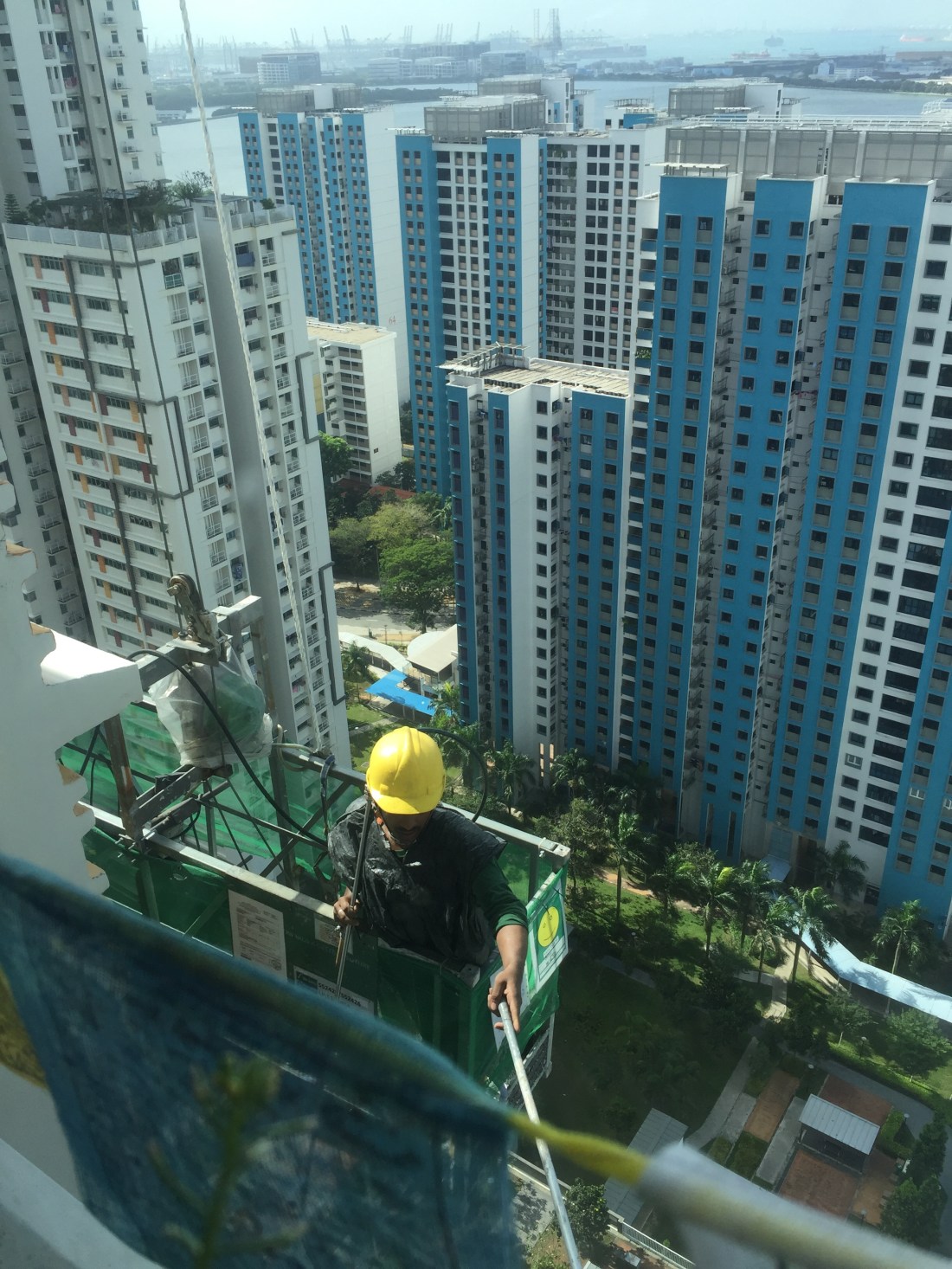
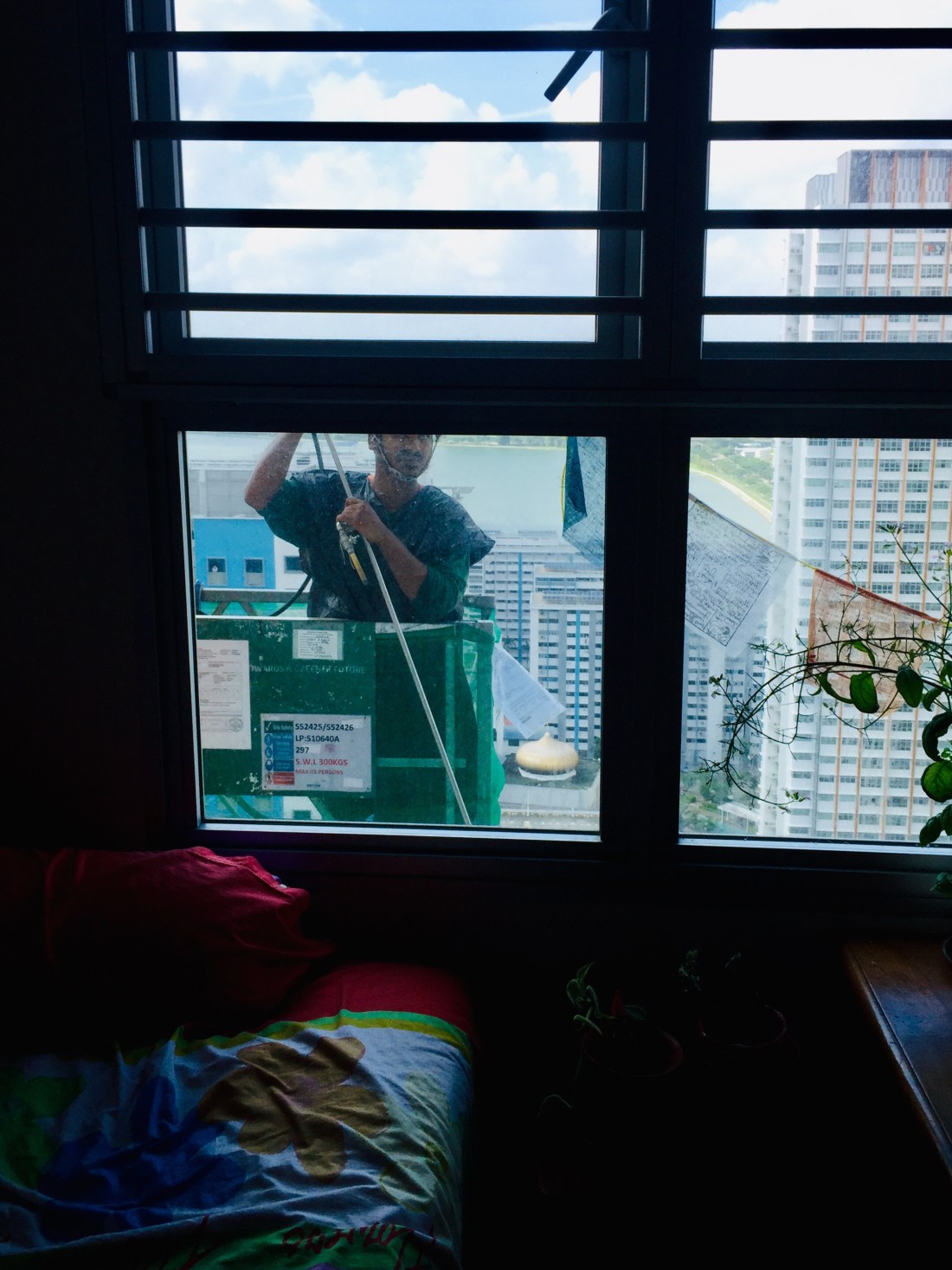
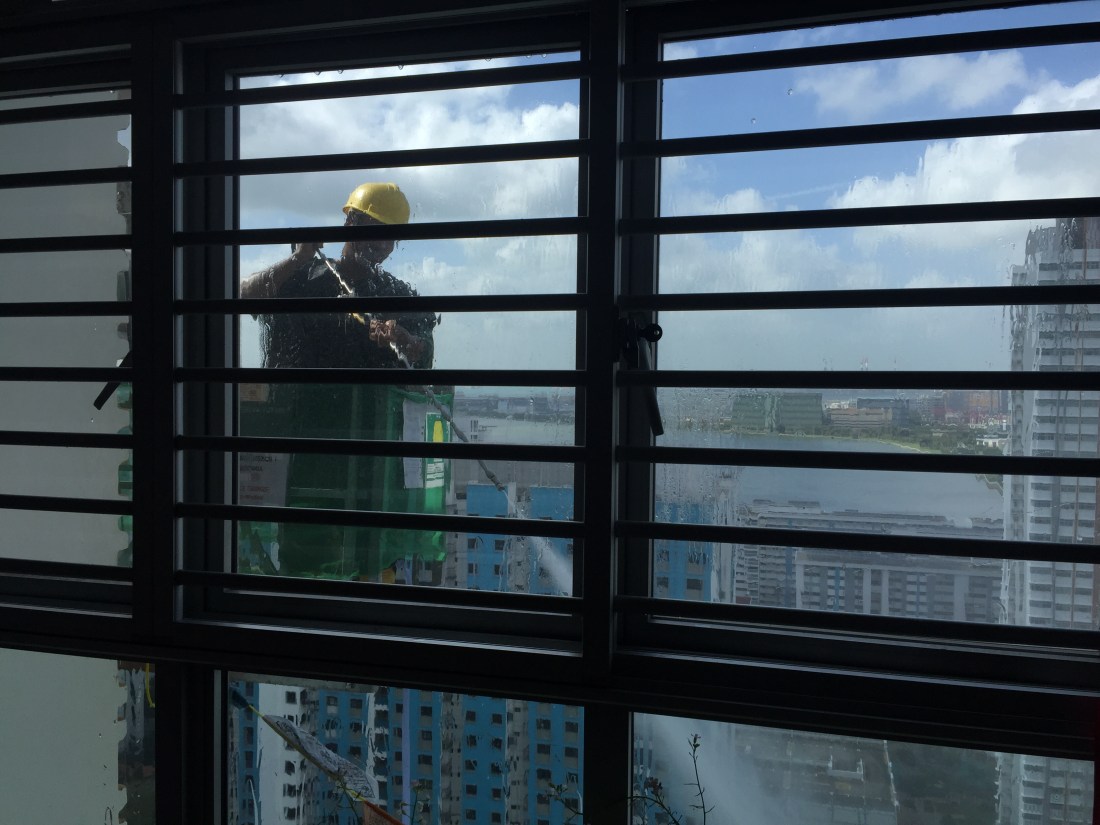
At each unit where the windows were left opened by absent owners, the workers doing the block washing used a metal rod to push shut the window panels before they started directing jets of water to remove dust & dirt.
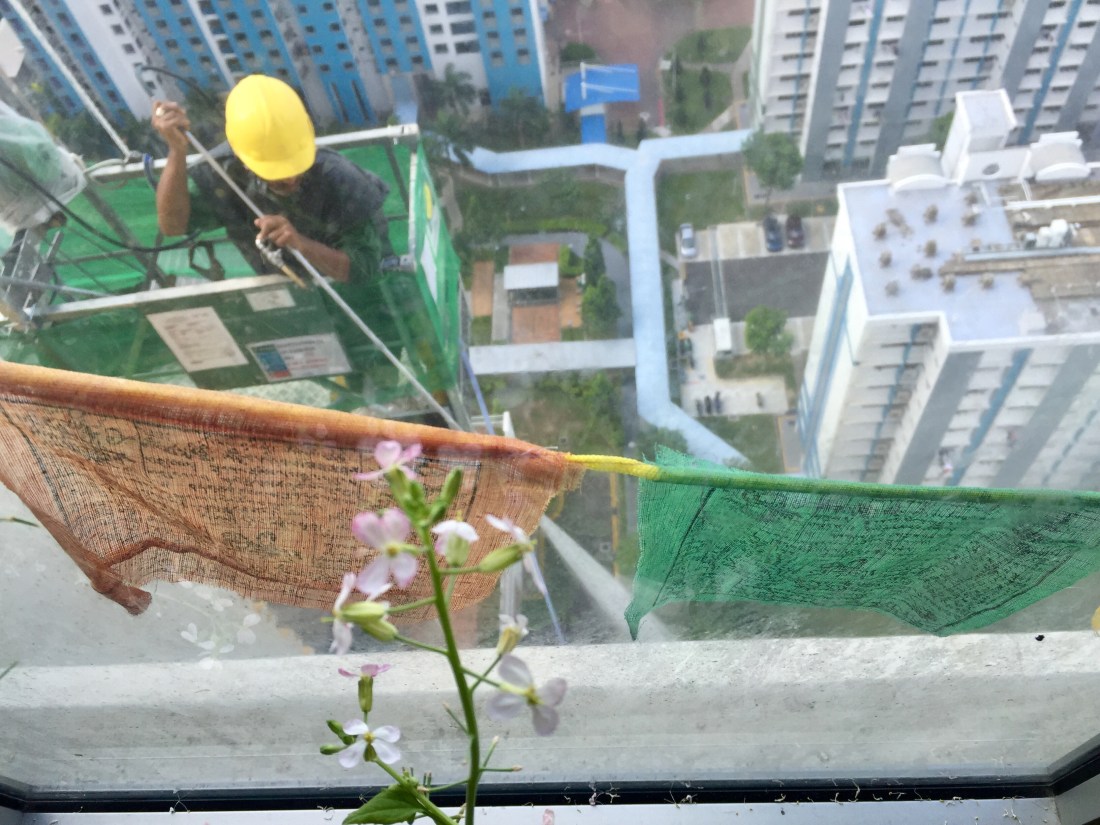
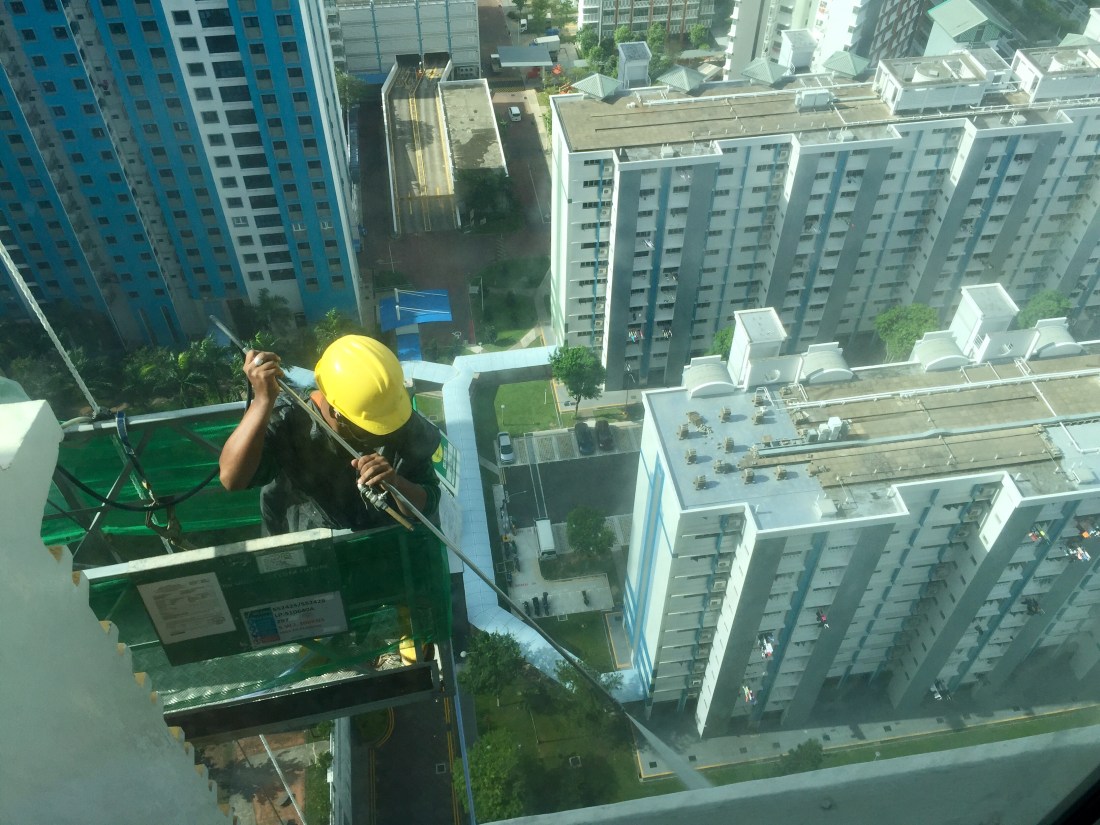
The worker uses a pole to shut windows that had been left opened.
Jets of water to flush out dirt and algae from walls & window panels.
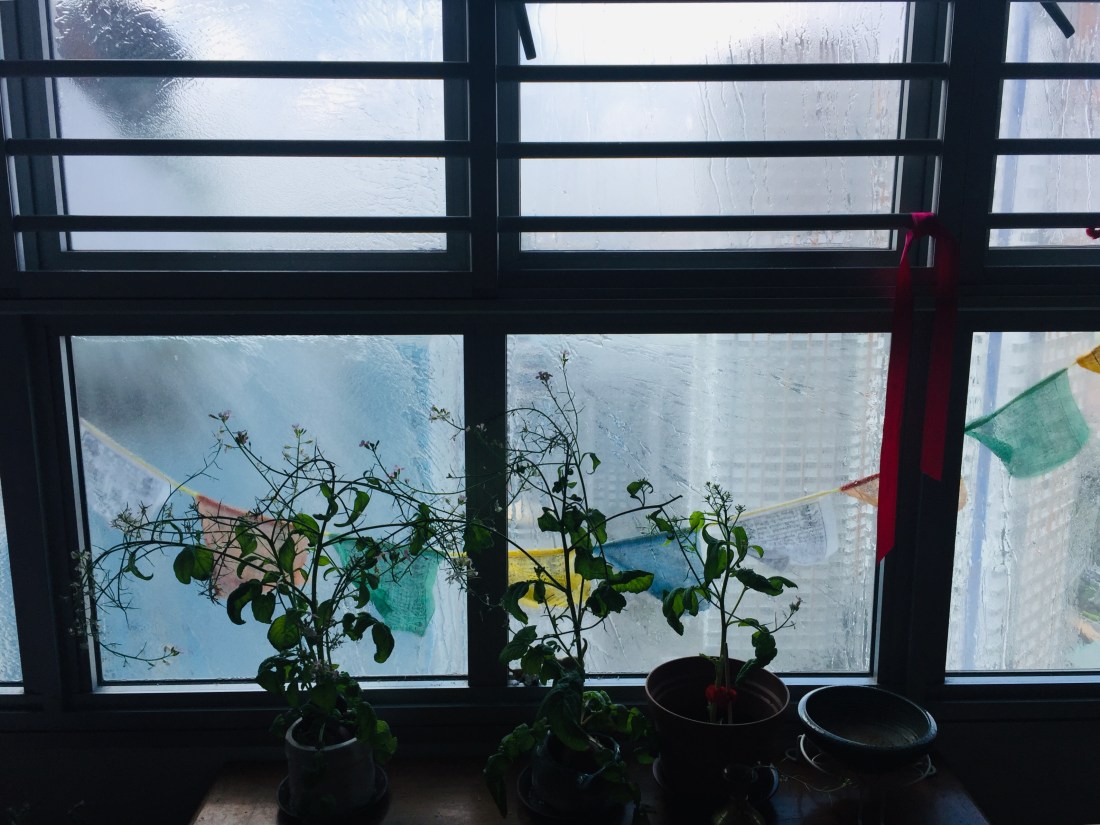
When they reached my unit, my windows were all shut. But still, one of them gestured if I wanted to remove the windhorse prayer flags hanging outside.
I gave the worker a thumbs up so that he could proceed with the cleaning while the prayer flags remained hanging. I could tell he was careful not to direct the jets directly at the windhorses.
I gave him the thumbs up to show that he could carry on.
He cleaned well, leaving the glass surface outside sparkling and the prayer flags dust free, while receiving the windhorse blessings.
Dust came off the prayer flags.
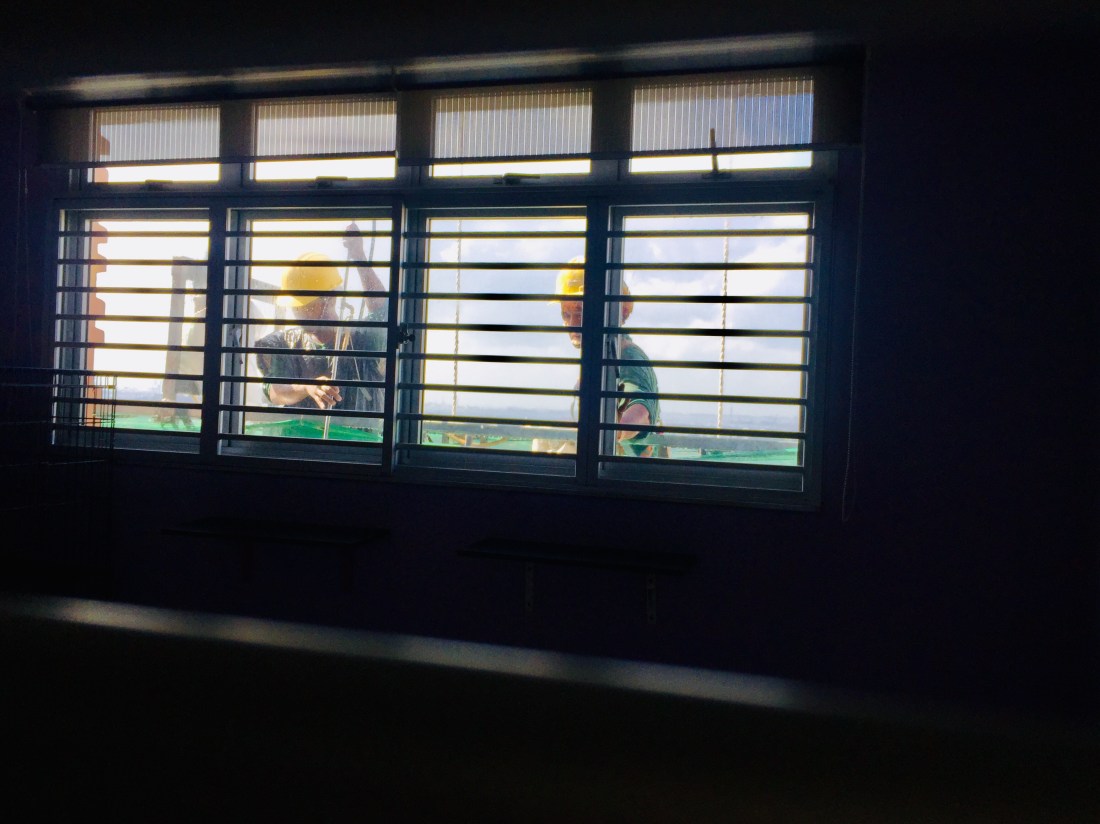
Outside the windows of the cats’ room, the thunderous roar of water upon impact with concrete and glass frightened Hakim and his siblings. They huddled pitifully at the door, wanting to be let out as far away from the strangers outside their windows as possible.
I waited till the workers had moved onto a few units below before I let the cats out to play in the living room to release their stress.
As a compensation for their 2 minute trauma while their windows were being washed, the cats had their early dinner of tuna.
Helmets and some wraps around the face were the protective gear they had on. The nature of their cleaning tasks and the height they are on probably need them to dress as lightly as possible so that they can move easily in the cramped gondola.
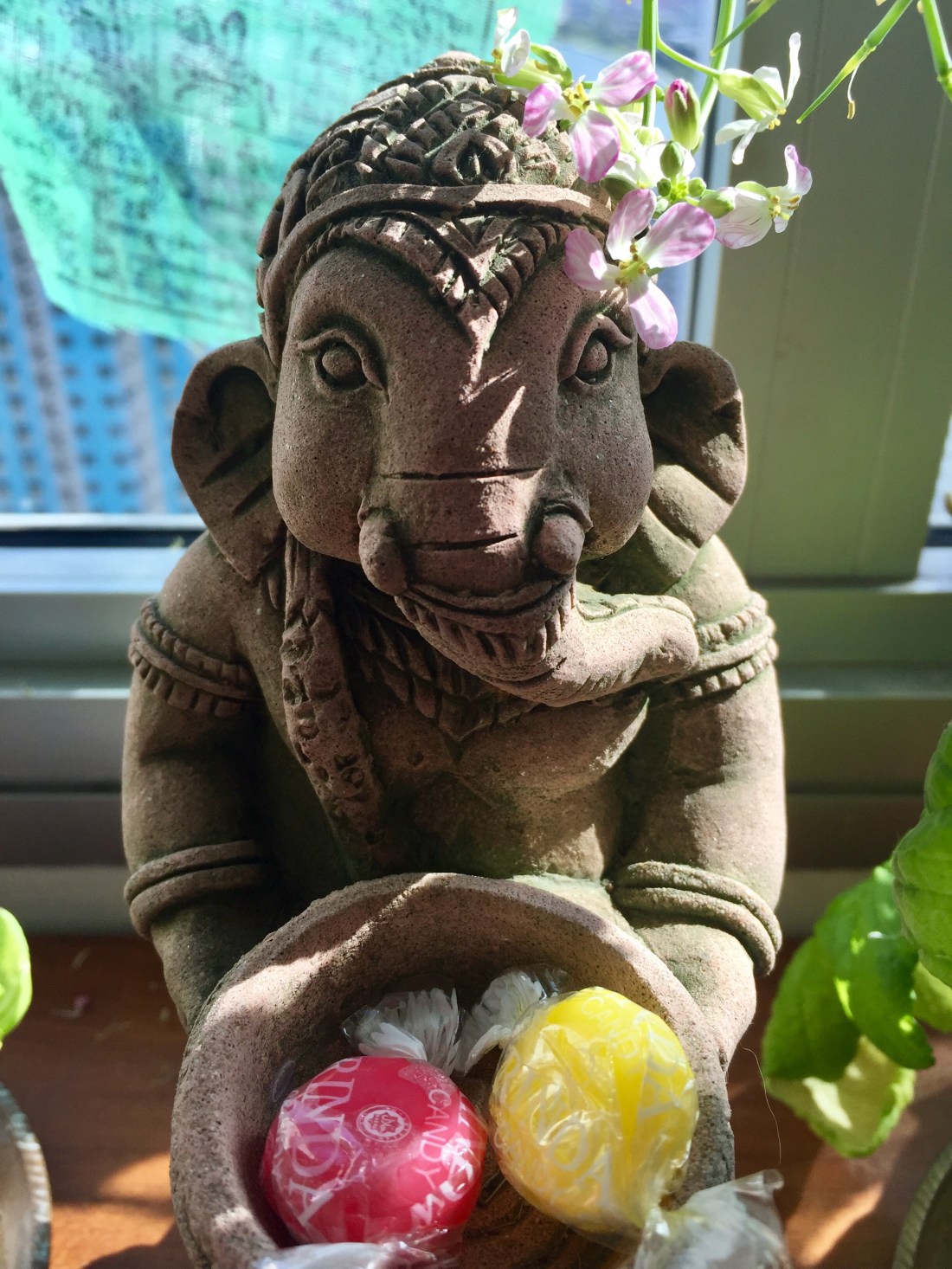
Finally a sweet offering was made to give thanks for the workers’ continued safety and good health, as they carry on purifying our living spaces.
May these workers have a sweet life while they go about making ours sweet. 🙏
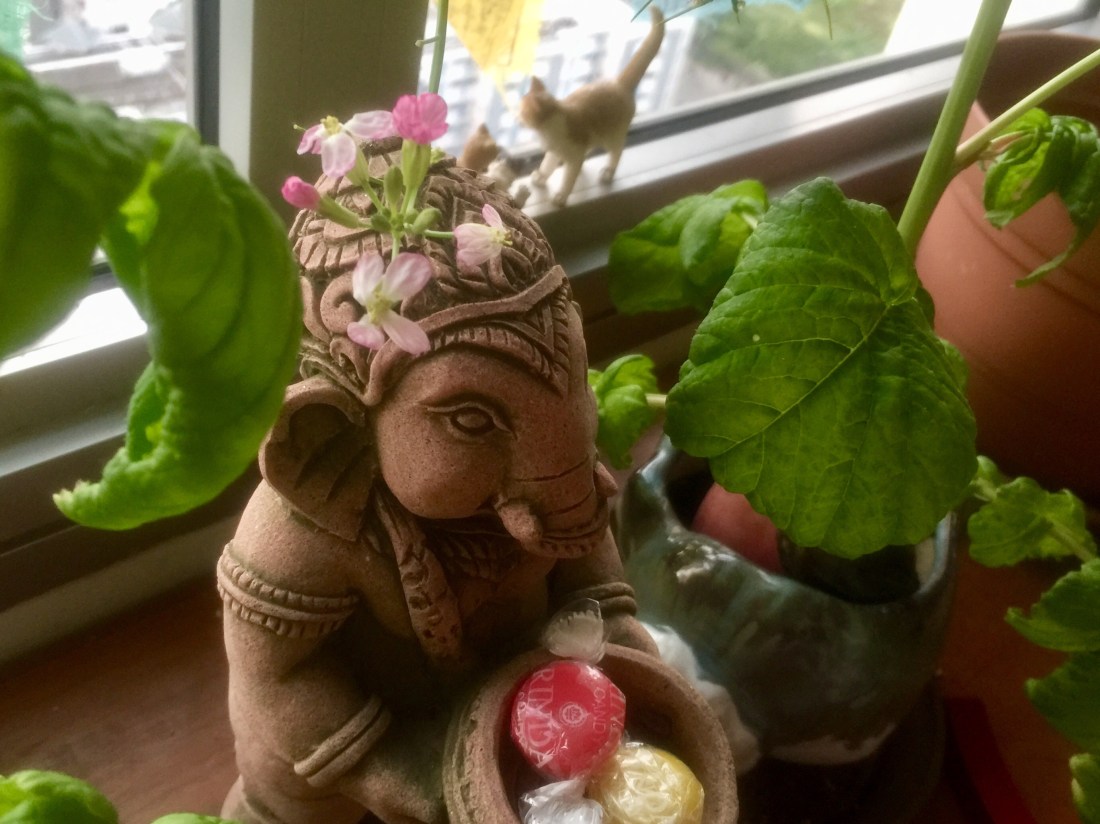
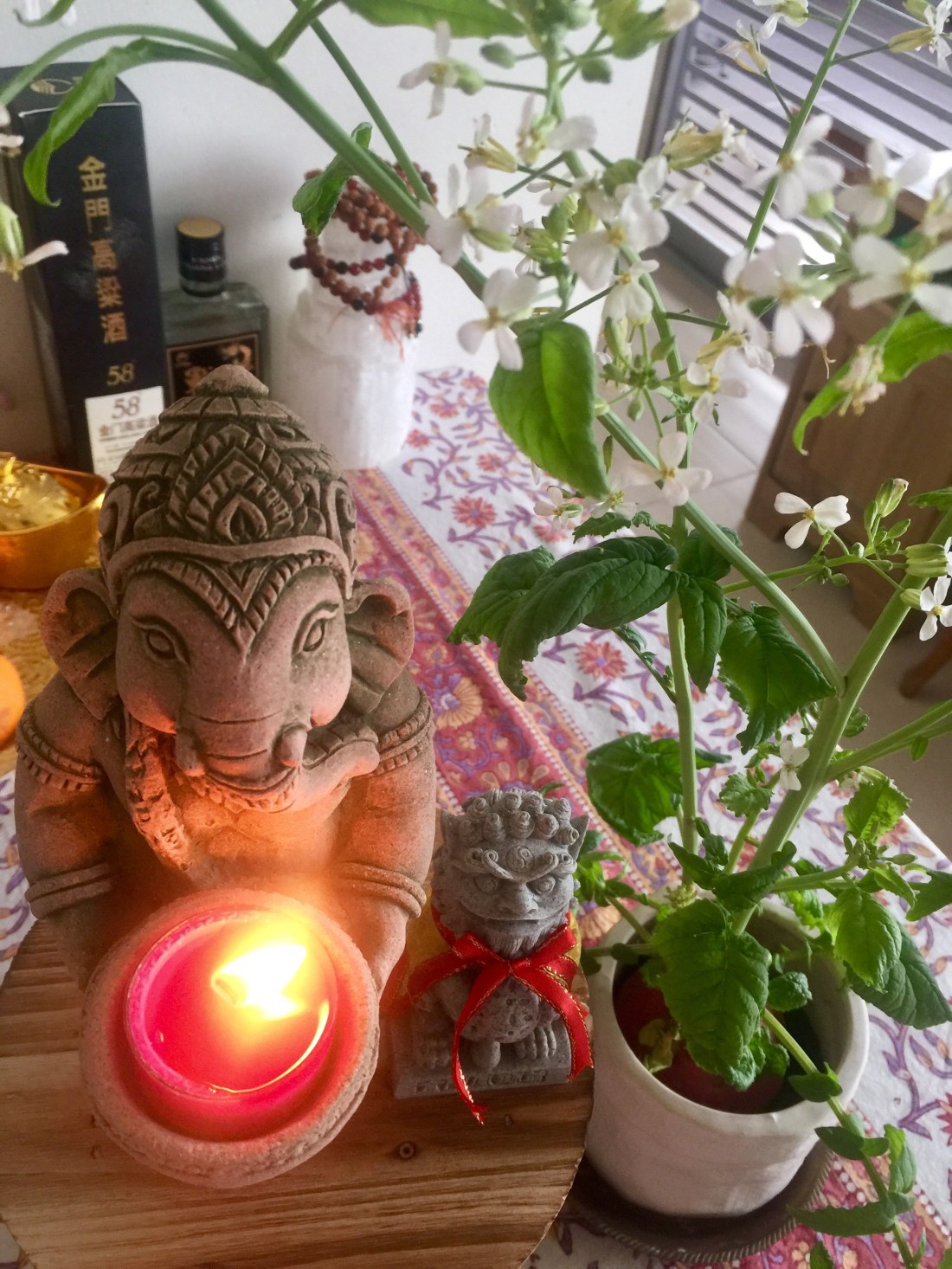
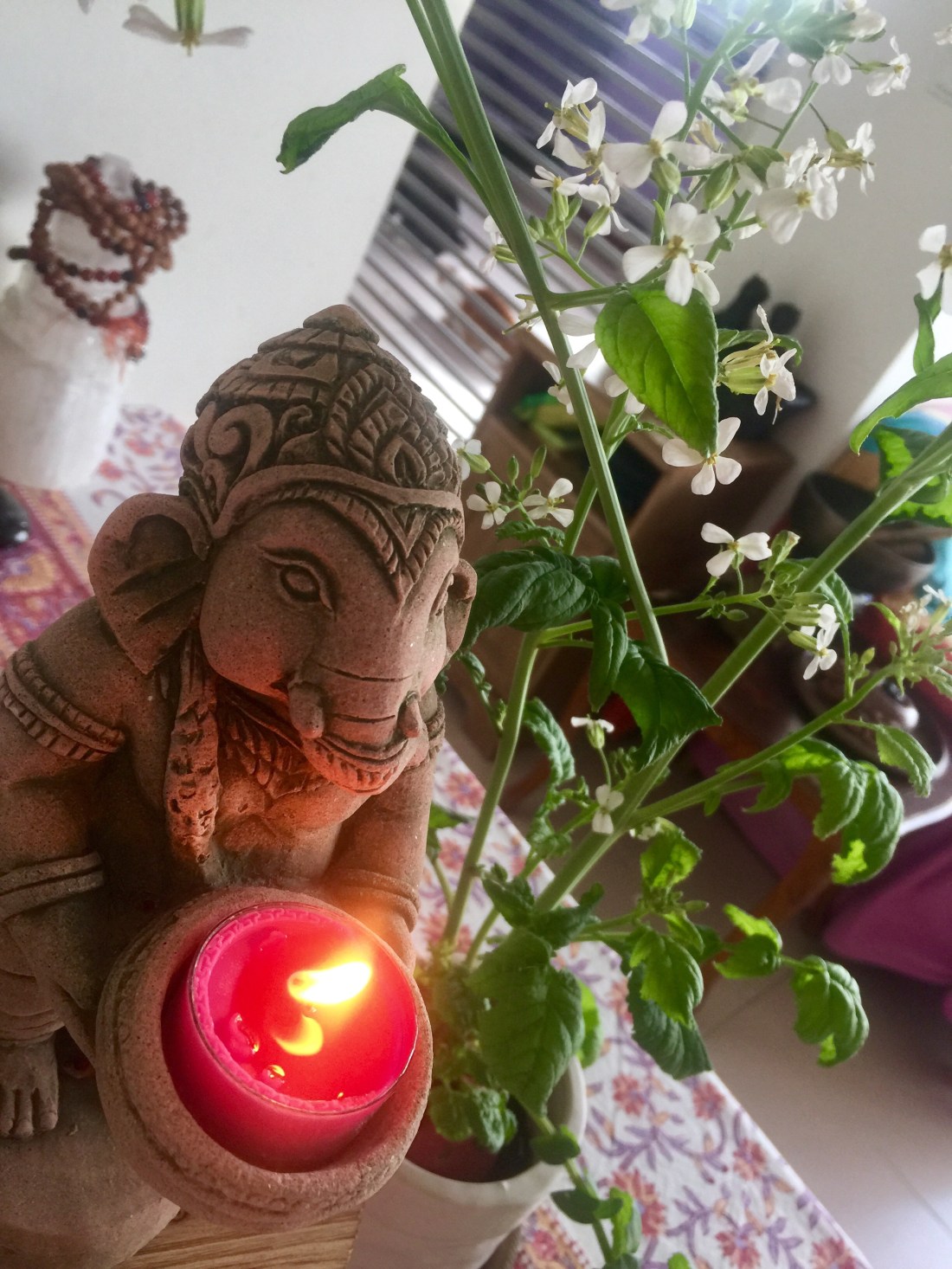
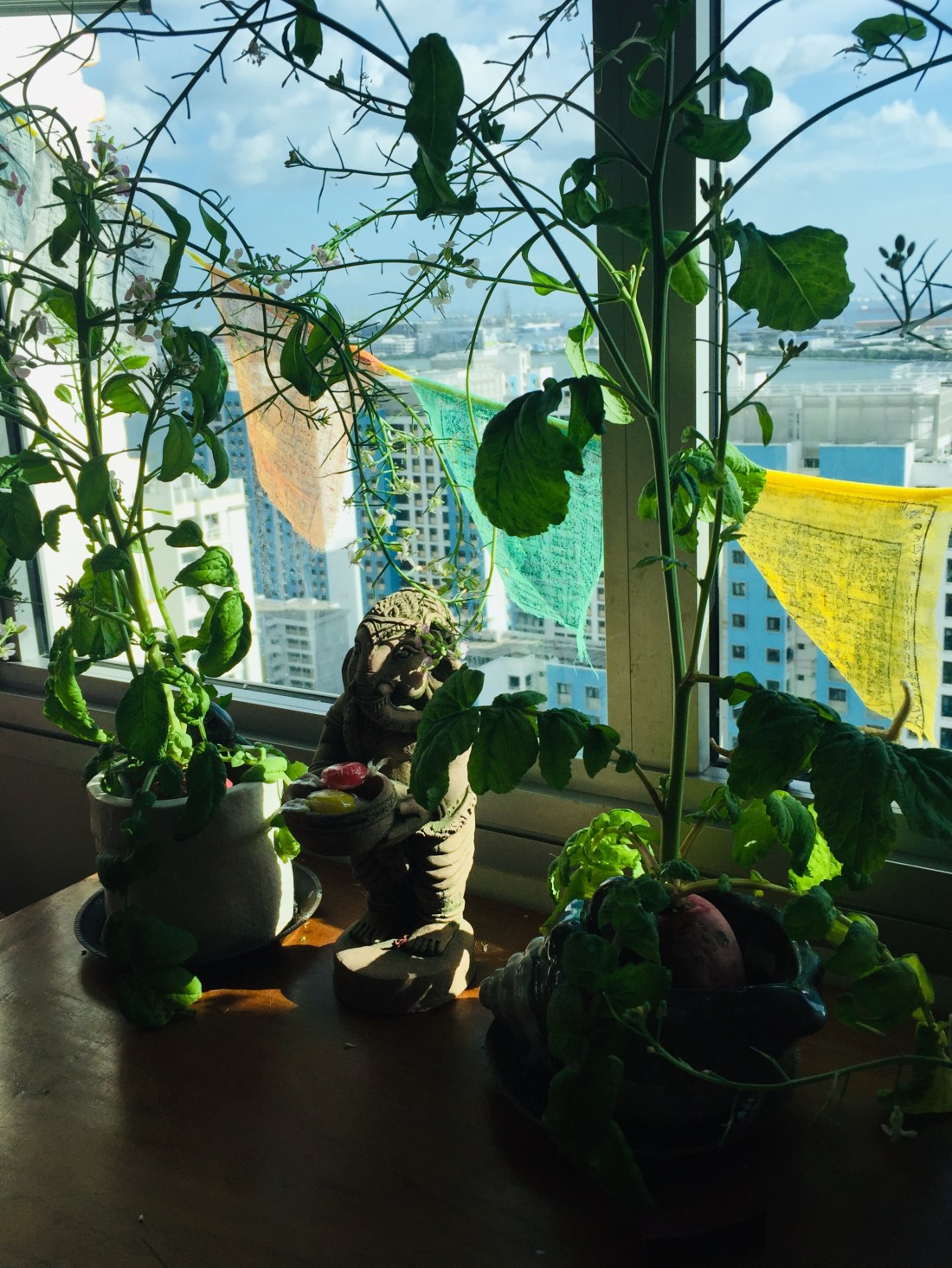
Thanksgiving Offering of sweets while the blooms of red radish plant adorned Ganesha’s head.Giving thanks for the ones who laboured and took risk in the hot sun and gusty winds to give me sparkling windows, clean walls & dust free prayer flags. May their life be full of sweetness.
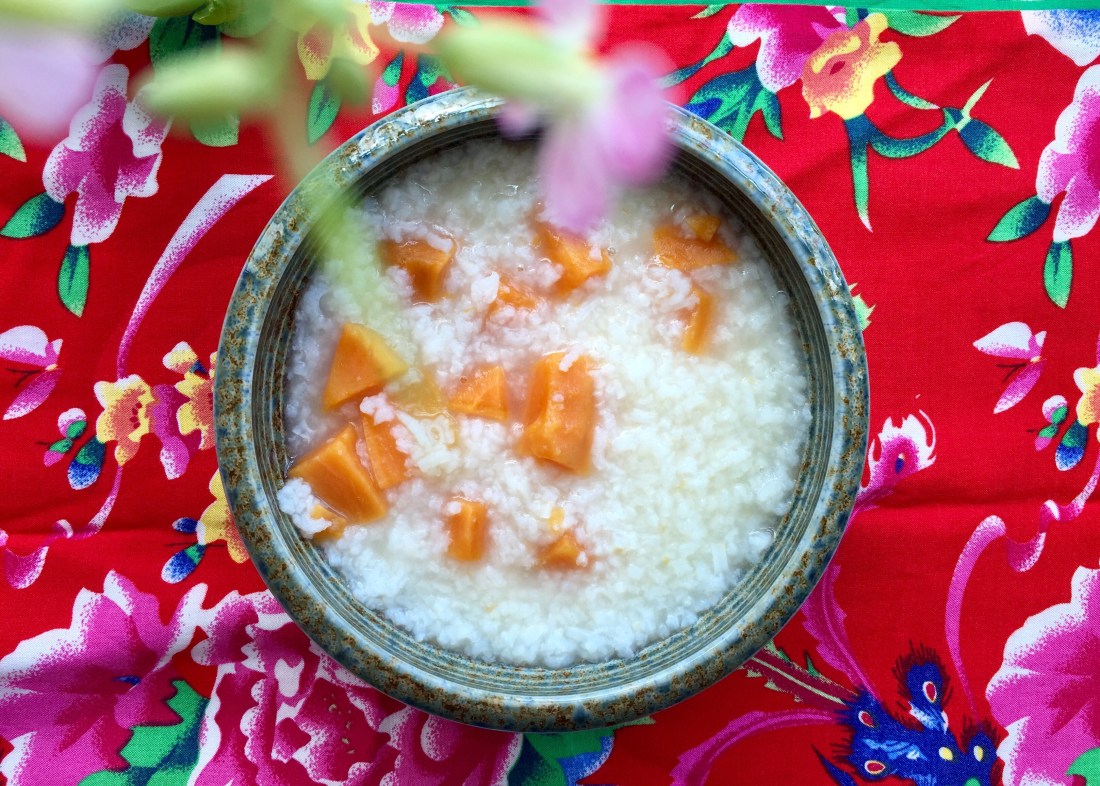
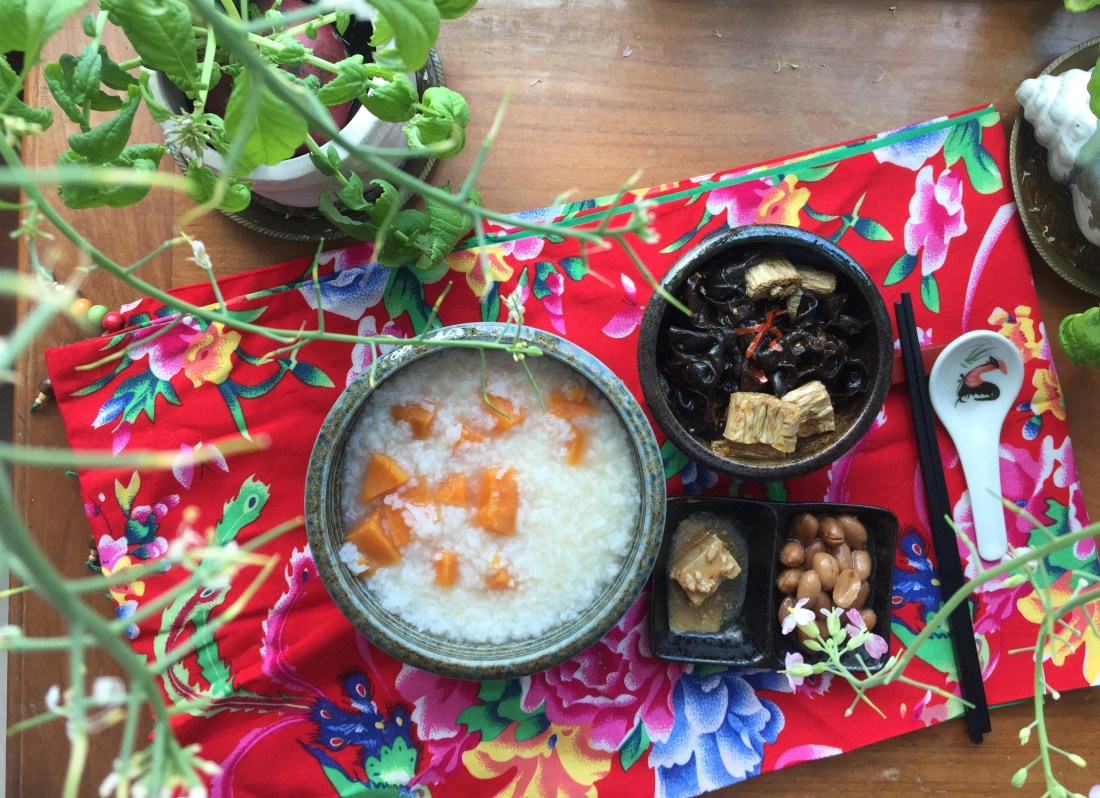
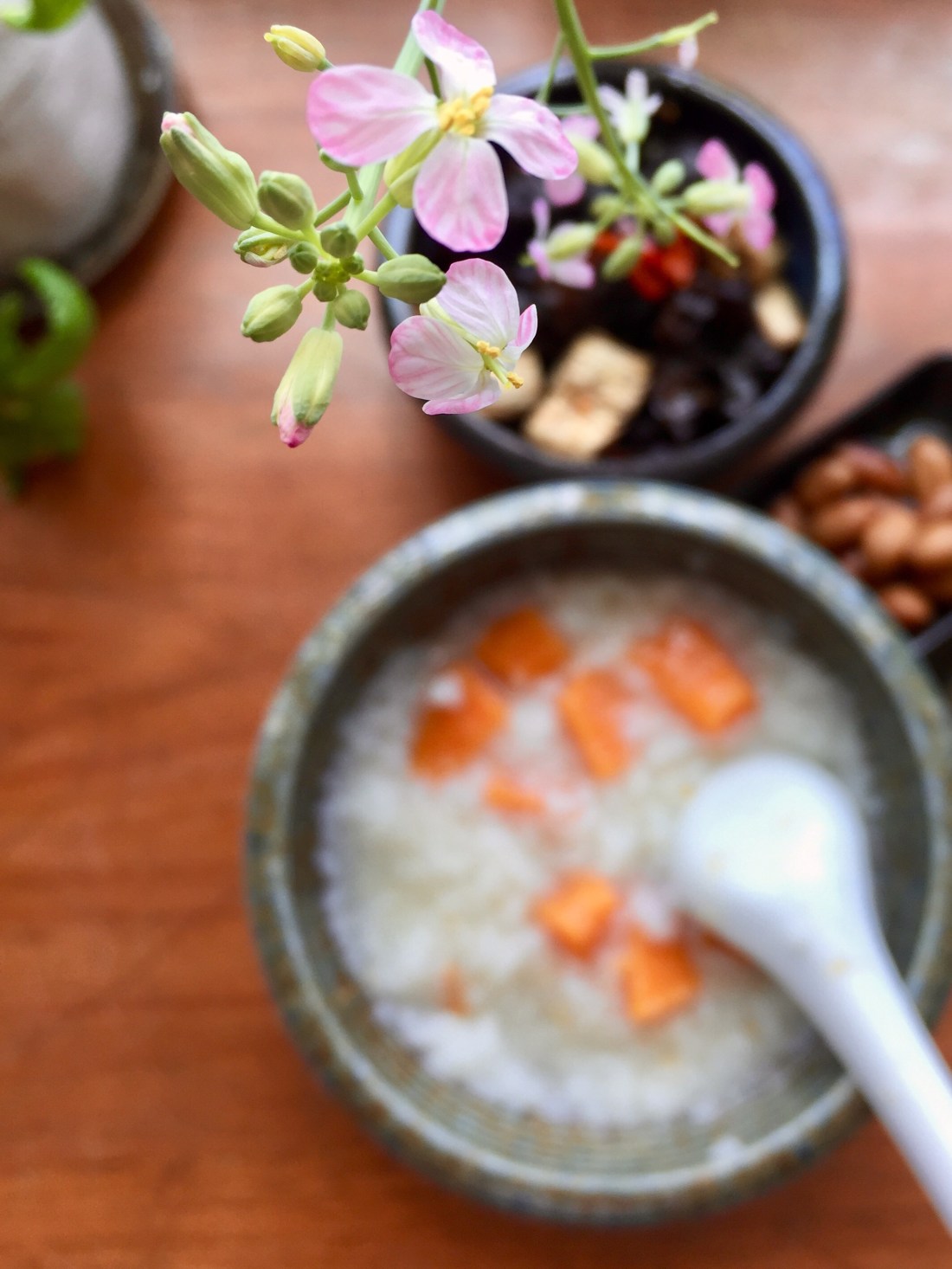
The ritual dish that binds me to my ancestors – sweet potato porridge.
Today I cooked sweet potato porridge in memory of my Kinmenese grandmother.
Where she came from, the soil was not conducive to rice farming, but good for growing sweet potato, yam(taro) and groundnut.
Adding sweet potato to rice porridge created bulk that filled the tummy. It also sweetened the plain porridge, and augmented the aroma of cooked rice.But most of all, it kept big families with little money from going hungry.
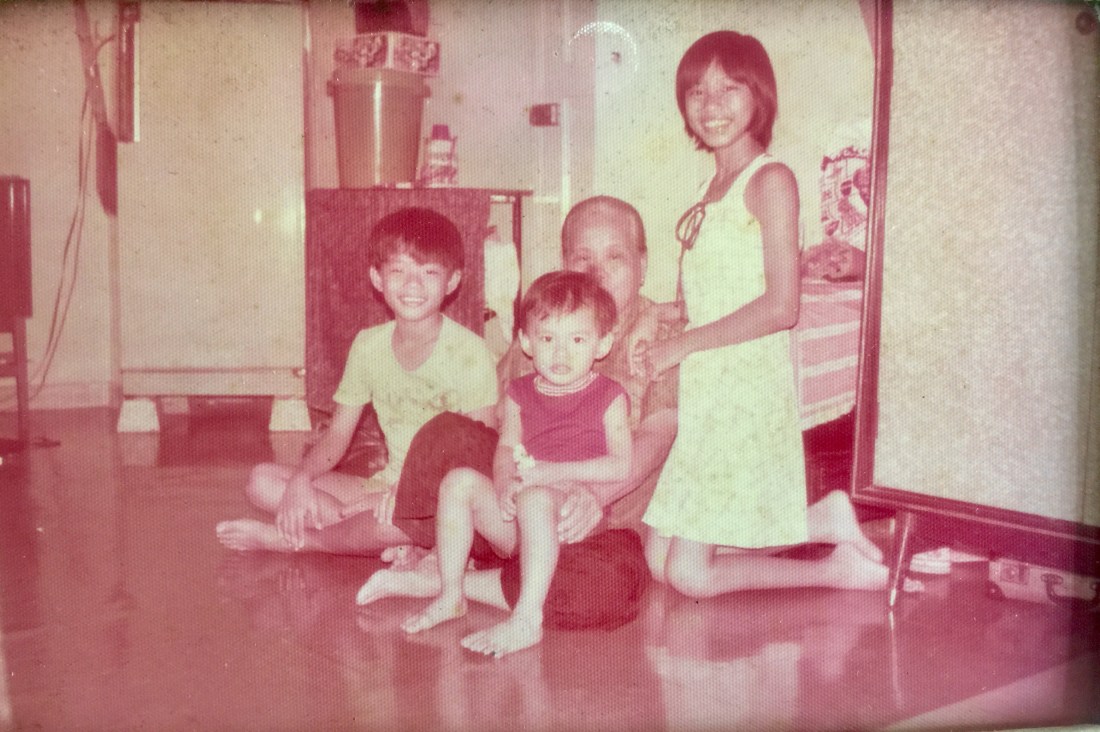
The only picture we have with our Kinmenese grandmother. This was in our first HDB flat in the 70s, where the refrigerator occupied pride of place in the living room. 😊
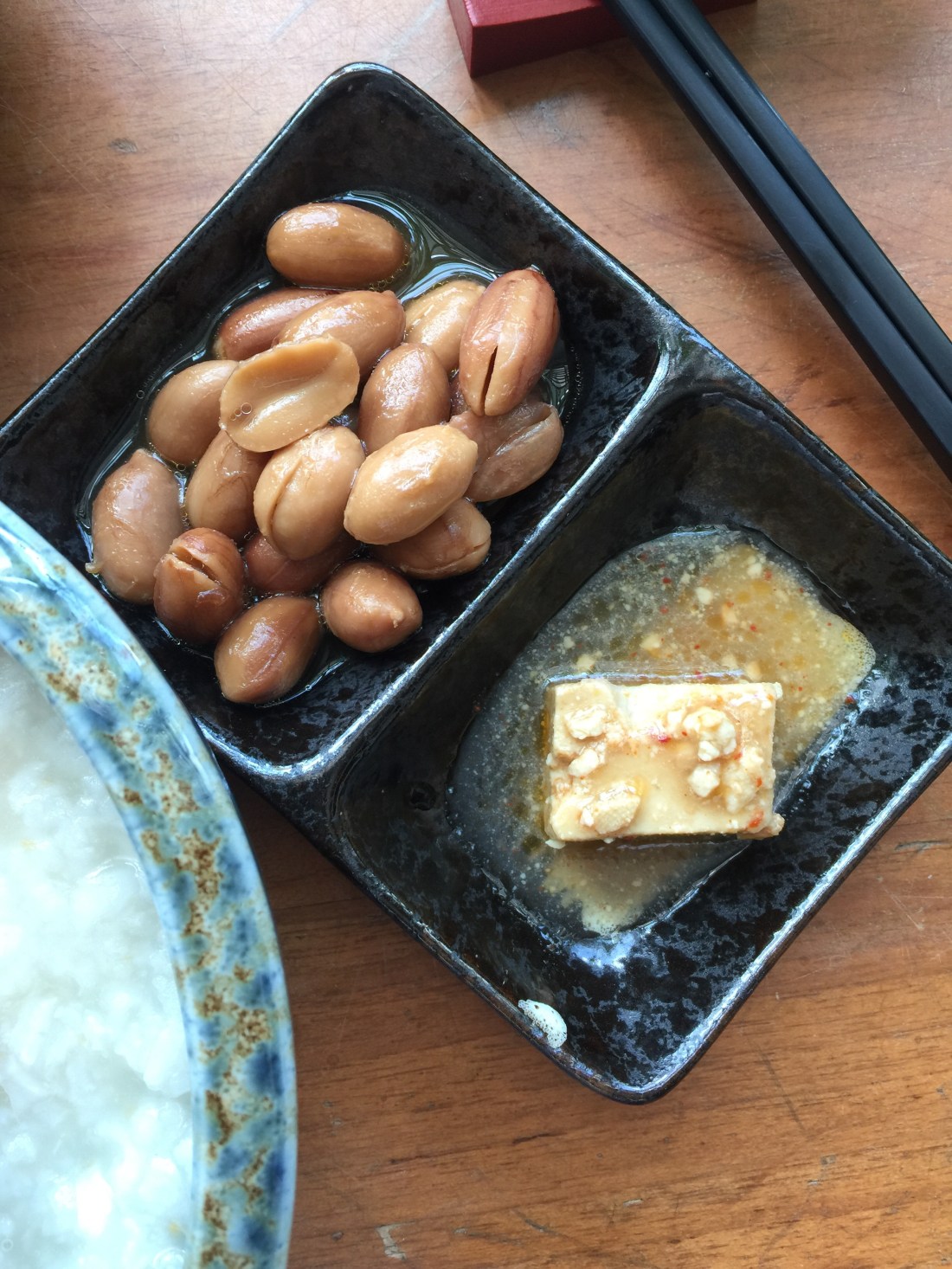
Each day after school, we would come home to my grandmother’s sweet potato porridge. Whatever meat side dishes were reserved for the evening meal when everyone was home. For lunch, my brother and I were happy with fried eggs and fermented bean curds or braised groundnuts to go with our porridge.
I can still see my brother in my mind – crew cut and bare torsoed in his primary school maroon shorts fanning his piping hot porridge with his exercise book impatiently.
Braised groundnuts and fermented bean curd.
Sometimes on a hot day, a watery bowl of rice porridge with sweet potato bits in it was all the nourishment I needed.
Over the years I’ve seen the humble sweet potato porridge listed in restaurants and hotel eateries. Many people who have the means to order far more superior staples on the menu gush over the sweet potato porridge.
Like some ritual food that binds a people to their cultural origins, the sweet potato porridge is more than a comfort food to me.
It reminds me of the generosity & ingenuity of Providence, and the faith of our forefathers that life would improve despite being confronted with evidence of scarcity & uncertainties everywhere.
If people before us could survive on such humble food and open up so many opportunities for others, our generation will definitely do better.
Flowers from Red Radish 2 (Numen) blessing Sweet Potato Porridge.
One time in a housing estate coffee shop, a foreign labourer was sitting alone at a table that was meant to accommodate a larger group.
A group of Singaporean men came by for their usual dinner and drinks. Their number necessitated the use of the table where the lone man was.
Without a word, the foreign worker picked up his things and moved to a smaller table.
One of the Singaporean men then gestured to the coffee shop staff who saw the move, to make a glass of hot milk tea for the foreign worker.
When the milk tea was brought to him, the coffee shop staff explained that it was from the Singaporean group. The foreign man nodded briefly.
We pay men born in villages to build skyscrapers for us. We pay sons of farmers to scale hundreds of meters to clean our walls. And many who can recite sacred texts in their own tongues by heart were paid by us to pick up our trash.
The foreign worker sat a bit longer and sipped his tea quietly. This is what respect must have tasted like.
Before he left the coffee shop, he asked for a plastic carrier to bring the remaining tea back to his dormitory.













 Lisa Ong