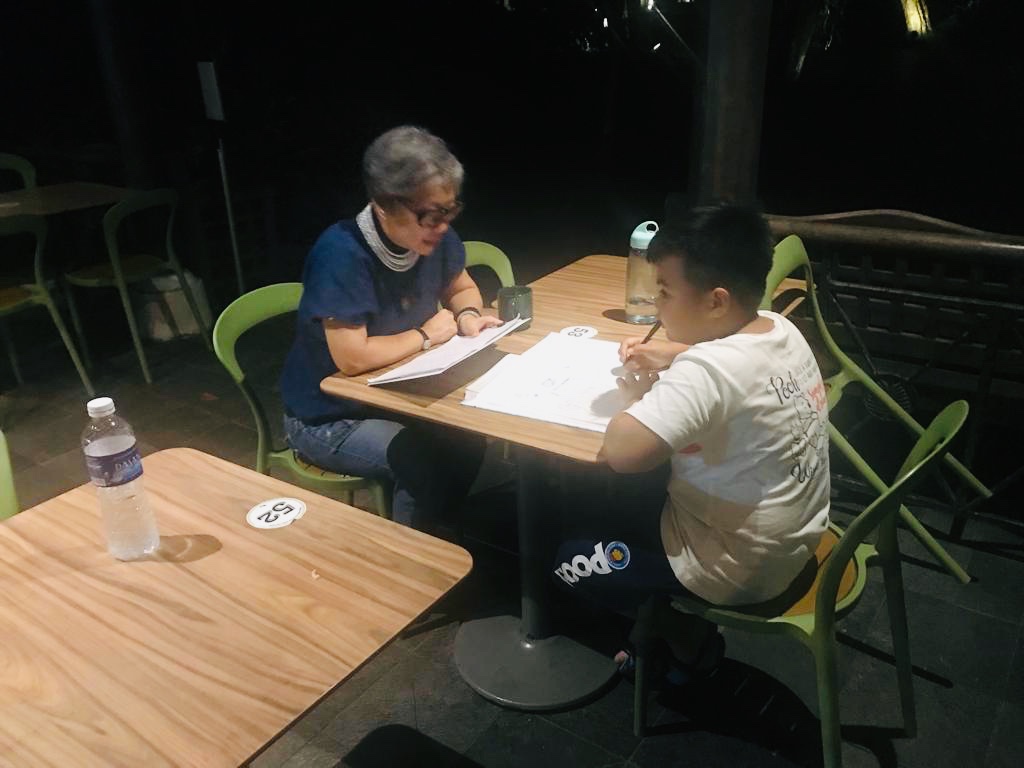
Me: Today’s full moon. So I don’t want you to say any rubbish. Words uttered on full moon has multiplier effects.
Boy: Okay. Yeah, the moon was already very bright last night!
Me: Oh yes? You notice the moon too?
Boy: Yes, it’s beautiful!
Me: You know that when you’re feeling sad or angry, you can look up at the moon or stand in the moonlight to calm down. There’s no need to argue or fight all the time.
Boy: Yes, I like to try that when the time is right for me.
May all aspirations of wisdom and compassion flood the world like the unstoppable light of the full moon tonight, & flower in good time.
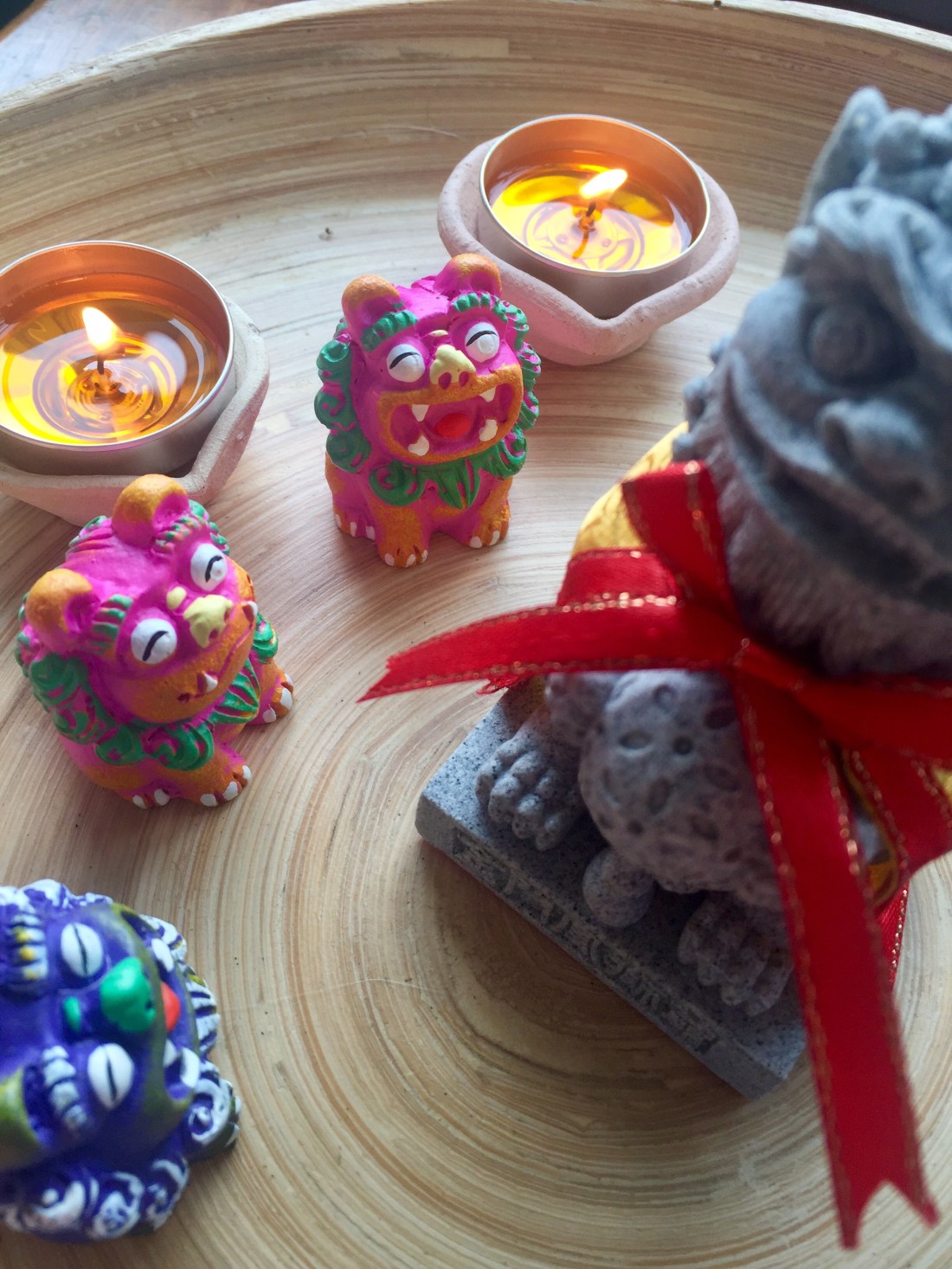
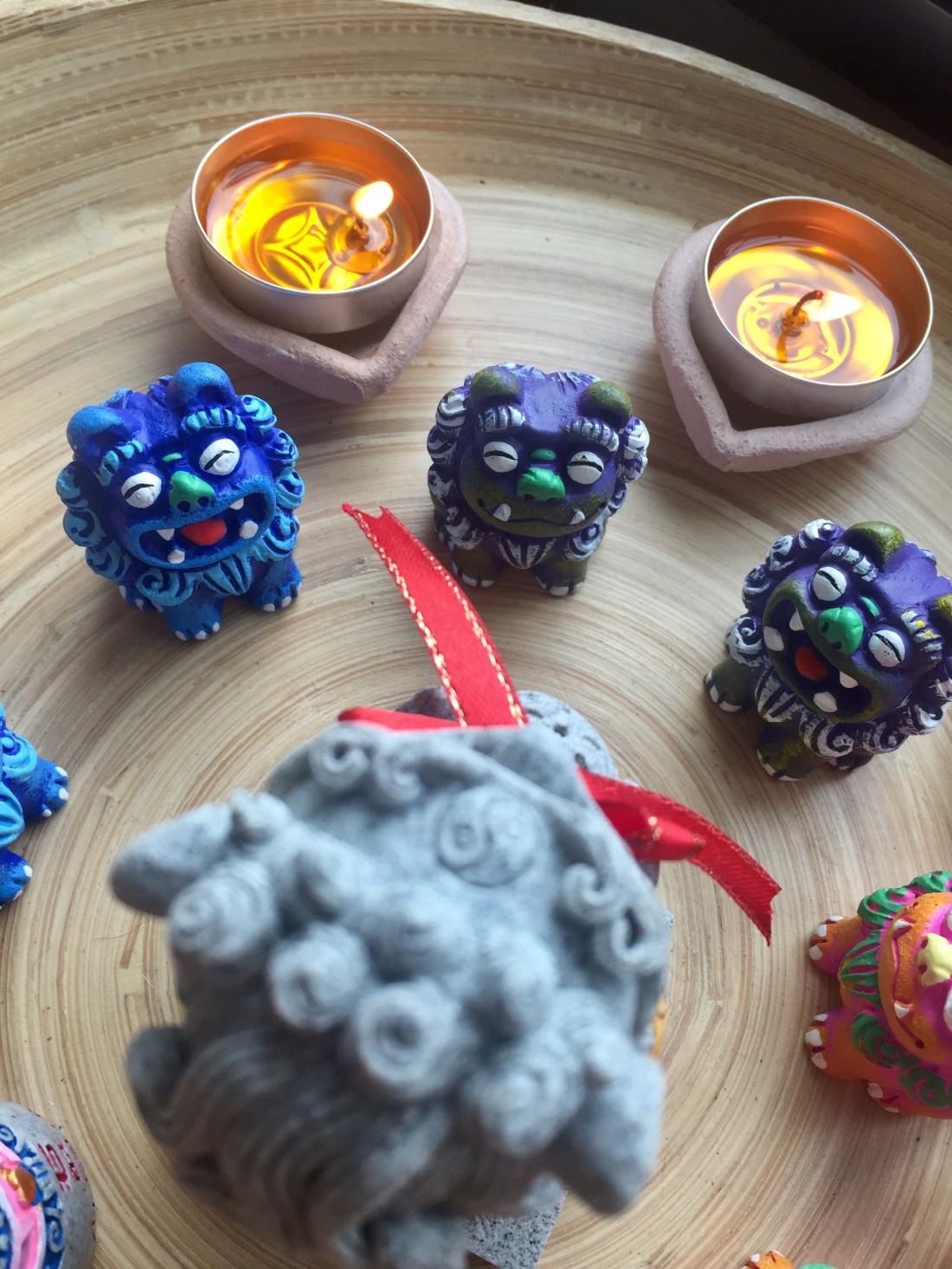
Bastet, Cat Goddess of Courage, and Ganesha, Giver of Wisdom.
One day an elderly client came to the car workshop to pick up his Mercedes Benz from my brother.
Benz owner then took a drive together with the mechanic to become better acquainted with the car’s personality.
As my brother was describing some of the finer details of the car during the ride, the old man suddenly asked if he was related to a person called “Ah Ong.”
Ah Ong (my dad) and Andrew (my brother) in the late 90s.
He had been watching my brother, and found his mannerisms reminding him of an old friend whom he hadn’t seen for years.
“Ah Ong” happens to be the name by which my late father was frequently addressed by relatives and friends.
It turned out that the old man knew our dad.
My brother then told him that “Ah Ong” had passed on a few years ago.
When the car ride ended, the elderly Benz driver said to my brother, “Your father bought me lunch when I had nothing. Everyone is scared of poor people, except your old man. If you’re ever in need of food, just call me. I’ll buy you all the meals you need.”
My brother thanked him for remembering our dad and agreed to keep in touch.
My dad wouldn’t have expected or known that the ONE lunch he had bought for someone facing hard times years ago, would end up contributing to the future livelihood of my brother and turn into promises of food relief should the need ever arise.
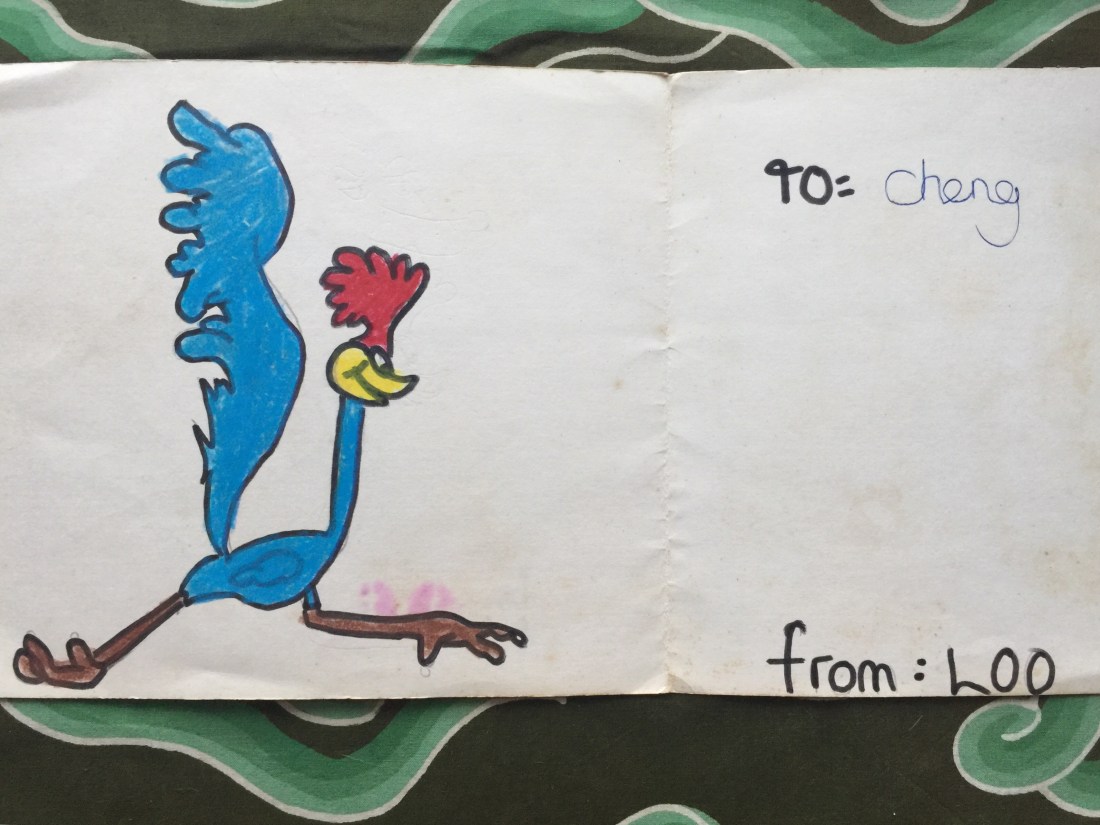
This “Roadrunner” card was drawn and given to me by my brother when he was in kindergarten. As an adult his work continues to deal with speed & precision.
My first English word was “cow”. I remembered the elation I felt when I could spell and pronounce it.
Respect for words is cultivated letter by letter.
As a child, I remembered fear leaving when I could understand what the doctor and nurses were saying about me.
As an adult, I remembered love rising when I could accept words that hurt me.
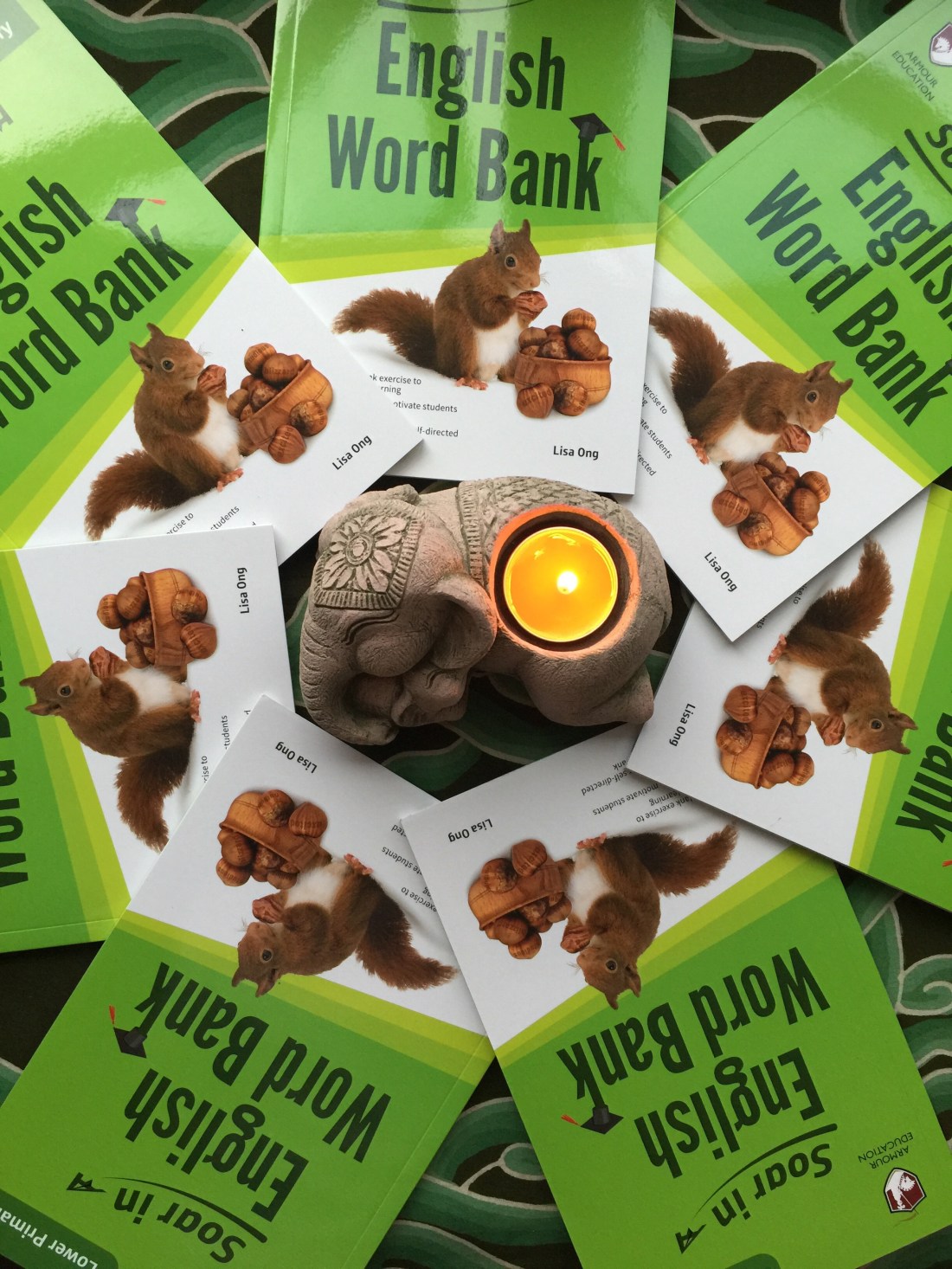
“Soar in English Word Bank” was published on 28 June 2019.
May the new moon shine her light on us and grant us a healthy relationship with words.
May the words we acquire turn confusion into clarity, hurt into love and ignorance into wisdom, for our own benefit and for the benefit of all sentient beings.
50 years ago my grandparents showed me that words are to be treasured more than material wealth.
It was late afternoon after we checked into Number Nine B&B in Jincheng, Kinmen.
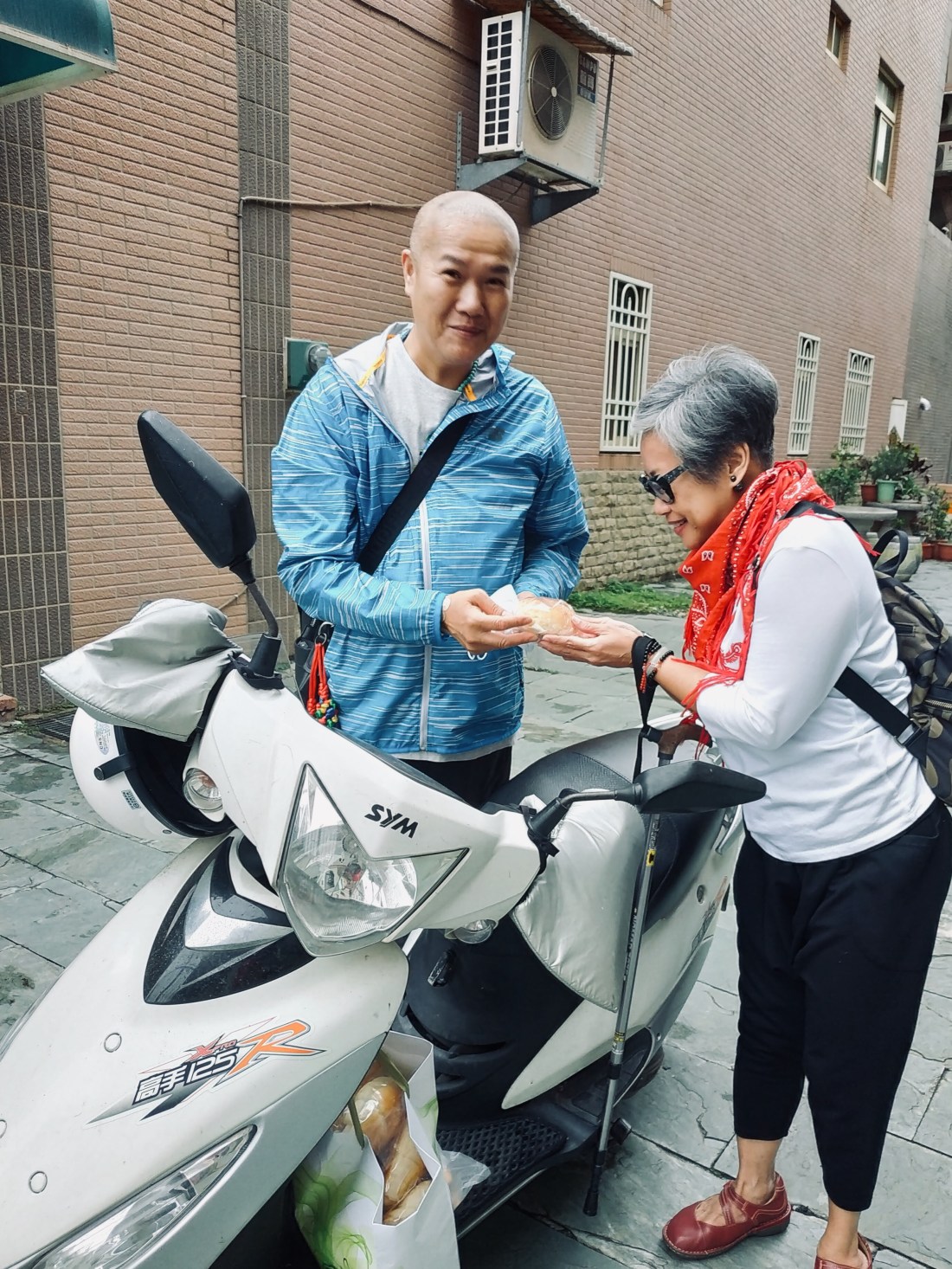
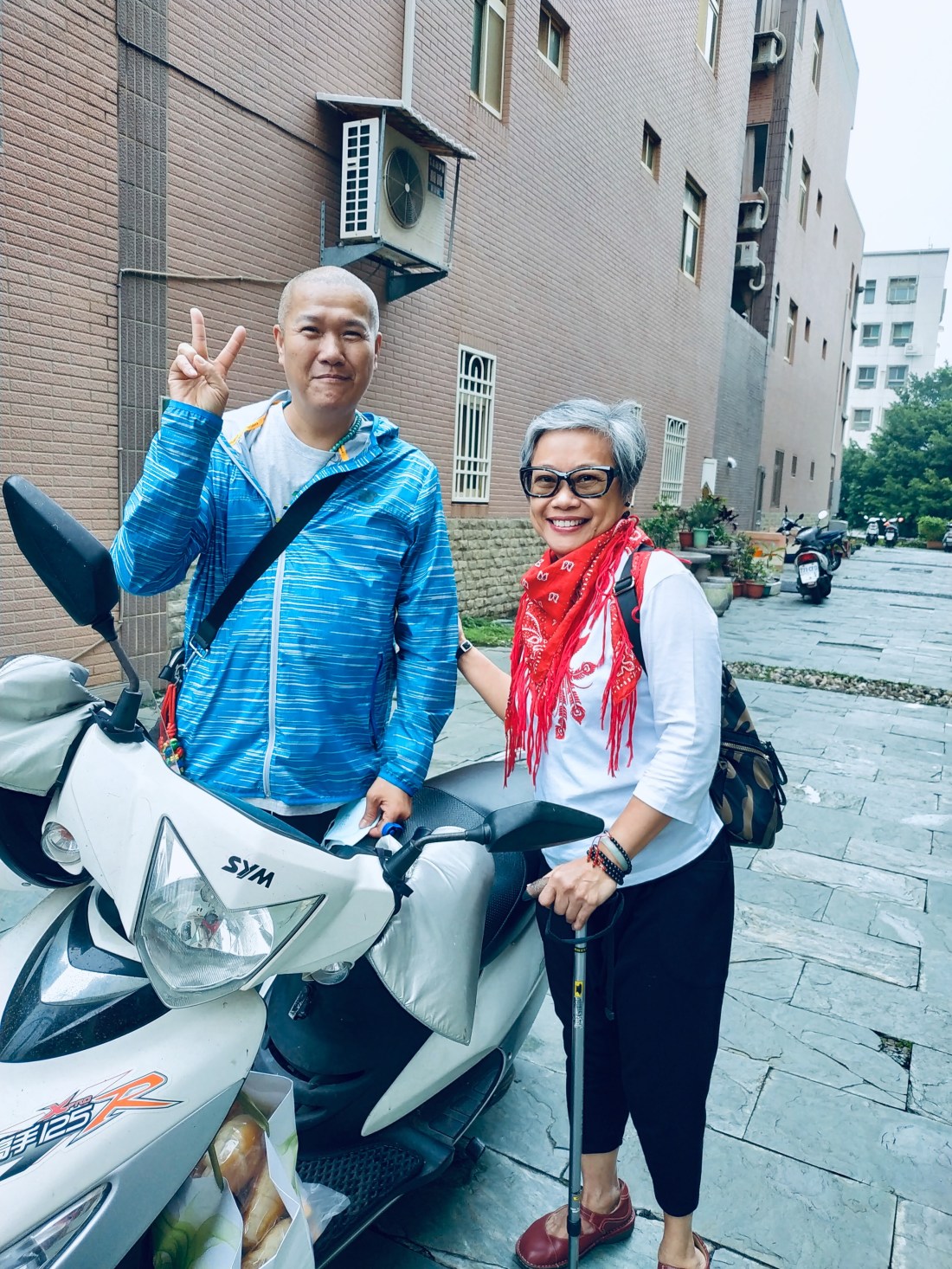
As we were taking pictures of our surroundings a man on a motor bike slowed down and asked if we wanted bread.
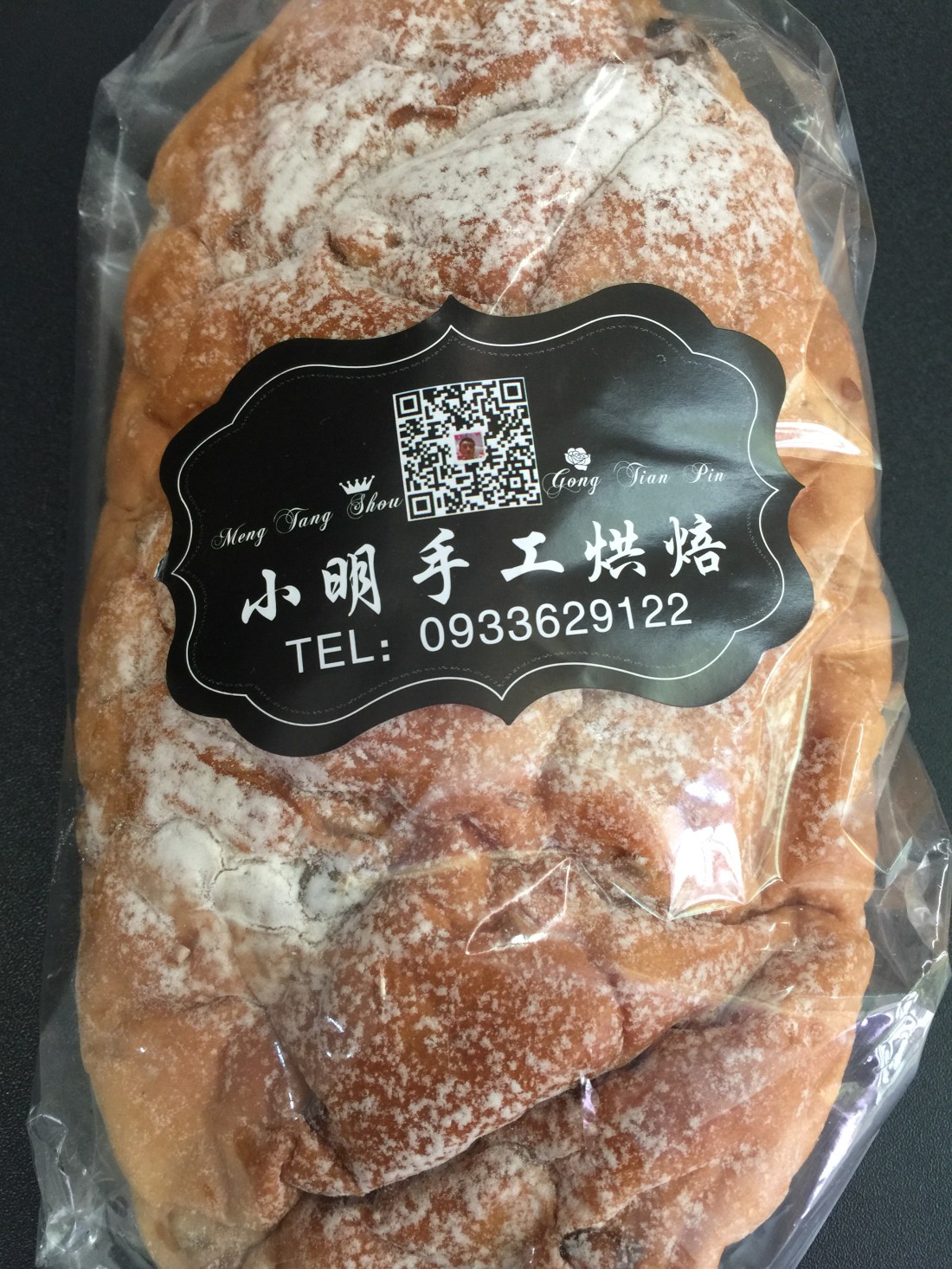
The Baker of Houpu (明章) literally “Gave us this day our daily bread.”
He ran a nearby bakery with his wife. The B&B units around us in Houpu were his regular customers and he had just completed his distribution rounds with a bag of fresh left-overs.
As we had missed lunch & were hungry from all that travelling I was fairly focused on getting ourselves a dinner where I could have some rice. Freshly baked bread was the last thing on my mind.
But the Baker was very proud of his bread.
As we looked on, he continued in his childlike chatter, to offer information on his bread and his life.
When I listened more carefully, I realised his stories were about working and caring for his elderly mother. But the way he narrated his difficulties & disappointments with such gaiety intrigued me greatly. His tone didn’t seem to match his content.
I was even more amused when he pointed to a posh looking apartment behind us and said without a trace of envy but with a bright smile, “那栋房子很贵。我们买不起囖!”
(transl: that apartment is very expensive. We cannot afford it.”)
When we finally decided to buy his bread and asked how much they cost, the tall man with a shaven head & special story telling techniques announced with heartfelt glee, “不用钱的啊!是要给你们的!”
(transl: no money required. I’m giving them to you.)
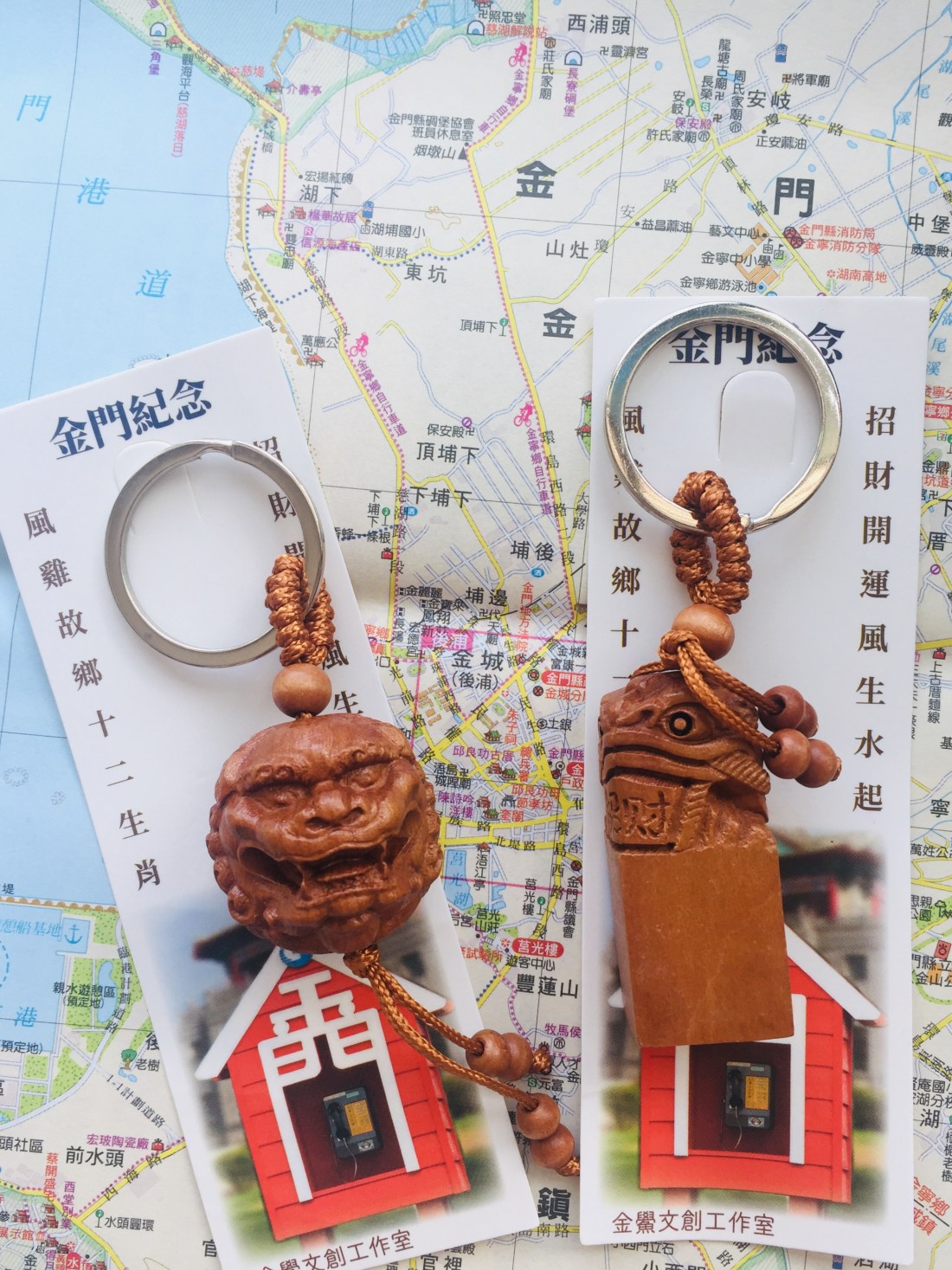
He would later ride back to his shop, rummage through his cupboard and return with our very first souvenirs, to welcome us to Kinmen.
In the Baker’s non-grudging attitude towards suffering and scarcity, he shows me that abundance is not about having a life of ease & plenty, but it is about approaching all difficulties with an attitude of ease.
Meeting him on my first trip to Kinmen feels as though Avalokithesvara, the Buddha of Heavenly Ease was already there waiting for me.
And my daily remembrance of the Lord’s Prayer, beseeching Him to give me my daily bread, takes on a greater potency as the life of this Bread Man has shown me.
I love “Mee Sua”. But I could never fully explain why till this recent trip.
Pronounced as “Mee Sua” in Minan or “Mian Xian” in Chinese, both meaning threads of noodles to reflect their fine texture and the way they can be manipulated and kept when dried, these noodles were a huge part of my childhood.
Also known as “Sho Mian” or longevity noodles, they are often coiled into figures of 8 to perhaps symbolise infinity.
The “Mee Sua” is thus the most important guest of honour in a traditional Chinese birthday celebration whether your party is held in the corridors of public housing or in the ballroom of the Ritz Carlton.
One of my former students from Peru, South America, the beautiful Janina, once told me that the “Mee Sua” is her favourite Chinese food in Singapore. And she often ate it at Causeway Point, Woodlands. She said it in 2010 but I can never forget a “Mee Sua” compliment.
In my childhood, a bowl of “Mee Sua” with a sprinkling of chopped spring onions, a drizzle of sesame seed oil and sometimes an egg, was all I needed to settle my hunger.
And on days when any kid in our family was sick or not keen to eat, my grandma would whip up a bowl of “Mee Sua” magic to end all food dramas.
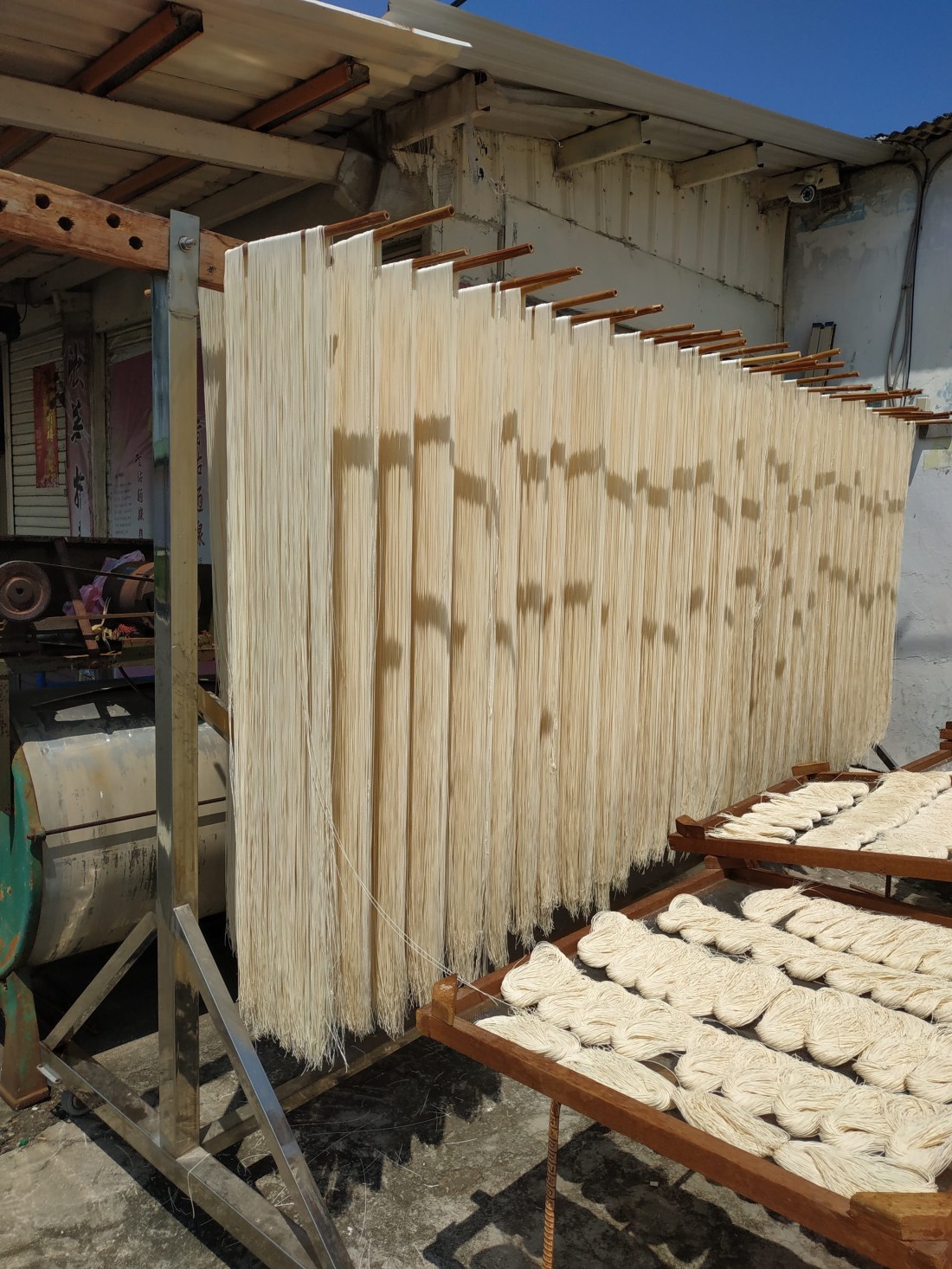
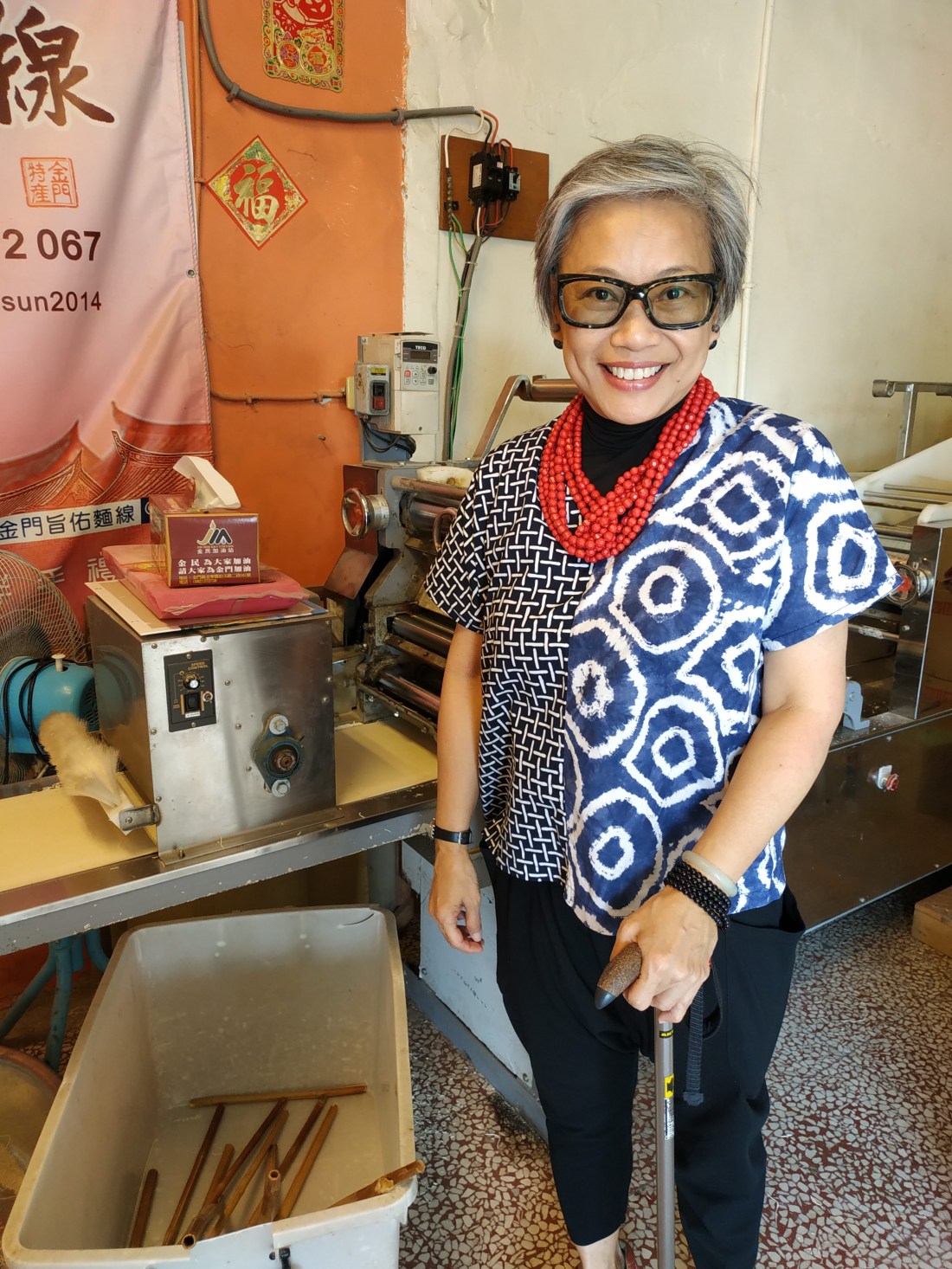
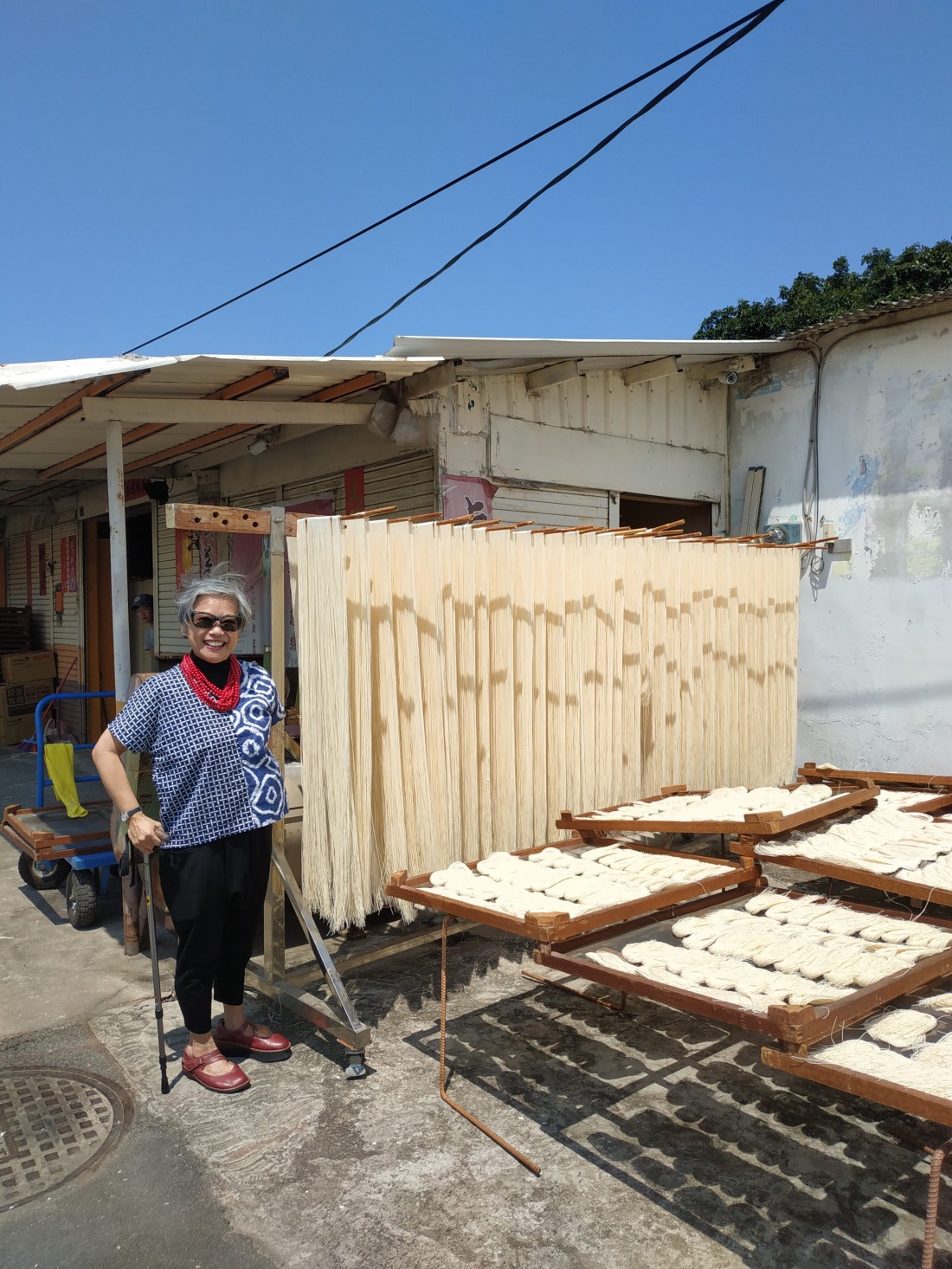
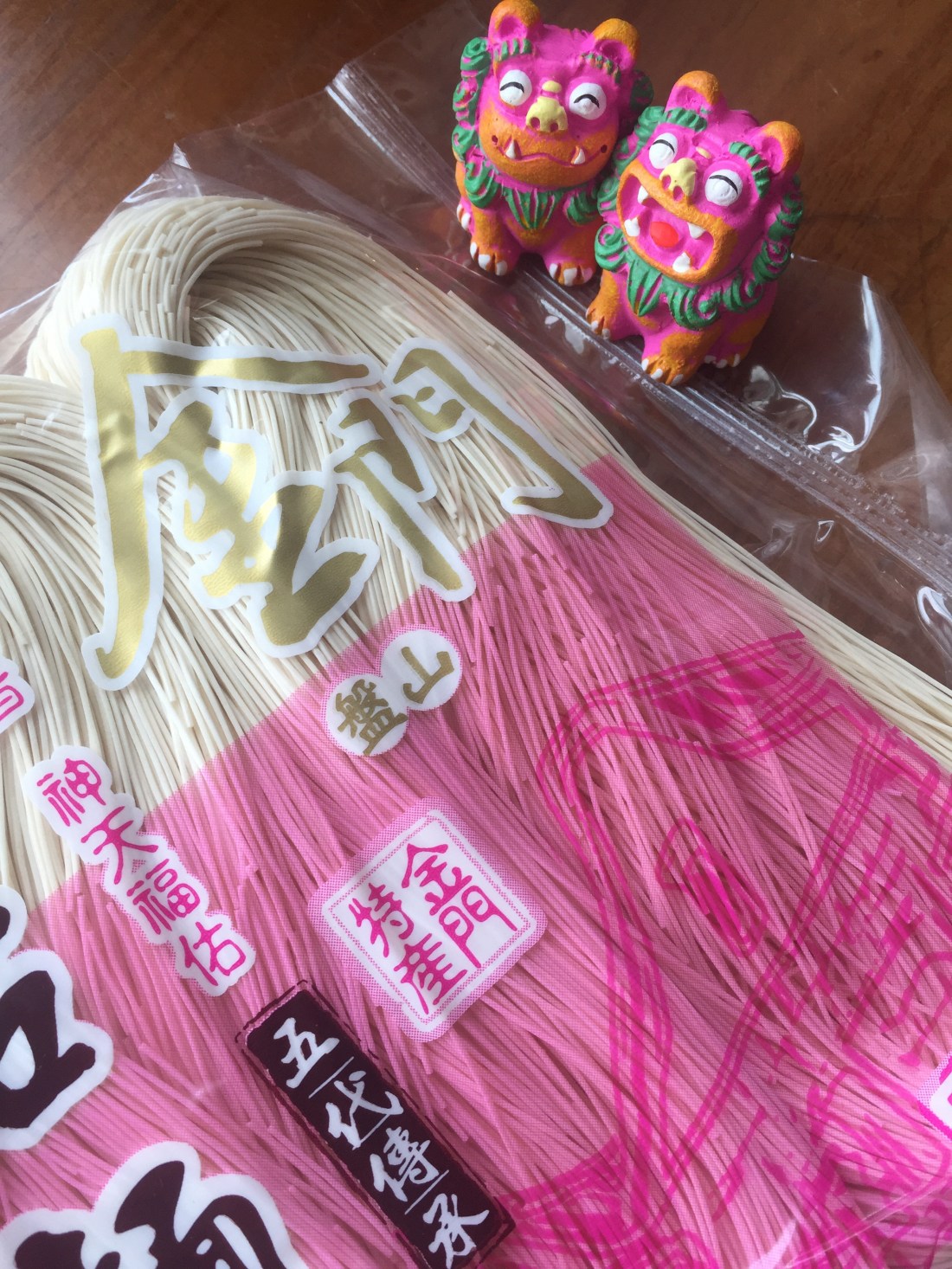
In our recent drive about Pan Shan, Kinmen, the village where people share her surname originated, we stopped at a little Mee Sua workshop.
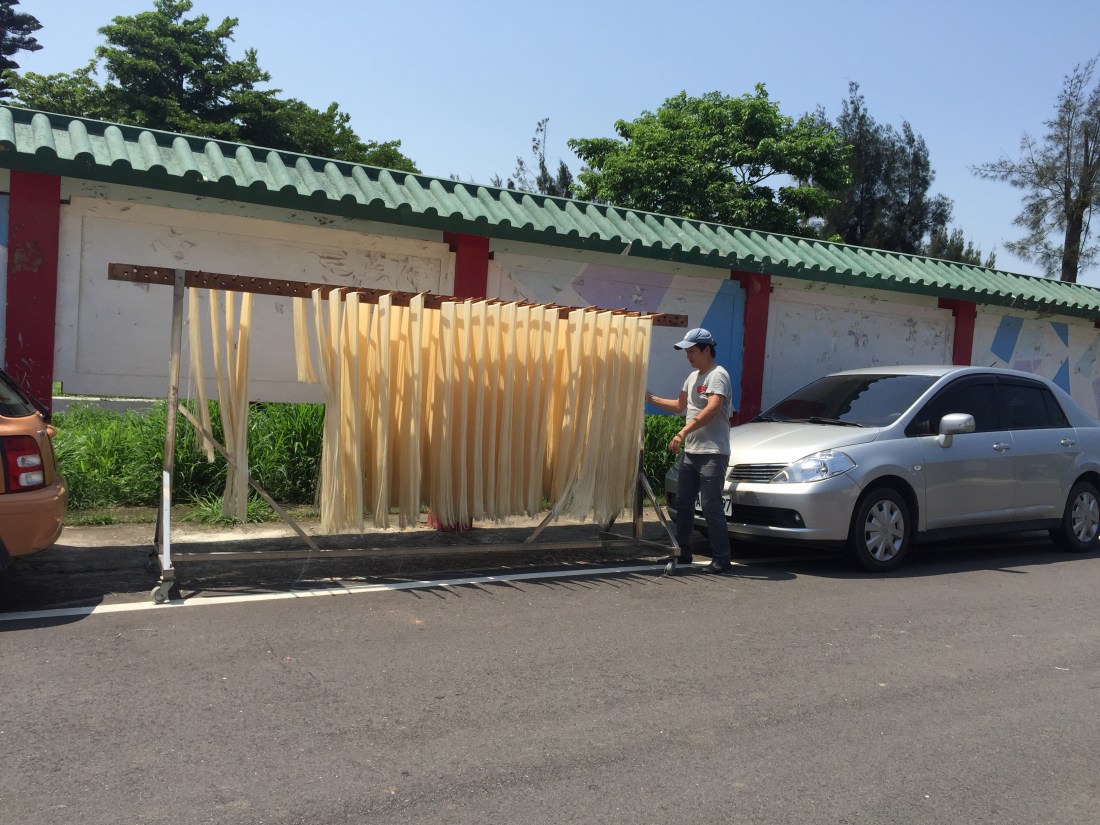
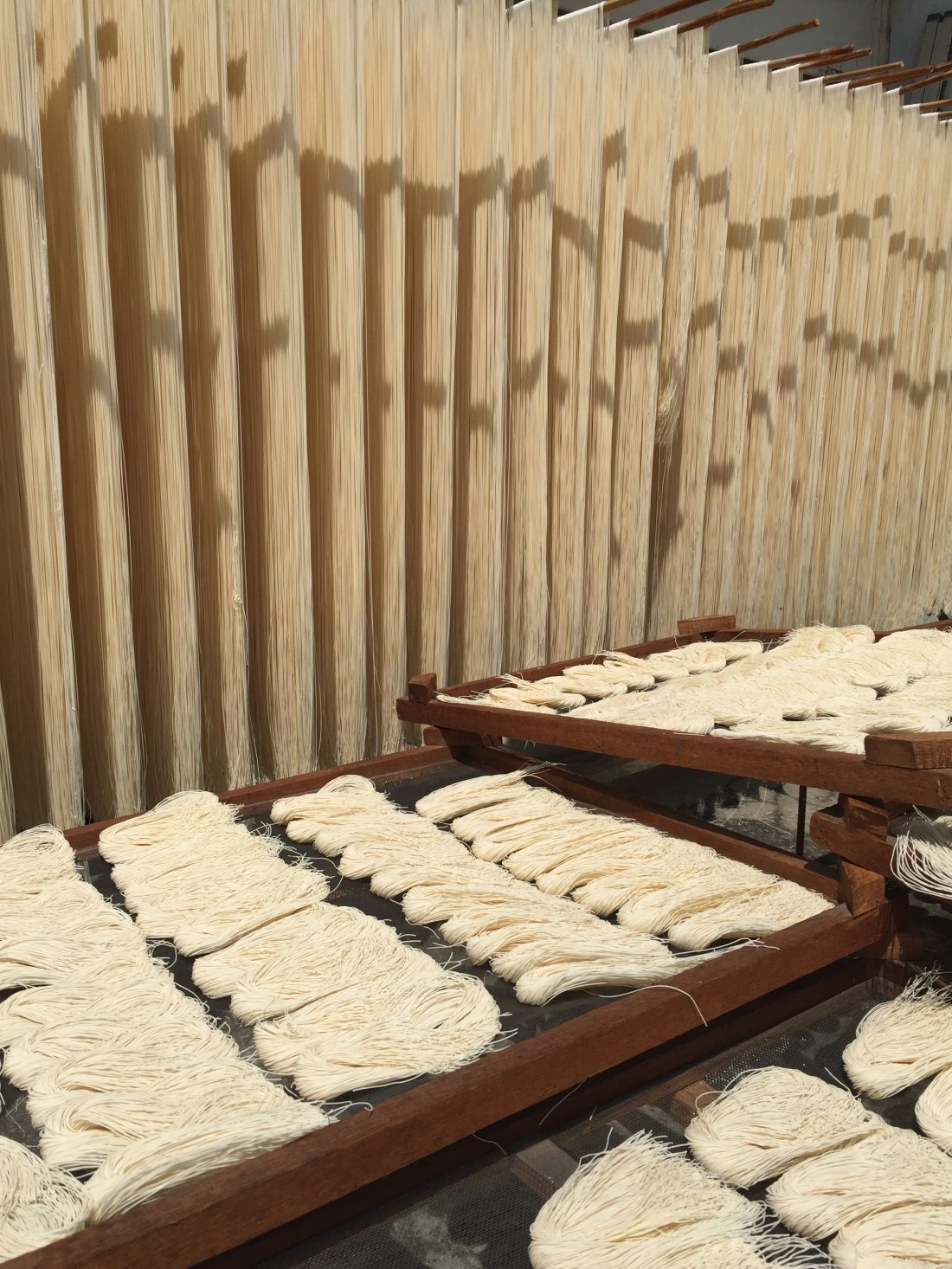
As I watched the life saving noodles of my childhood swaying in the sun spattered Kinmen breeze I felt myself giddy with a mysterious glee.
It was no exaggeration to say that for me seeing the noodles felt like I was meeting an actual person. Weird yes? I’ve never felt such adoration for food before.
My crazed look might have scared the Mee Sua maker somewhat because he kept smiling as he went about his chores while avoiding eye contact with me.🤣
When he wheeled out a rack of freshly made Mee Sua for airing & sun drying, I had the urge to ask for his autograph. I couldn’t express enough my gratitude to craftsmen like him whose dedication to food making has kept ancestral connections alive.
So I stood star struck in the cosy sunlight of Kinmen and listened to the whispering sea winds as the aromas of flour mixed with salt & water, swirled around us.
It then dawned on me that each time I slurp a strand of the Mee Sua, I’m not just eating, but partaking in the rich blessings of the Sun & the Wind that have sustained all living things. 🙏
Tomorrow, 25 June, happens to be the birthday of the older of my two younger brothers, Terence. It gives me a special sense of gratitude to know that he’ll be having a bowl of Mee Sua right from the place where his Kinmen ancestors came from, and made in the very village of Pan Shan where his grandma’s people originated.
And by the power bestowed upon me in the light of my long standing relationship with the longevity noodles, I would like to wish my brother and all my friends a long & happy life of love, learning and reconciliation.
For many of us childhood outings with grandmas usually centered around going to school, going to the market & temple visits.
On mornings if I woke up late & missed the market outing with my grandma, I would stand by the kitchen window of our Prince Charles Square flat and watch for her return as she briskly crossed the bridge on the Alexandra Canal on her way home.
Once she had to cross the canal twice just to go to the market to make sure she got me the clay monkey figurine that I really liked. Things bought for me must not look like it was meant for my brother.
When I got older, her trips became infrequent.
As she aged and we moved to a new flat, my grandma became more housebound & more isolated.
She was always standing by the window and waiting for us to come home.
By then I was occupied with my own life & thought very little of her loneliness.
Many afternoons I saw her sitting by the stove silently, but I would never risk asking what she was thinking or feeling lest it gave her a chance to criticise my mother again. Likewise I learnt not to ask my parents what was on their mind.
That was how Silence invaded our home.
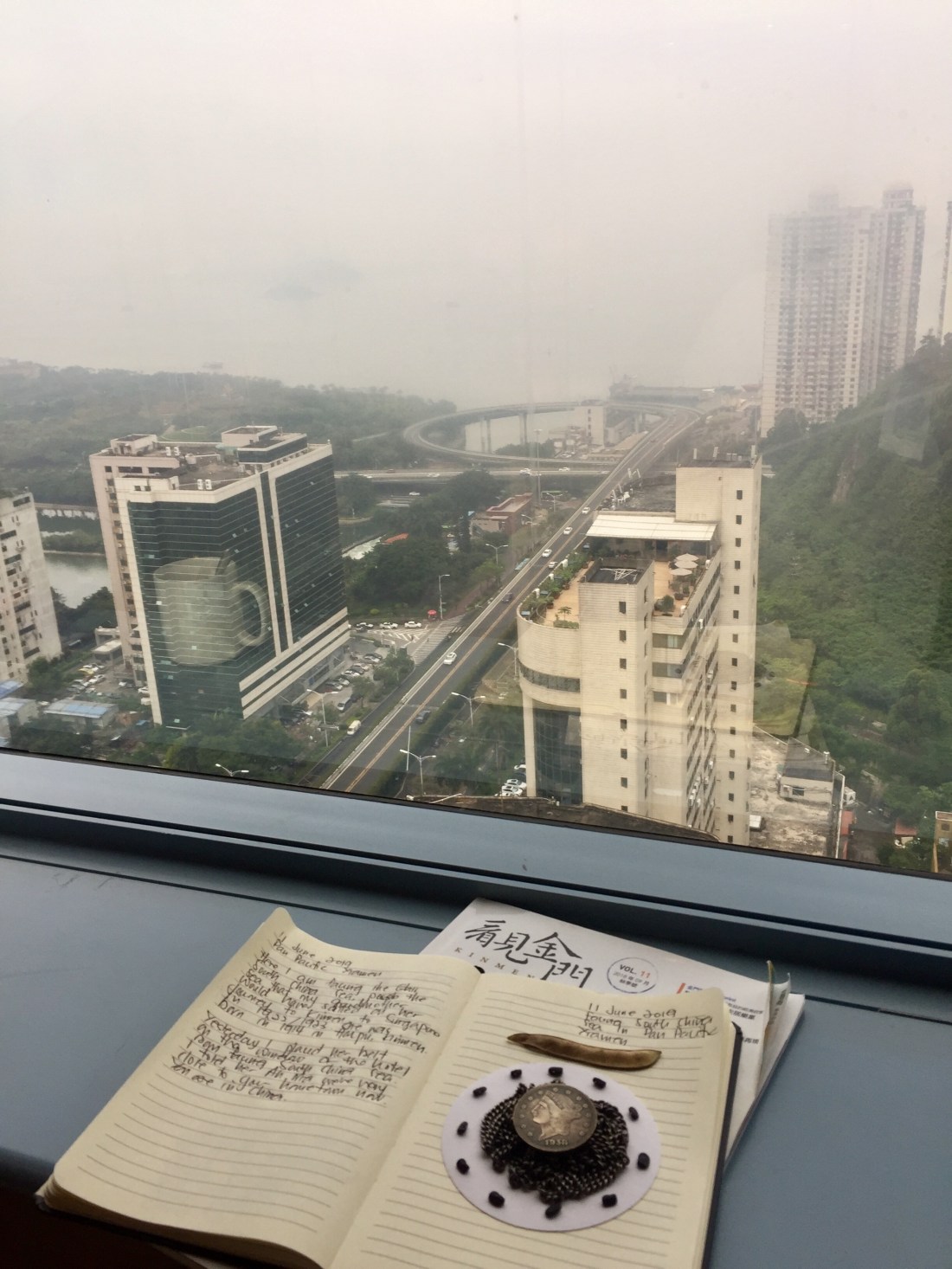
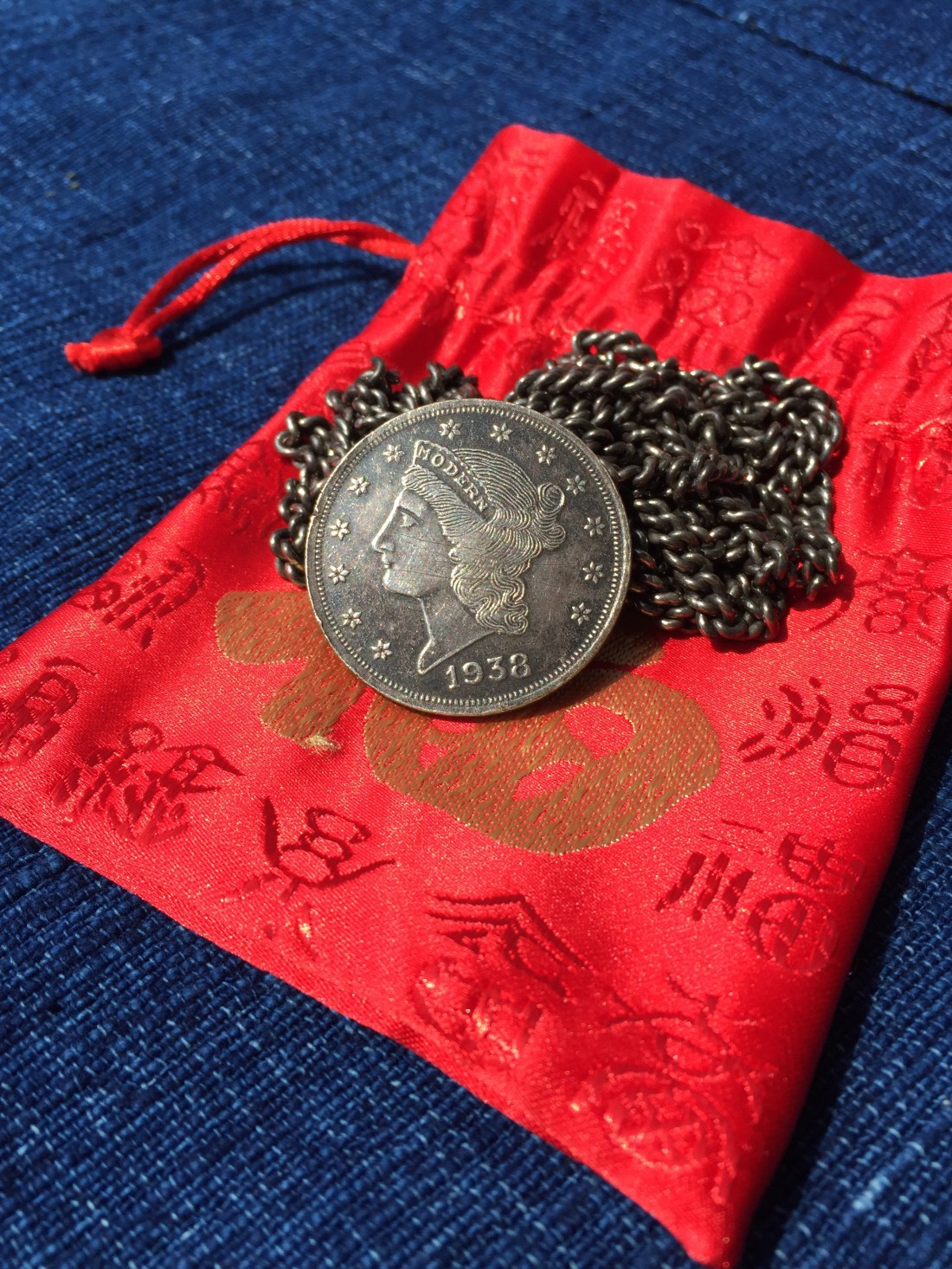
Silver belt and magazine overlooking the South China Sea on 11 June 2019.
This time when I landed in Xiamen, I wanted to be able to talk freely. So I placed my grandma’s silver belt by the window sill of the hotel room facing the sea. I told her we would be making the crossing to her Kinmen Island in a few days’ time.
When I got the ferry ticket at Wutong Harbour, I told her.
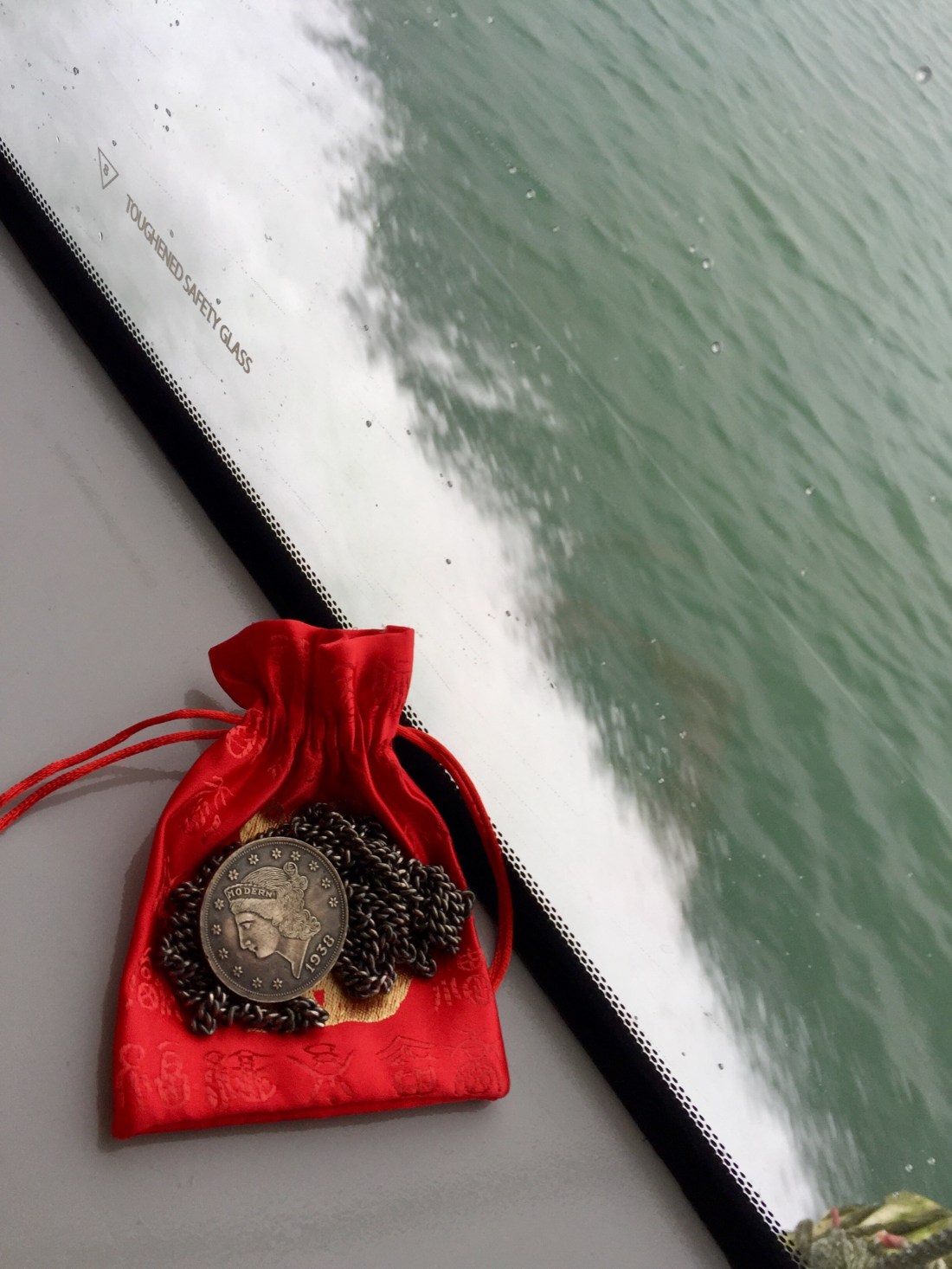
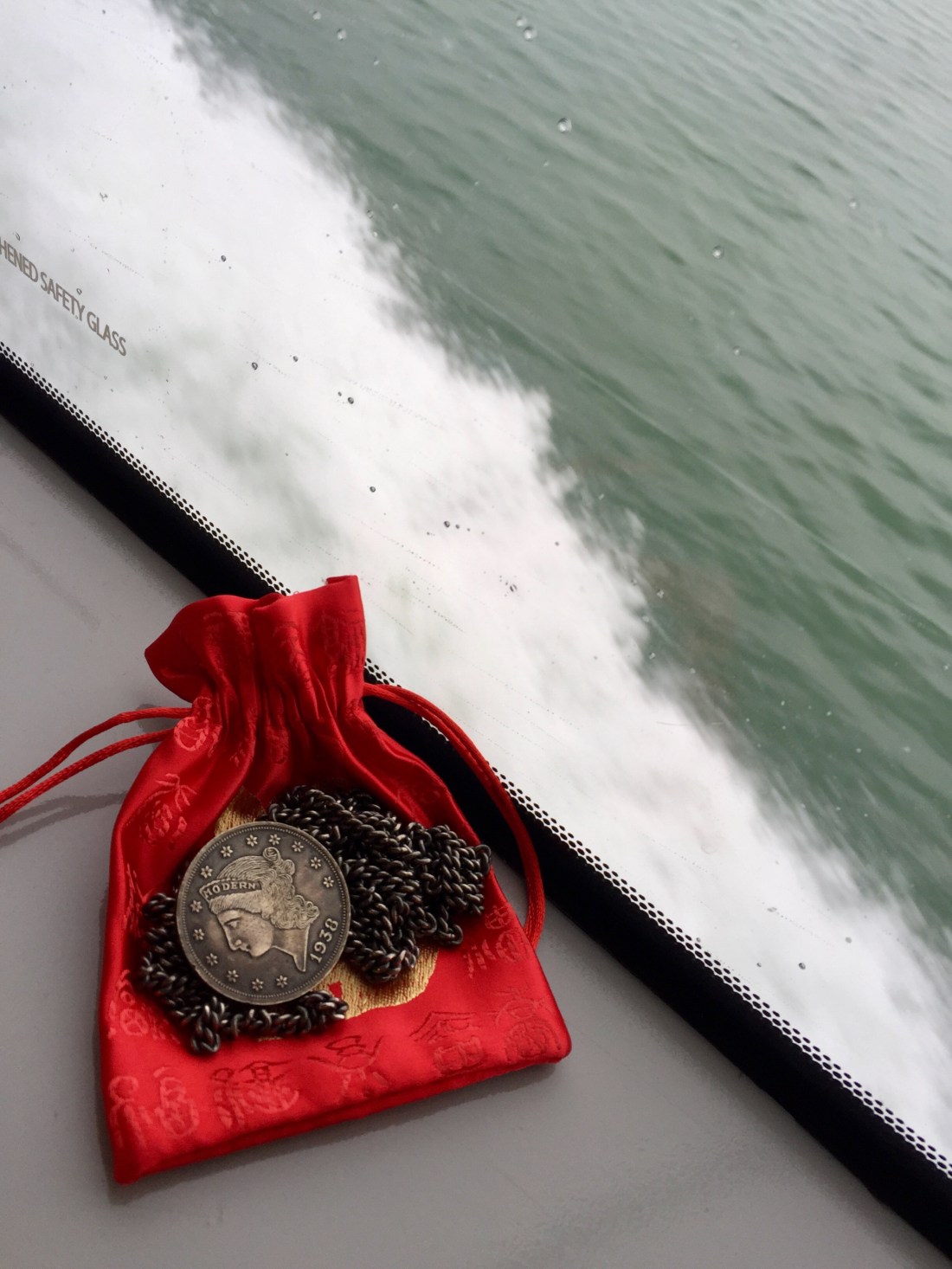
As the ferry departed for Shuitou Harbour in Kinmen, I placed her possession by the window of the boat & showed her the waves that she rode on nearly 100 years ago.
Riding the waves to Kinmen. (13 June 2019)
A drizzle had begun when we landed on Shuitou Harbour, Kinmen Island. A harbour staff by the name of Mr Zhang Hui Ren (张惠人) quickly came to our assistance by getting us a trolley for our luggage. He showed us great Kinmen hospitality by supervising our customs clearance and looked for our B&B host who was there to pick us up.
He reminded us to let the counter staff know on our return trip that I would need help with luggage and boarding. Everyone was in a chatty mood. Even the security personnel with the cute beagle were happy to see us. I wanted to hug the dog but controlled myself.
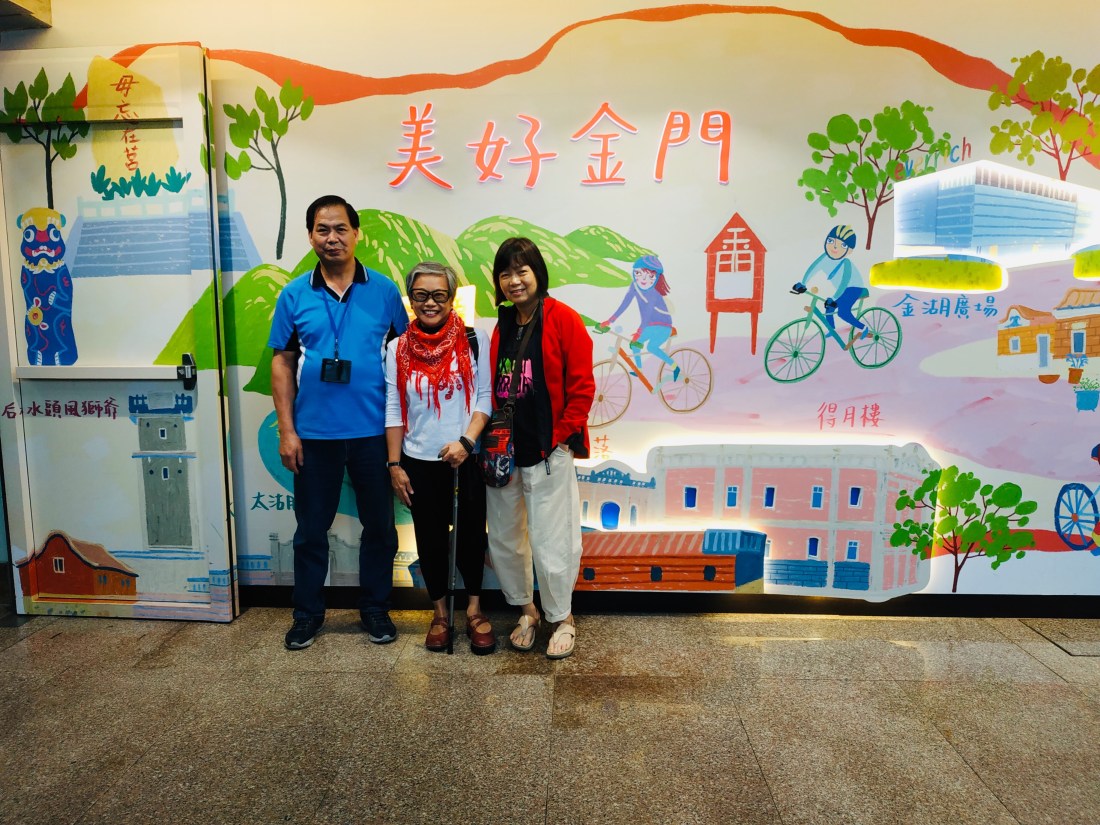
My travel mate, Pin Lay & I were treated to premium Kinmen hospitality by Mr Zhang. (13 June 2019 at Shuitou Harbour)
The sun shone brilliantly the next day and the next 2 days as I walked the streets of my grandma’s hometown, Houpu & visited her ancestral shrine in Pan Shan.
On the morning before my journey to Pan Shan (15 June) I placed her silver belt on the balcony ledge of the B&B we were at.
Below my unit, mammas and pappas scooted about with kids on their vespas. Above me the sun shone brightly and the birds tweeted. The air was cool & crisp.
I felt the sun’s warmth on my face & neck as I gave thanks.
After I had told my grandma about our plan for the day, a butterfly bearing markings of brown, white and orange landed on her silver belt. I held my breath as it lingered briefly before taking off again.
A butterfly landed briefly on my grandma’s silver belt which I had placed on the balcony of the B&B to give thanks for the sun and the journey ahead.
The journey ahead for the rest of the day was filled with wonderful sights, heartfelt conversations and unexpected discoveries, assuring me that the longevity of Love continues outside time.
I almost fainted with joy to see these longevity noodles airing in the warm sunlight of Pan Shan,Kinmen.
After I had set my intention to visit Kinmen Island, Taiwan, I read up more to prepare for the trip.
I would fly from Singapore to Xiamen and from Xiamen, ferry to Kinmen Island, Taiwan.
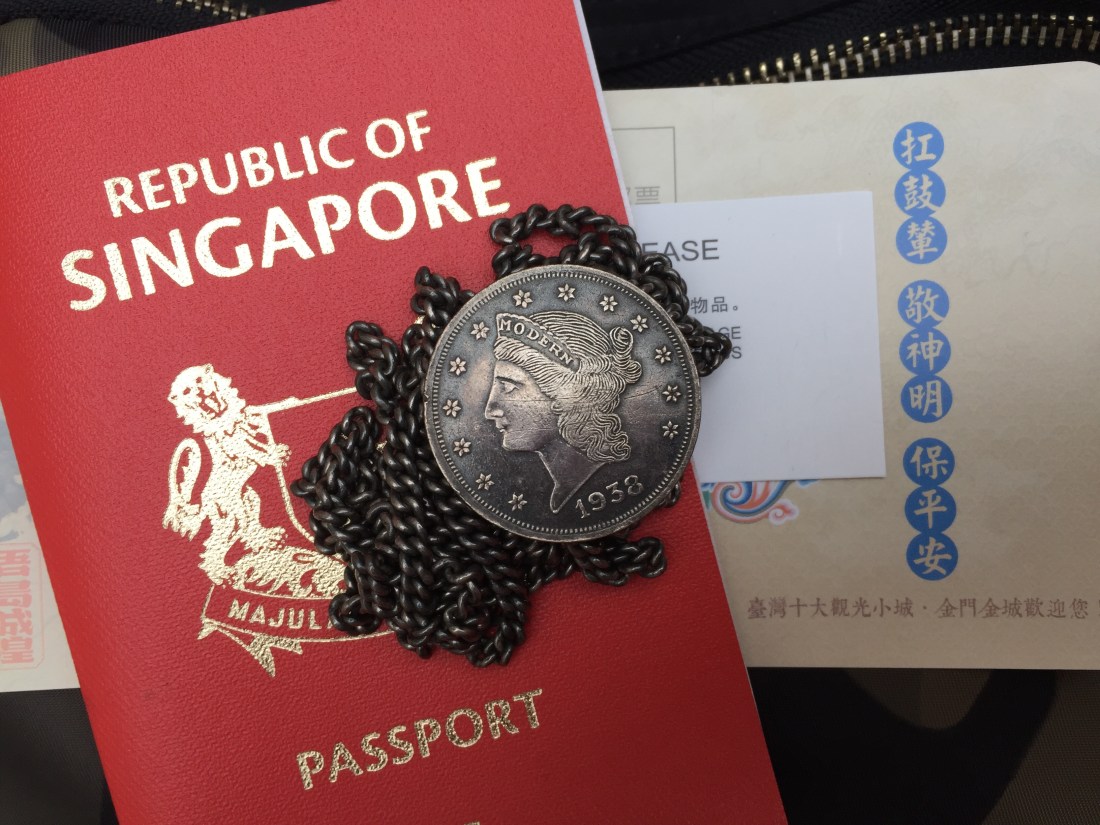
My passport, grandma’s silver belt and ferry ticket from Wutong Harbour, Xiamen to Shuitou Harbour, Kinmen. (13 June 2019)
The song, 漂洋过海来看你 (Crossing Oceans & Rivers to See You) by Jonathan Li had been running inside my head for months.
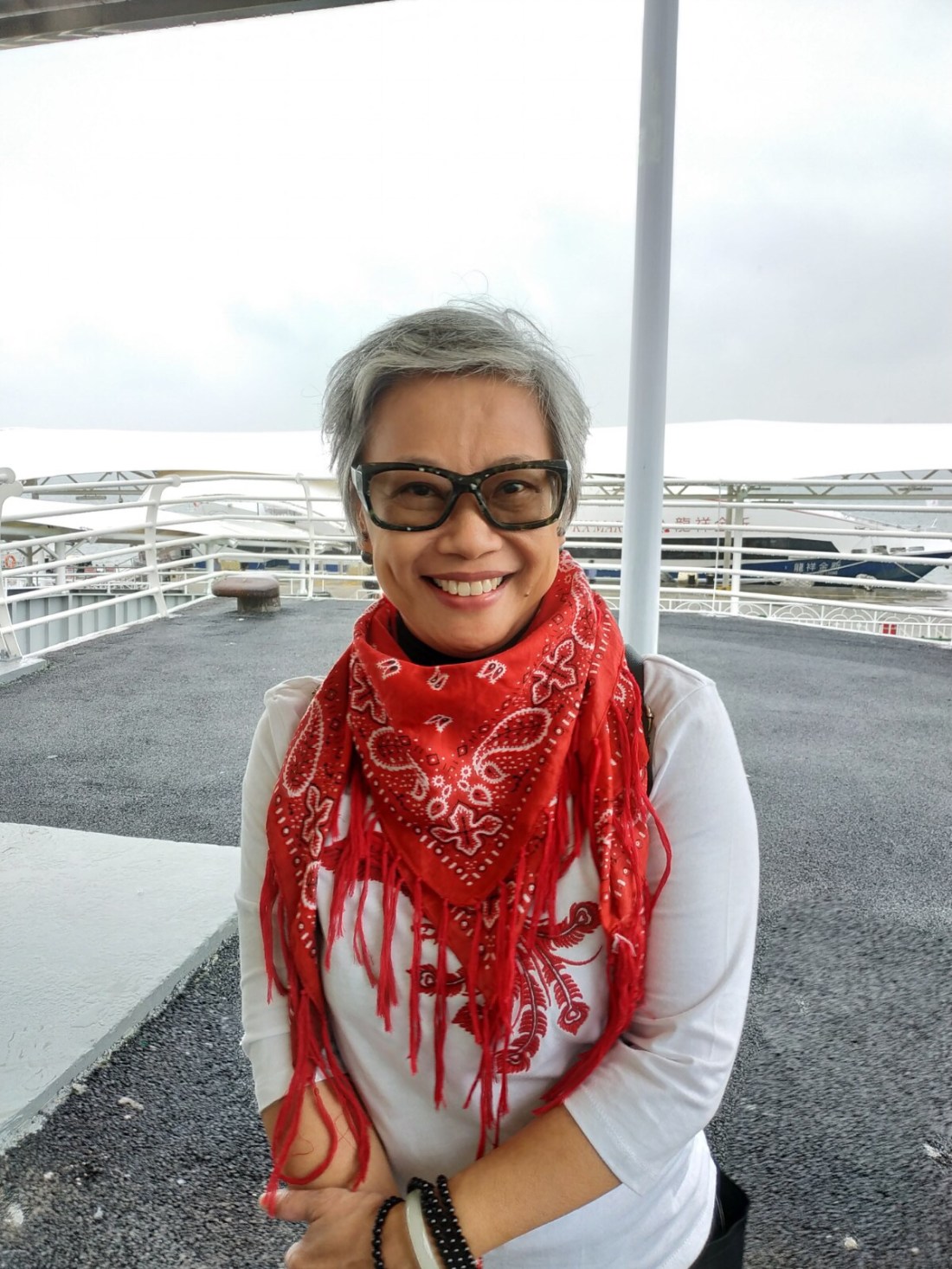
At Xiamen’s Wutong Harbour minutes before taking the ferry across to Kinmen Island for the first time. The Tshirt I had on was bought from H&M Xiamen and has a red phoenix embroidered on it. I didn’t know then that 2 days later, I would be standing under a Phoenix Flower Tree at the entrance of Dongsha Village in Kinmen.
My motives for flying and ferrying were simple: First to see Houpu (后浦), the place that my grandma spoke about all the time. Second, to visit an ancestral shrine that bear her family name or surname, Weng (翁) which she had fiercely guarded without much success against mispelling and mispronunciation in her lucid days.
This trip was my way of assuring her that in Kinmen her surname is pronounced accurately, and it’s always present even if she’s absent.
As shrines built to honour ancestors are mostly Asian constructs and not exactly tourist attractions, information on them in English was scarce.
For my friends who read Chinese, ancestral shrines are called “cong zi” (宗祠). It is an alien vocabulary for me given the state of my Chinese proficiency.
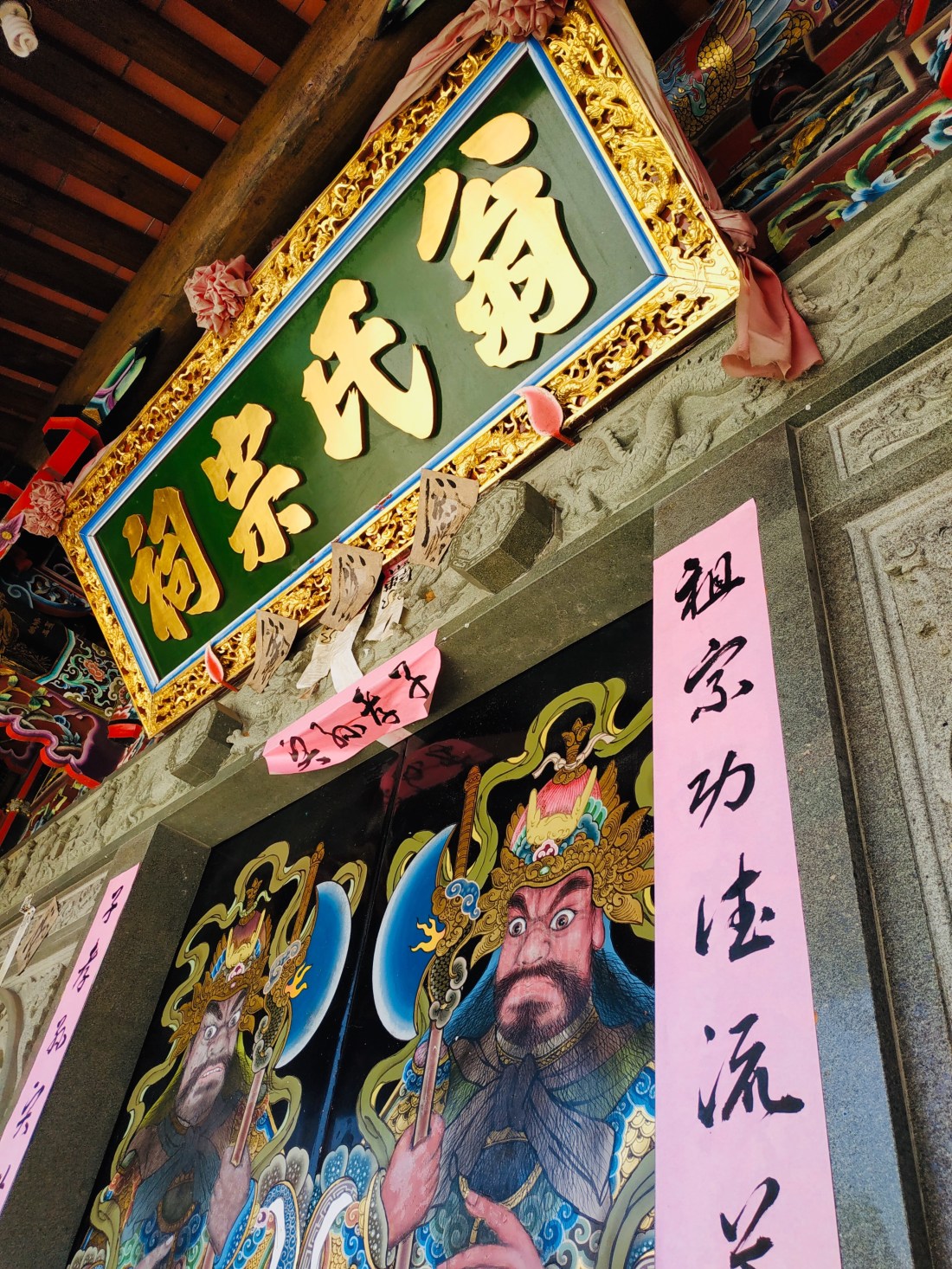
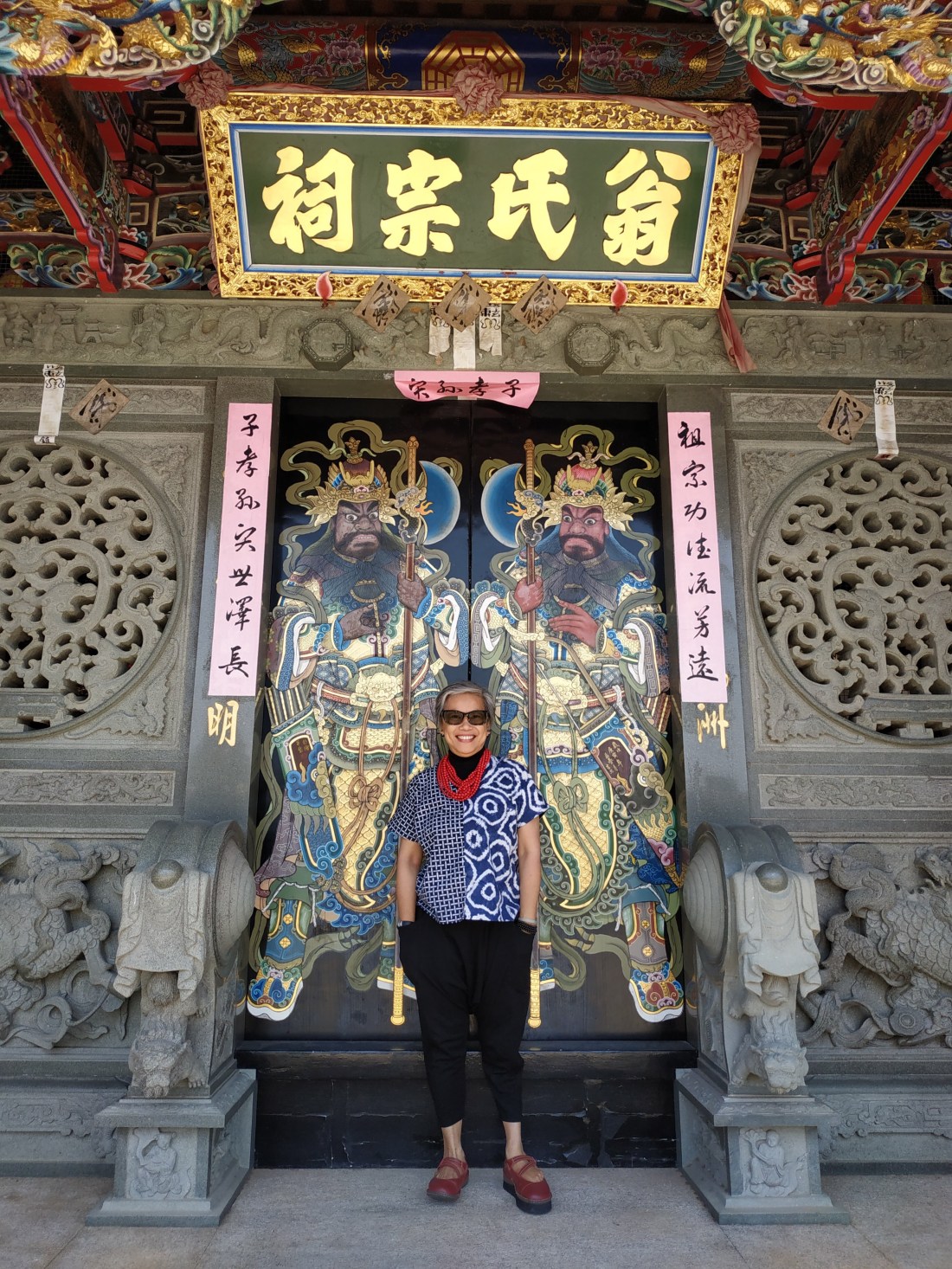
I just learnt this year that a shrine that’s dedicated to forebears sharing my grandma’s surname is called 翁氏宗祠 in Chinese. It took me forever to identify and pronounce these 4 magical characters accurately and in the right order.
Having done the above, I smugly thought my search should be more productive. Unfortunately all the googled materials that surfaced after I typed in the magic formula were in formal Chinese. Too difficult.
I felt the frustrations of an illiterate person. And now I realise that access to any language in any form is really a privilege.
Humbled, I took to trolling on older users of Facebook who share my grandma’s surname in hope of knowing more.
I figured FB posts in Chinese might be more accessible. And if I could just communicate with one FB user who was even remotely related to what I was searching for, I would be Queen.
Around Ching Ming (清明) season I saw this picture on the timeline of Mr Weng, one of the older FB users I had been trolling.
And as Providence would have it, sometime in late March this year, around the ancestor honouring period of Ching Ming (清明), one of the few older FB users that I had been trolling off & on, Mr Weng (翁文奥), posted a photo of an ancestral shrine on his timeline! And of course, it had to be a Weng (翁) shrine!
In my best broken Chinese, I wasted no time in privately messaging him about who I was and my reasons for visiting the shrine. (I did feel a bit shady reading his posts all these times without introducing myself).
Mr Weng replied immediately with the address of the village where the Wengs (翁)live and where 4 ancestral shrines are located.
His reply made me feel as if I had won a ticket to Bhutan!🤣
By the time I got to Kinmen Island on 13 June I was able to recall & pronounce the Chinese words related to my purpose with less awkwardness.
Due to my own language inadequacies, I didn’t make any transport arrangements or contact Mr Weng beforehand about my plans.
But the Universe is benevolent and knows my limitations.
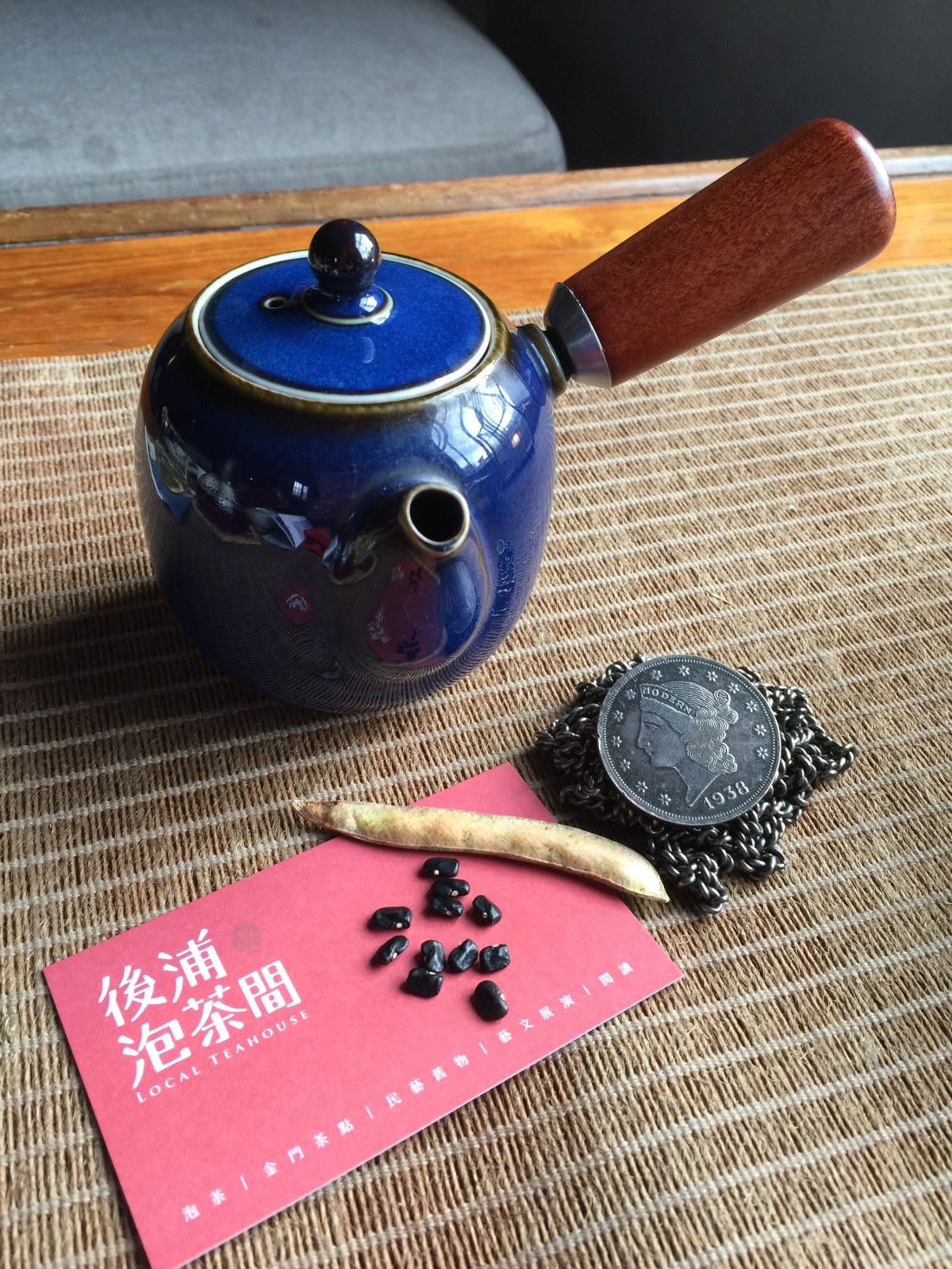
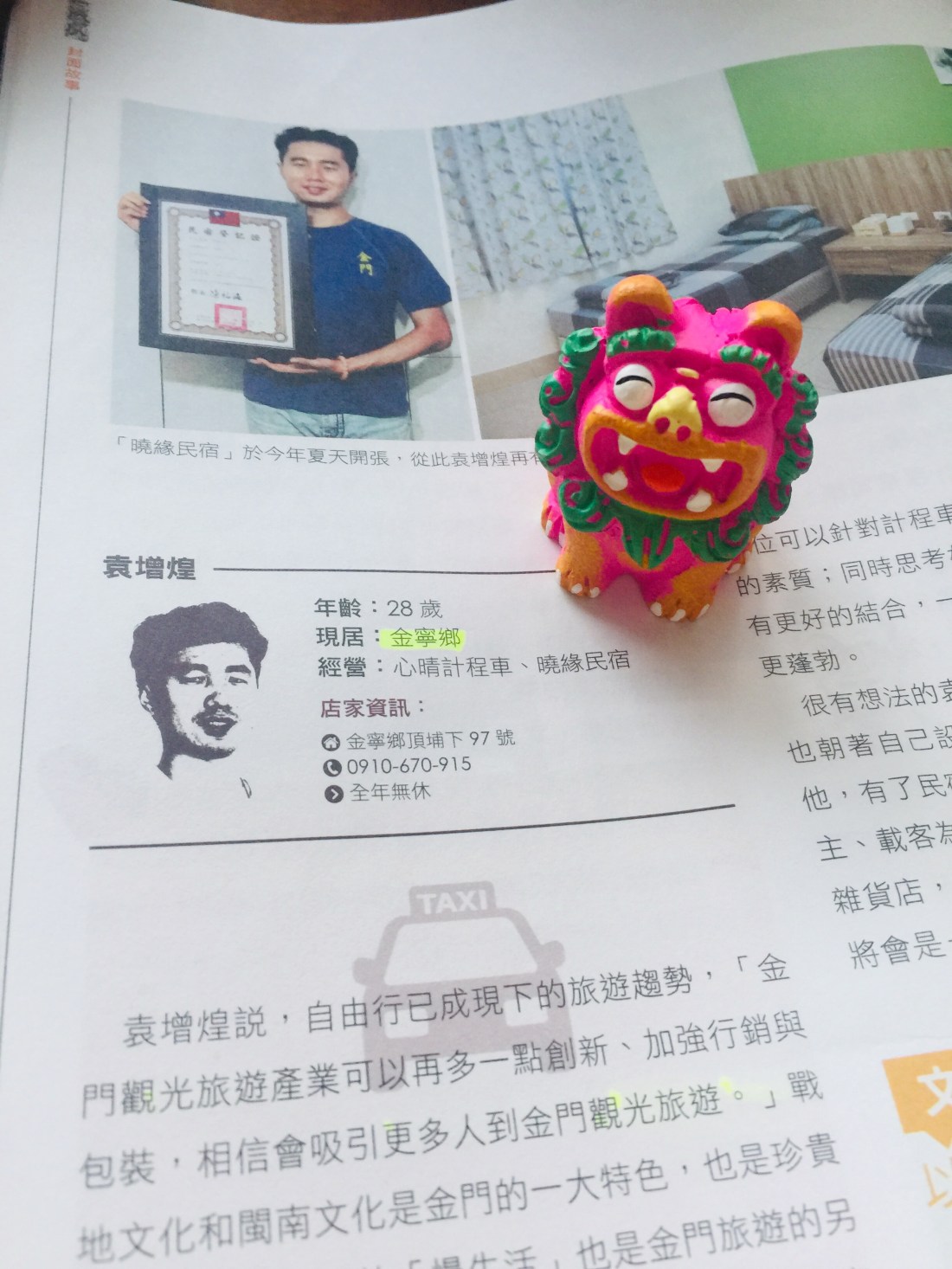
It sent Wang Ling from Local Teahouse in Houpu (后浦) to introduce taxi driver, Yuan(袁 ) to me and guide us to the places I needed to see & more.
I had read about Yuan months ago but didn’t recognise him when we met. 🤣
I would realise later on that I had read about Yuan in my pre-trip preparation. I even highlighted his details. But at that time the thought of contacting him in my near non-existent Chinese seemed daunting.
I would also find out after this trip that Yuan has a Masters in Minan Cultural Studies from the Kinmen University.
It probably explains why he didn’t just drive & leave us at our locations, but took the effort to walk with me happily and point out details to me.
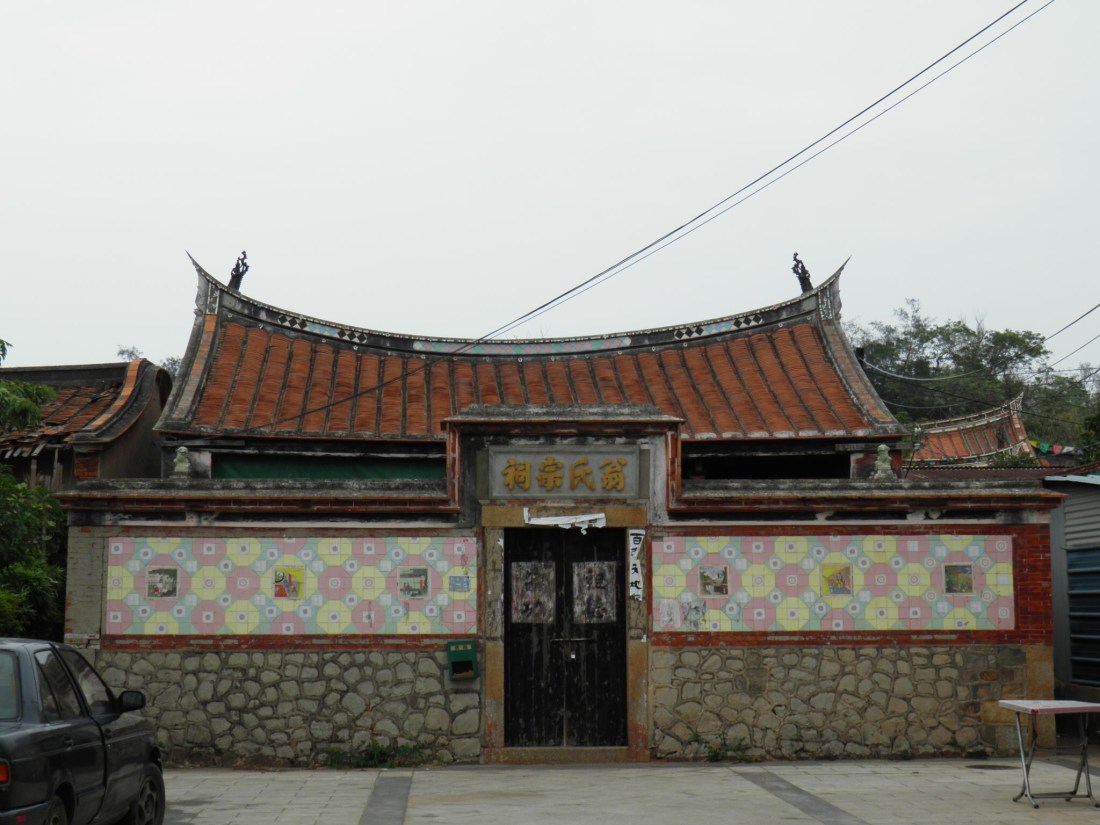
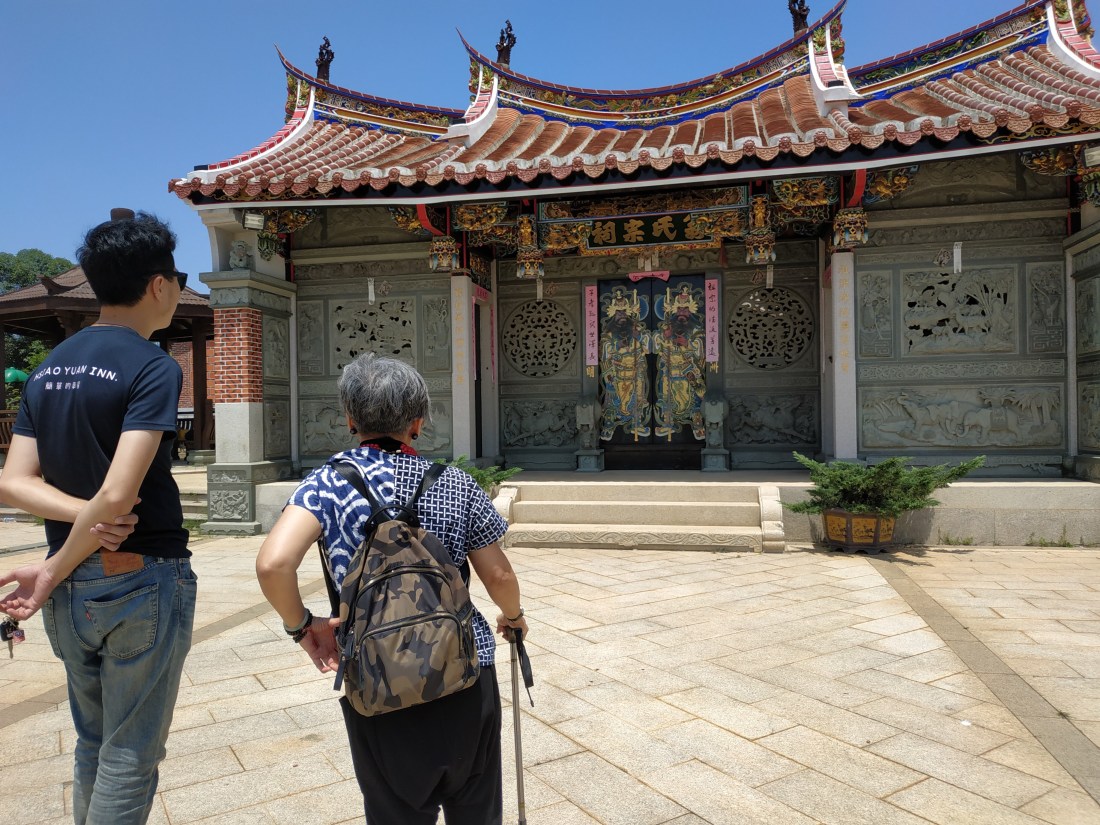
My first sighting of a Weng ancestral shrine. Being able to decipher words has never felt more important to me.
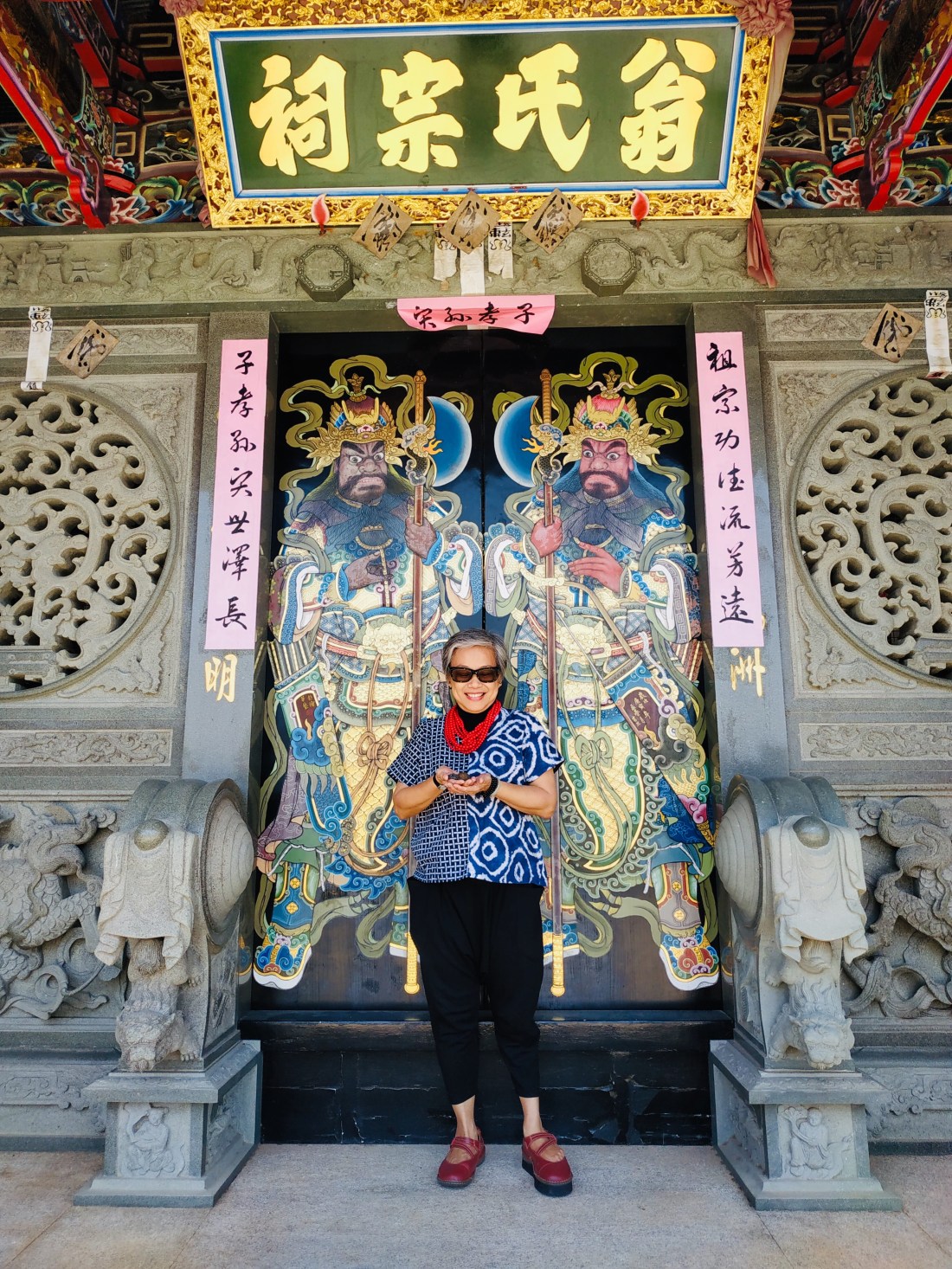
Yuan drove us to the village, “Pan Shan” (盤山)where my grandma’s people originated. And the first shrine we stopped by had just been restored not long ago! My grandma’s surname Weng 翁, was painted in a fresh coat of brilliant gold!
“It’s all good now, grandma.”
Holding her oxidised silver belt in my palms, I paused prayerfully at the shrine entrance.
“See, your family name is brighter than ever now, so don’t fret. It’s all good,” I told my grandma.
After Yuan learnt that my male ancestors also hailed from Kinmen Island and belonged to the Ong clan, he was very determined to take us to the village where the earliest Ongs from Kinmen began. This was a bonus for me.
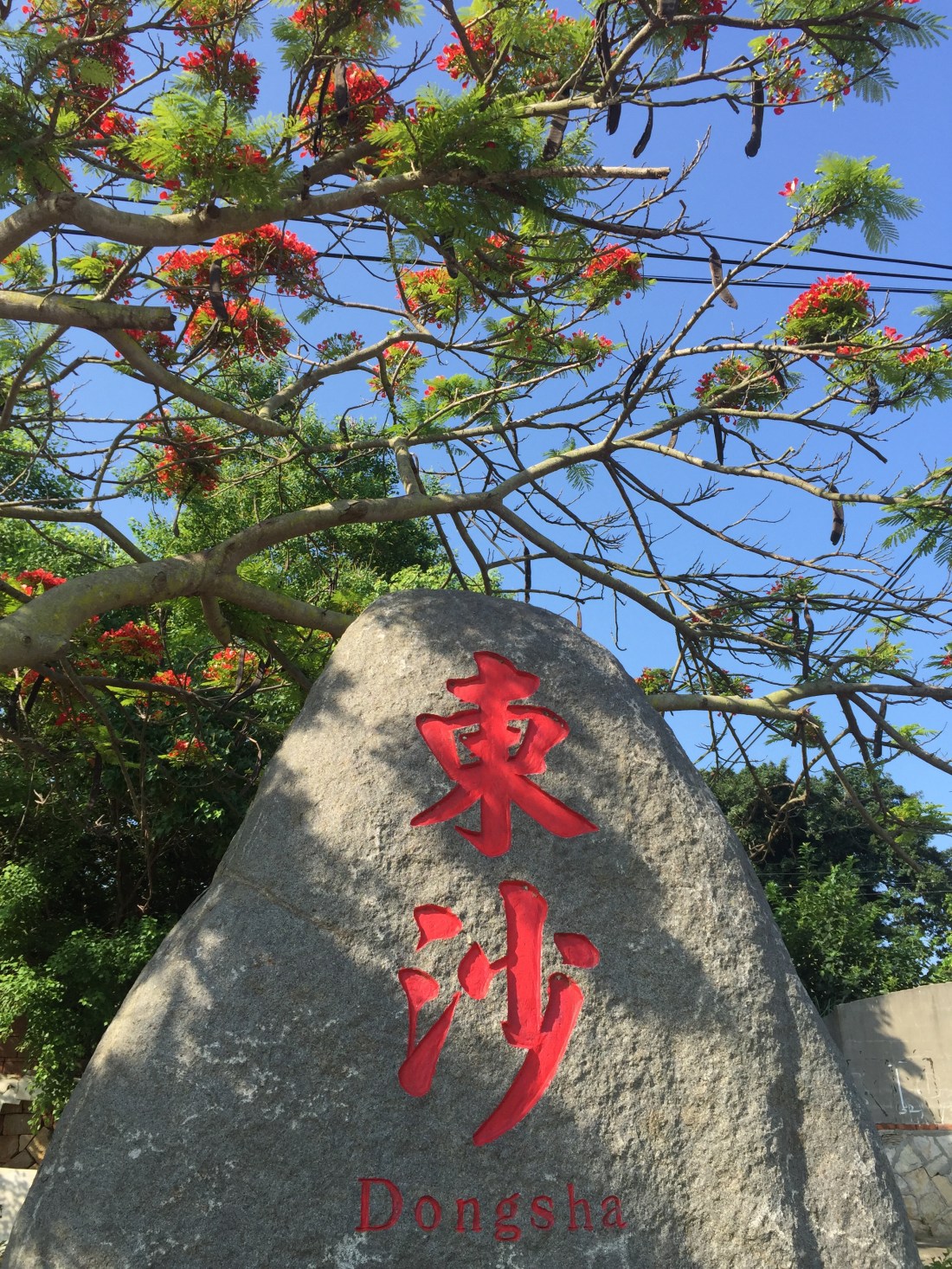
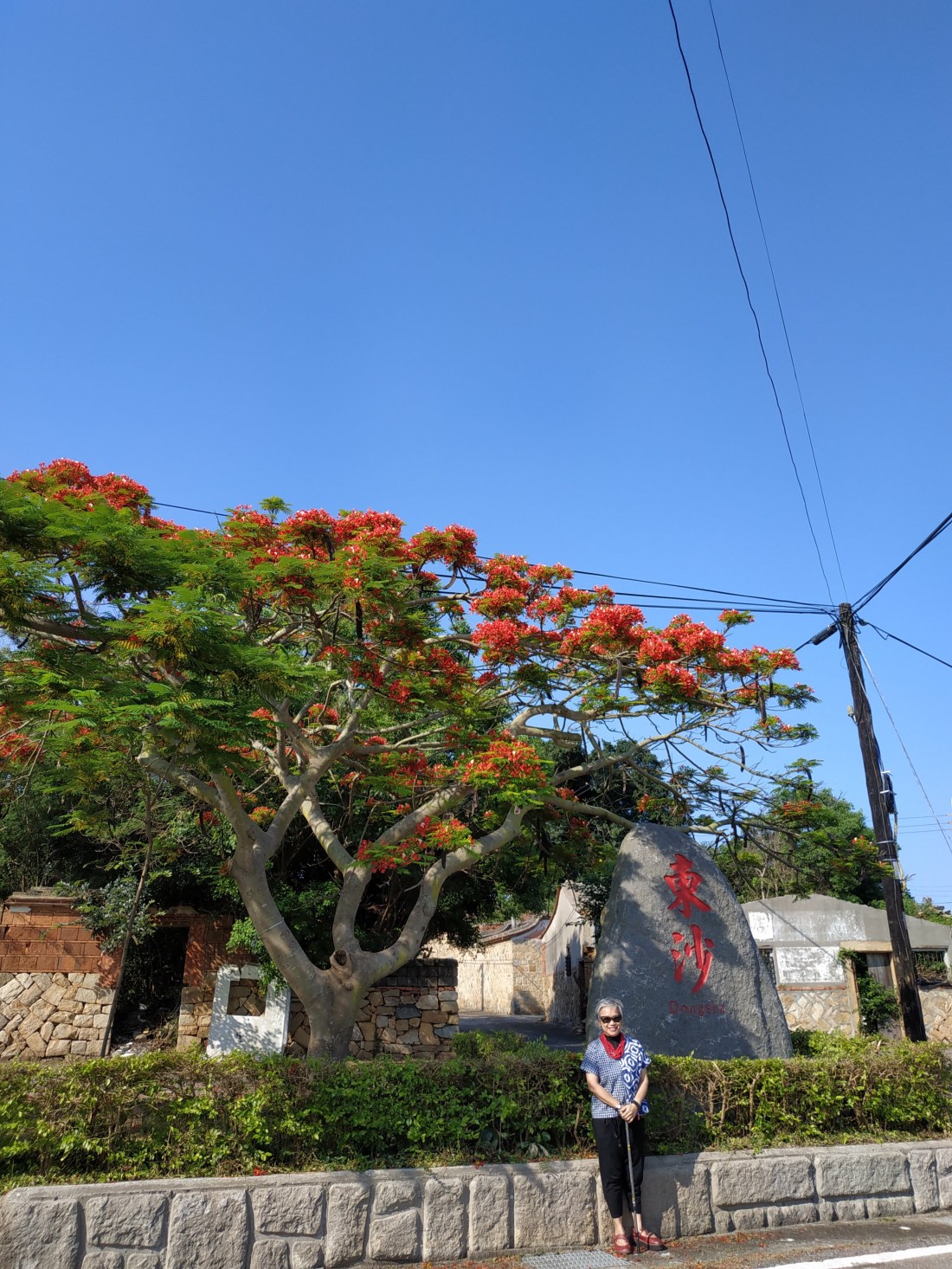
Dong Sha, the village where the oldest Ongs of Kimen orginated.
We arrived and stood at the Ong village entrance of “Dongsha” (东沙) where a Flame of the Forest Tree was in full bloom. Yuan told us the flowers are called 鳳凰花 (feng huang hua/ phoenix flower) in his part of the world.
Standing under the Phoenix Flowers of fire cracker red and breathing in the fragrant embrace of my Ong forefathers.
Under the bright blue summer sky and sheltered by the flowers of fire cracker red, I smiled and breathed in the fragrant embrace of my long forgotten forefathers.
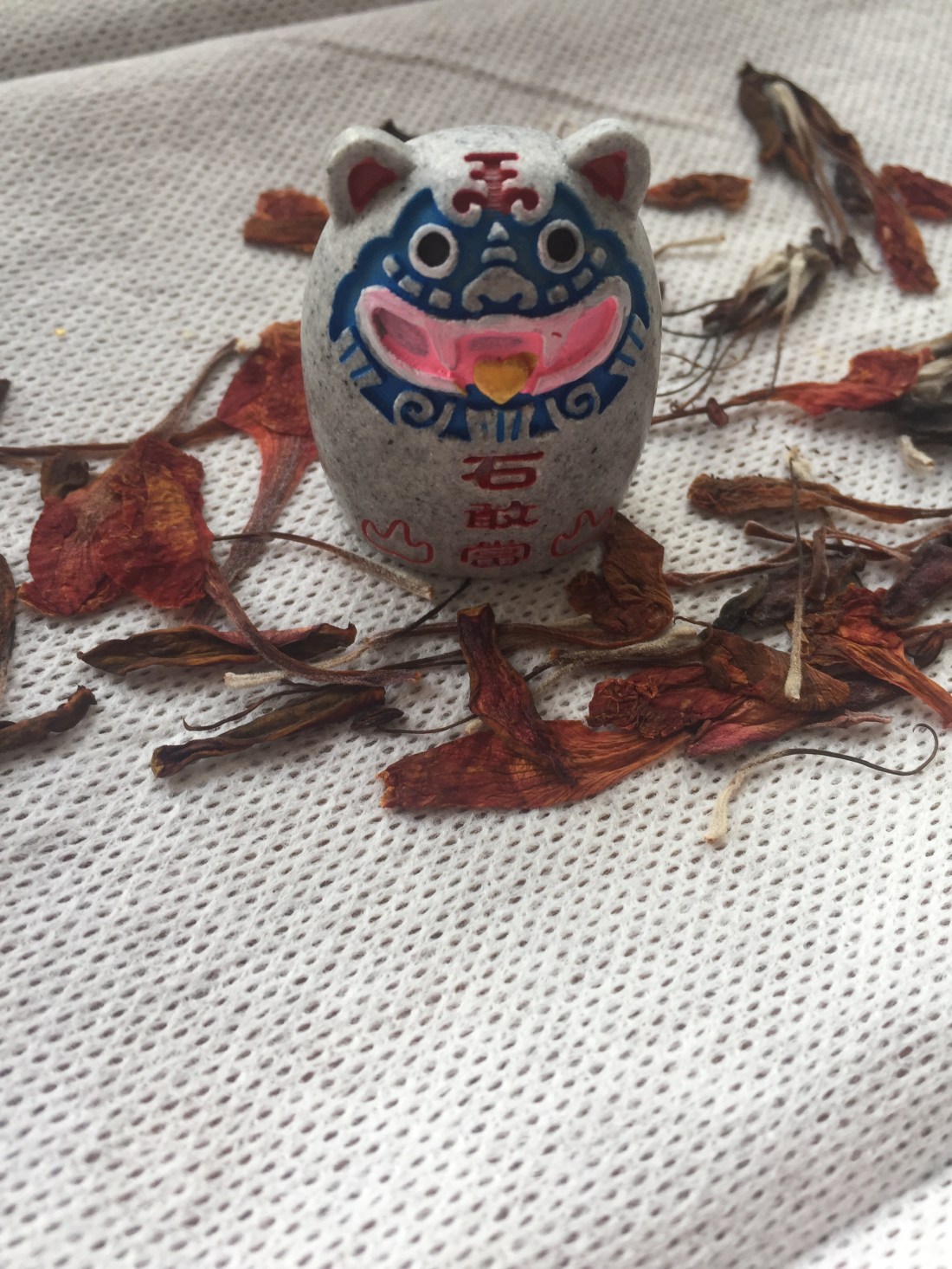
I picked up some of the phoenix flowers from Dongsha Village.
On our quiet taxi ride back, I gave thanks for the series of events that have unravelled since last year and for the people sent to facilitate my intentions the moment I decided to make a trip to Kinmen for my grandmother.
On 14 June 2019, 28 years after her demise, I finally arrived at Houpu (后浦), the birthplace that my grandma pined for all her life, but never got to return to.
“Gua si ongg. Gua di aw paw cu xi. Gua si kim meng lang,” my grandma would chant these 3 sentences depicting her origin in Minan language to just about anyone who would listen.
“我姓翁. 我在后浦出世. 我是金门人.” (Mandarin translation)
“My surname is Ongg. I was born in Houpu. I’m a Kinmen person.” (rough English translation)
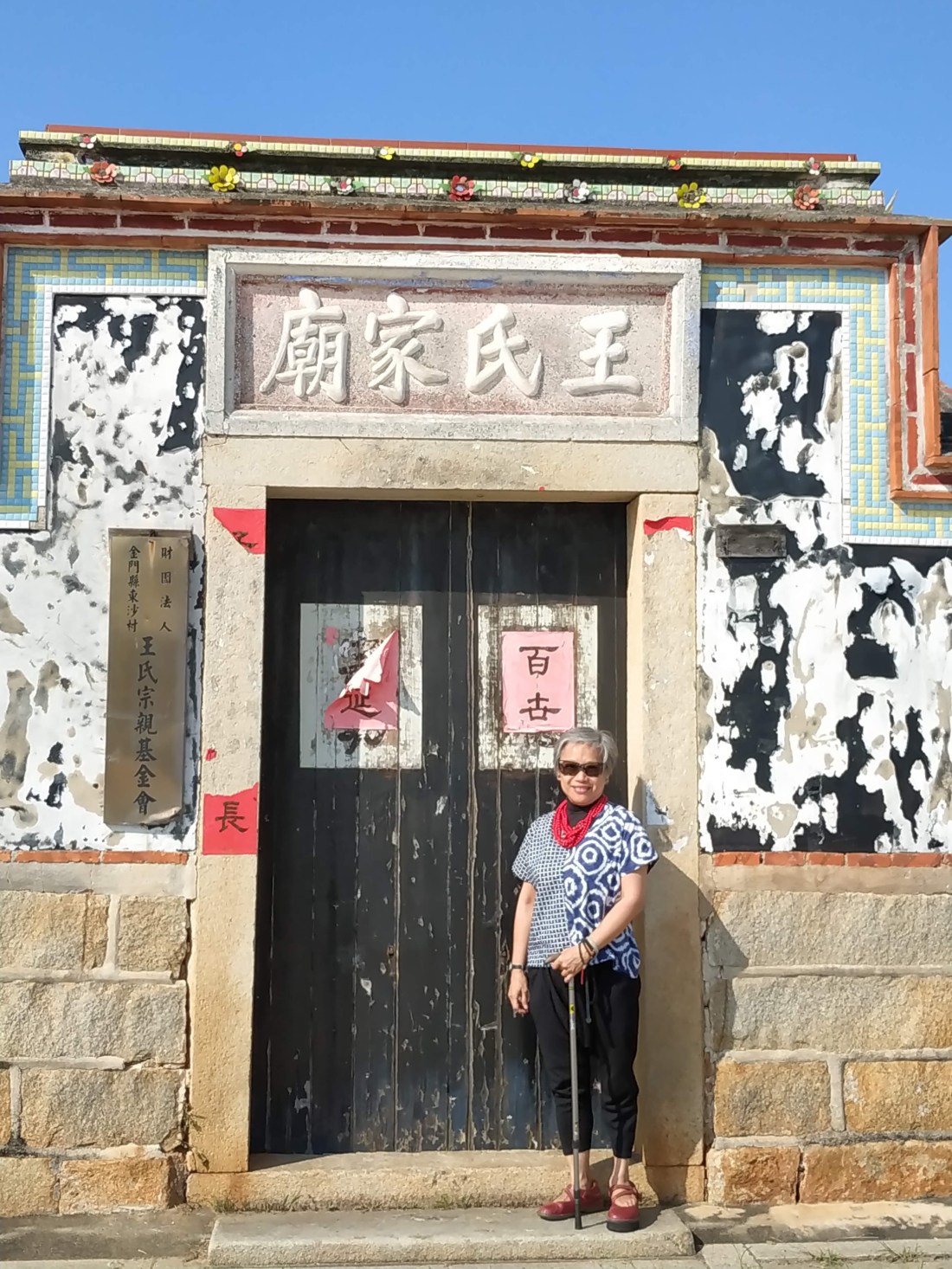
At the entrance of a recently restored ancestral shrine belonging to surname Ongg/ Weng 翁, which is my grandma’s surname. I told my grandma her precious surname is now newly painted in gold and no amount of bad spelling or poor English translation can undermine it.
She held on to the above 3 expressions for dear life and was able to tell us who she was right to the end, even when dementia rendered her incapable of recognising her own grandchildren.
In my primary school days, one of her favourite activities was to show me her S’pore Citizenship Card issued on pink vanguard paper. She had it bundled up with other important documents with a handkerchief which she tied the four corners together to make it into a folder of sorts.
She would unknot the handkerchief and remove her citizenship card like a cherished mandate. Then she would direct my eyes to the romanised version of her name, “Ang Gaey,” handwritten in blue ink. She would also remind me that it had been wrongly translated. The cadences in the Minan language by which she was named had no corresponding sounds in the English Language.
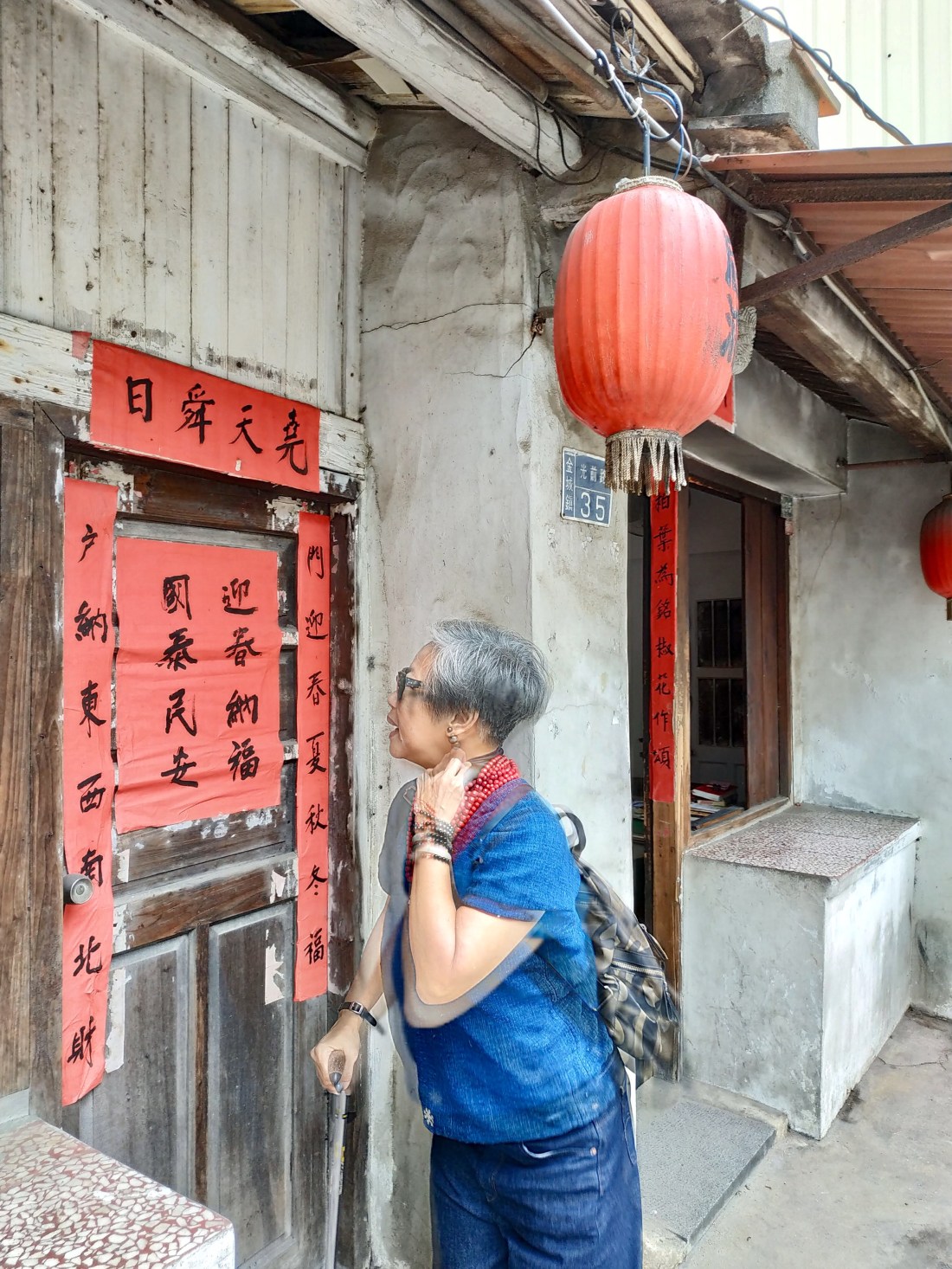
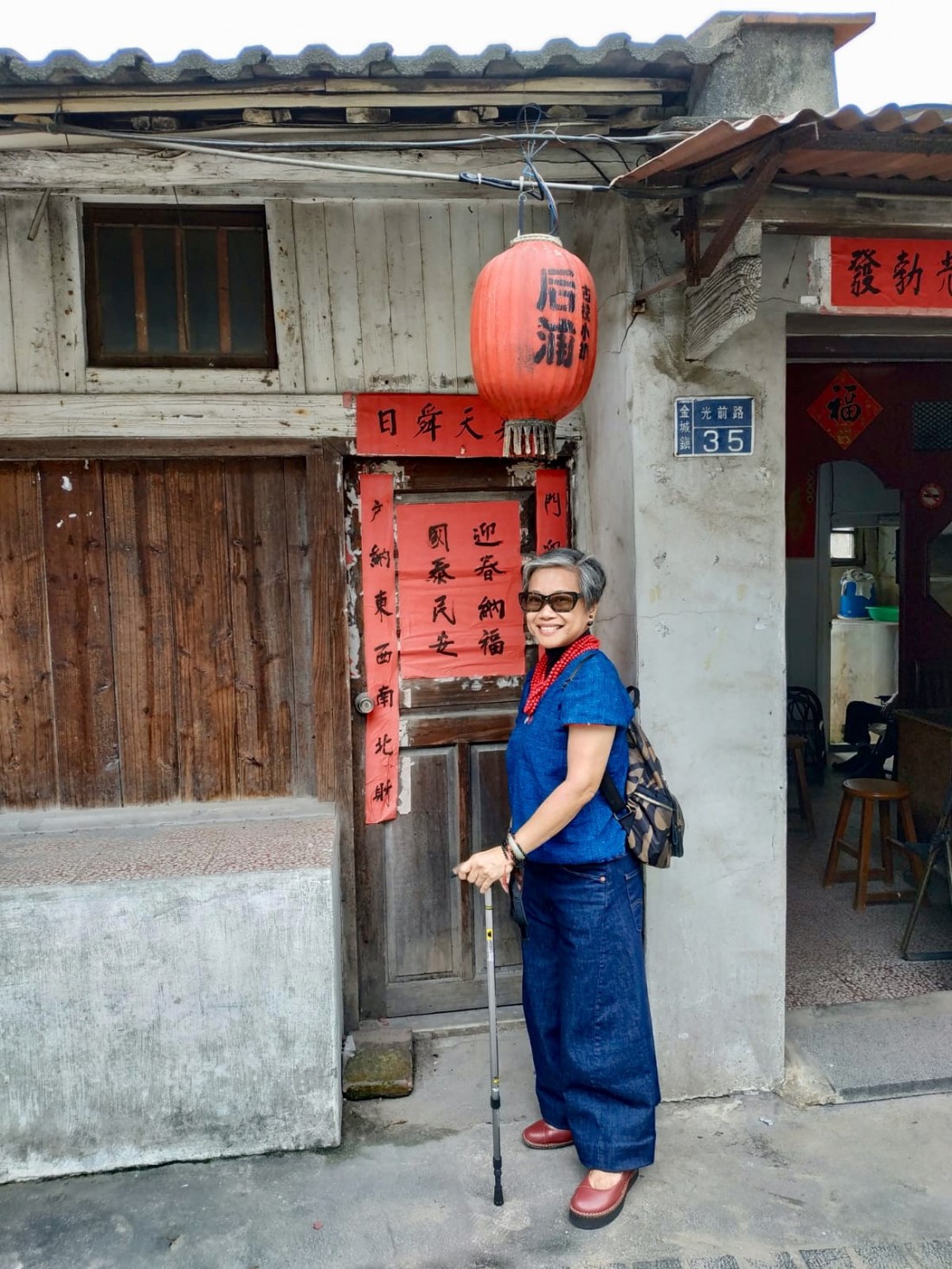
Auspicious words continue to be displayed on the doors of an old house in Houpu. Words when written with love become a talisman for good.
In my teens, instead of becoming more understanding of my grandma’s insecurity about her poorly translated name on government documents, I became annoyed with her for boring me with such dated & inconsequential details.
Wang Ling, founder of 后浦泡茶间Houpu Teahouse shares old pictures of Houpu with me. It was an honour to receive advice from her. When I was at her age, I was still struggling with personal stuff. And here she is running a teahouse to promote exchange of ideas on culture, society, arts and craftsmanship.
But now in my aging years, and as a teacher of language, it hits me extra hard that my illiterate grandma having been separated from her birth family at age 7, must have been so desperate to preserve whatever bits of information pertaining to her origin. And to have her adoptive country, Singapore, getting something as basic as her name wrong on official papers must be very unsettling indeed.
Perhaps repeating her details to me was the only way she knew how to protect her identity & stay connected to her roots.
The fear of forgetting looms in a person like some invisible illness that those with means to documentation may find it hard to empathise with.
As I strolled the streets of my forefathers, “Houpu (后浦)” is no longer a strange sounding word repeated by a neurotic old woman. And I deeply regretted the times when I was dismissive and cruel even, towards an old lady who couldn’t stop talking about her surname, her birthplace and her island.
Had I the compassion & intelligence to listen more and judge less then, I might have helped to mitigate her unspeakable sense of loss and loneliness.
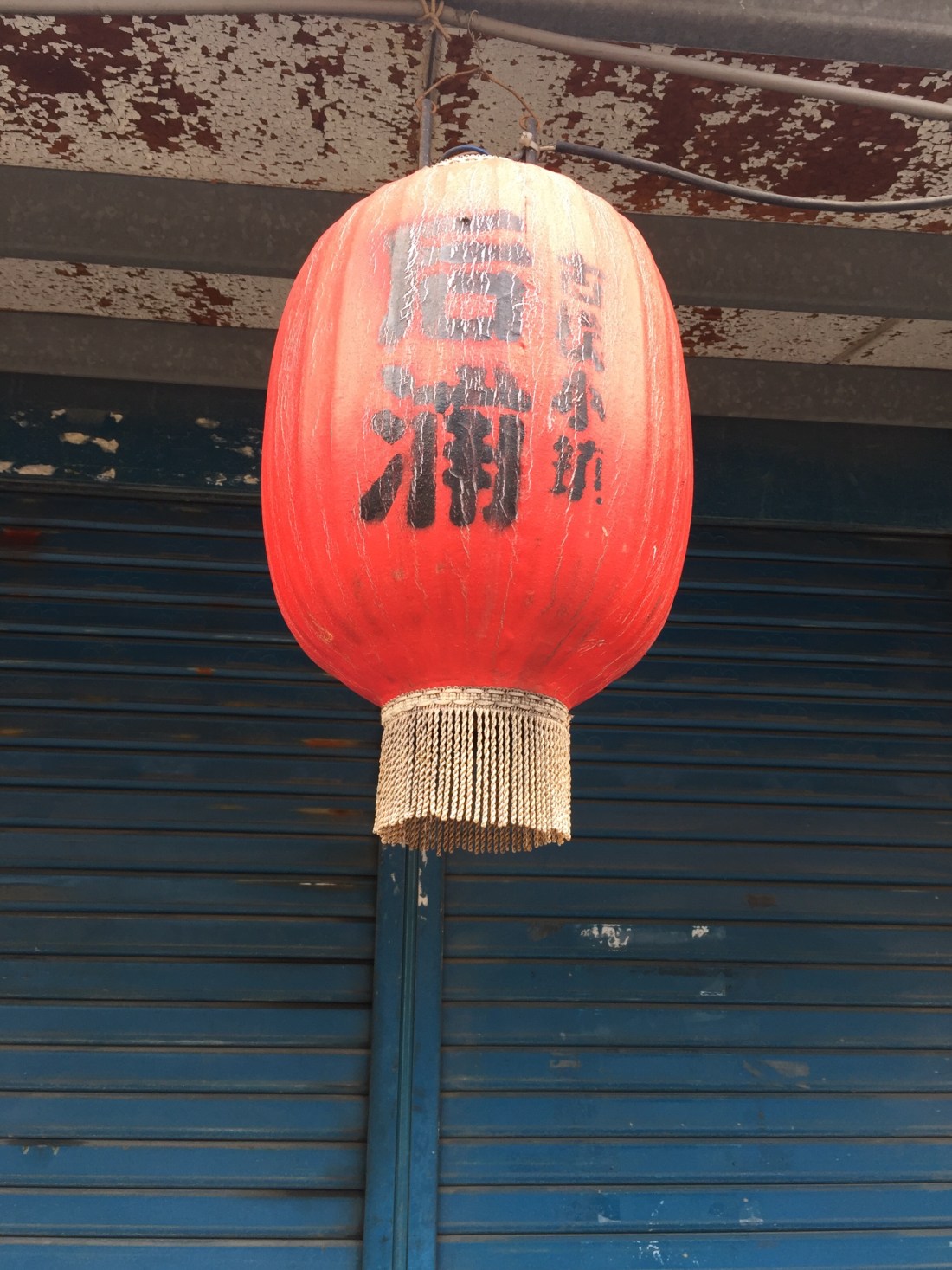
On this trip, strings of red lanterns with the characters Houpu (后浦) written on them swayed lightly above me in the cool summer breeze as if saying to me & my grandma, “Yes, yes! This is Houpu! And you are home!”
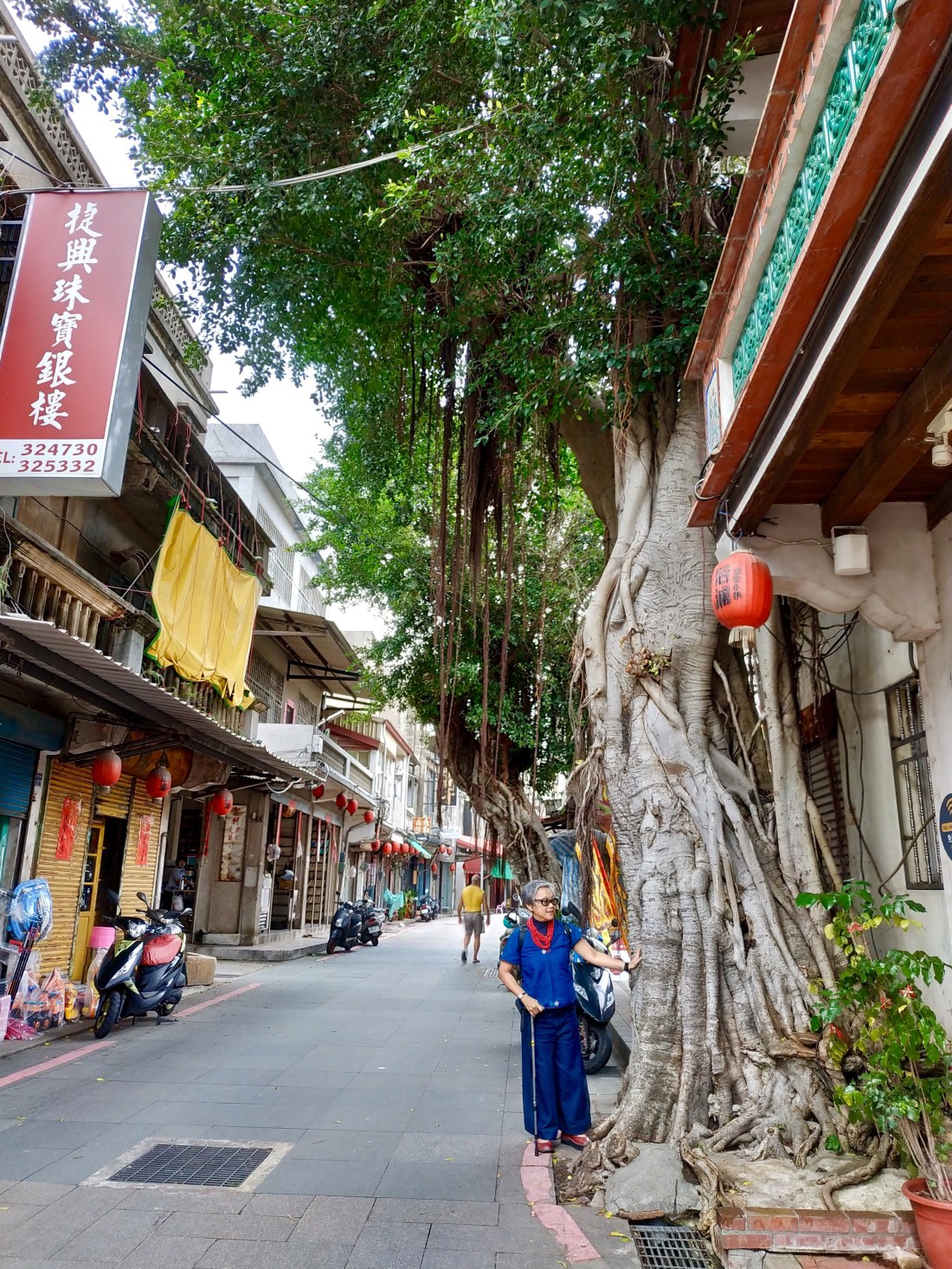
As I stopped to greet the ancient Banyan tree whose branches rose to touch the window of Houpu Tea House (后浦 泡茶间) above, I felt a sense of peace & grounding even though I wasn’t born there.
After this visit, I feel that my grandma is no longer that frightened little girl who was made to sail from Kinmen to Singapore, and then spent her whole life trying to find her bearing. Far from being lost, I think my trip has helped her gain back her footing and now she has two places to call home, Houpu (后浦) and Singapore.
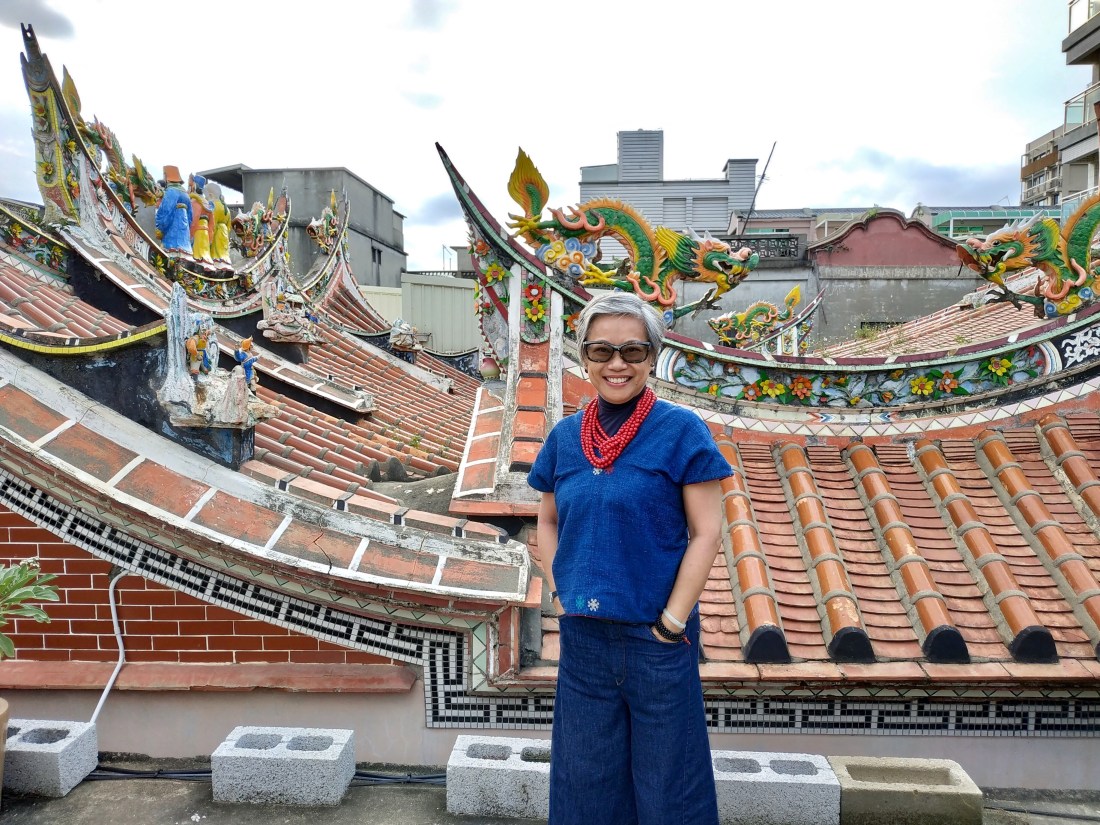
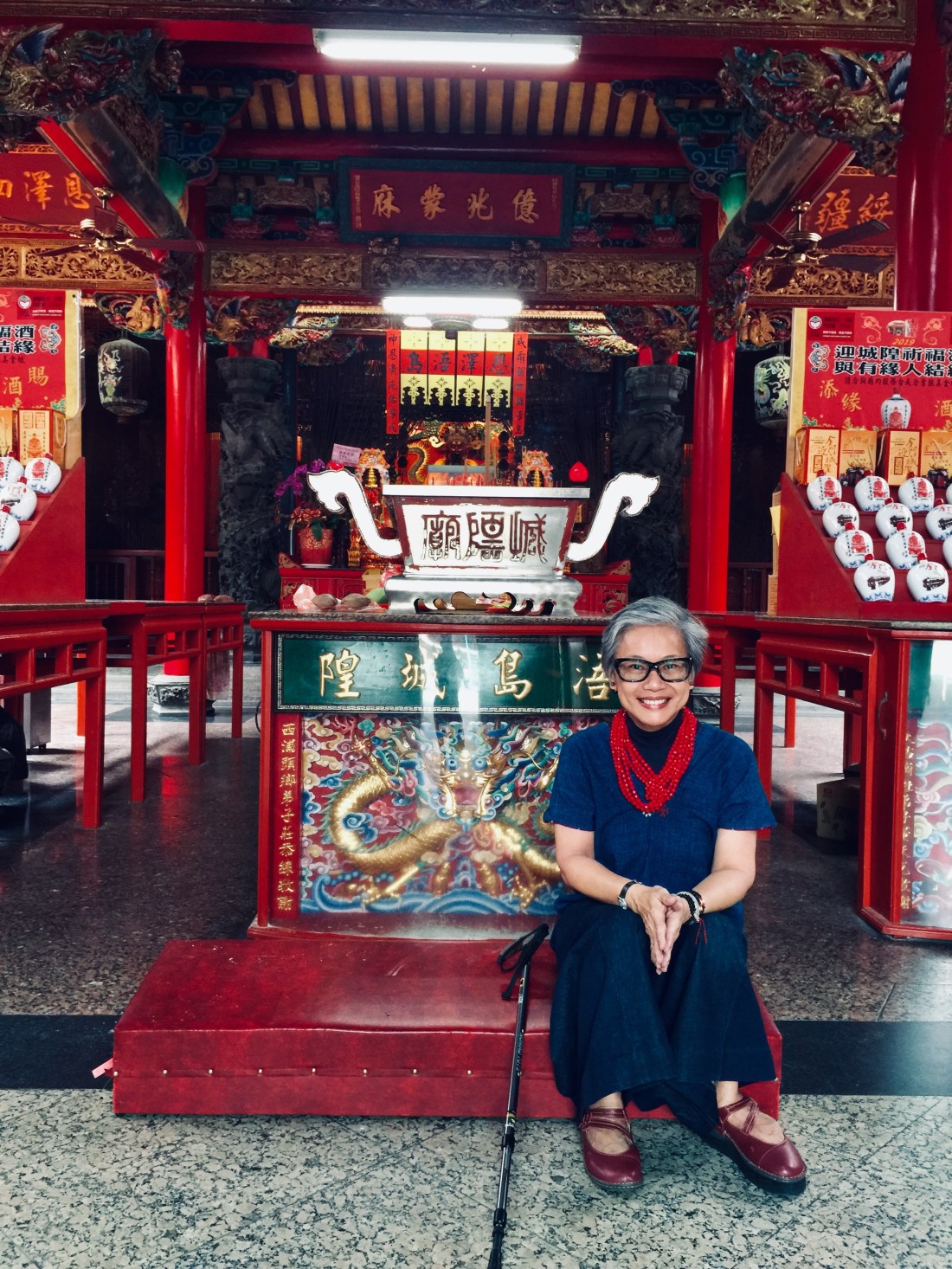
On the deck of Houpu Tea House (后浦泡茶间) overlooking Wu Miao, the temple dedicated to Kwan Gong, the Warrior God of Righteousness & Justice.
Thanks to her persistence in talking about Houpu (后浦) despite the sniggers she received, a whole world of new experiences has opened up for me, many years after her life had ended.
So I wish for all my friends, the tenacity of my grandma to keep talking about what we love & believe in, be it a name, or larger topics such as gender equality, animal welfare, good governance etc, even when no one seems to care. Because one day, someone is bound to pick up your message & thank you for it. 🙏
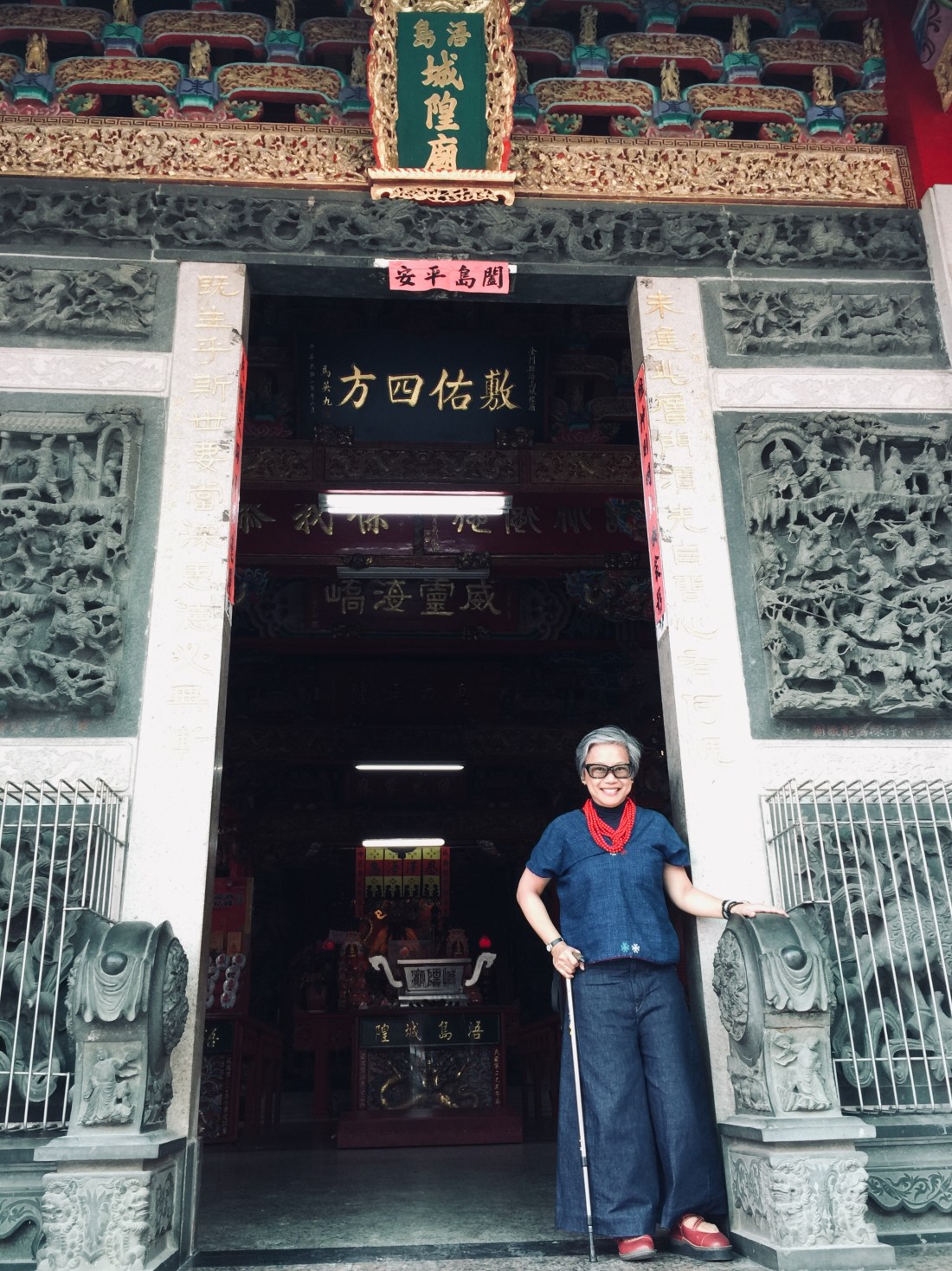
The temple’s intricate stone and wood works have calming effects on me. I felt unusually solid even though I was physically tired from climbing the steps.
Wudao City God Temple (浯岛城隍庙) is located in Houpu (后浦)the birthplace of my grandma. “Wudao” is the old name of Kinmen Island. A “city god” in Taiost beliefs is a protector deity of the city, ensuring its environment and inhabitants live in harmony.
The temple dedicated for this purpose of peace & protection for all is more than 300 years old. In fact it just held its 339th year of celebration on 22nd April this year.
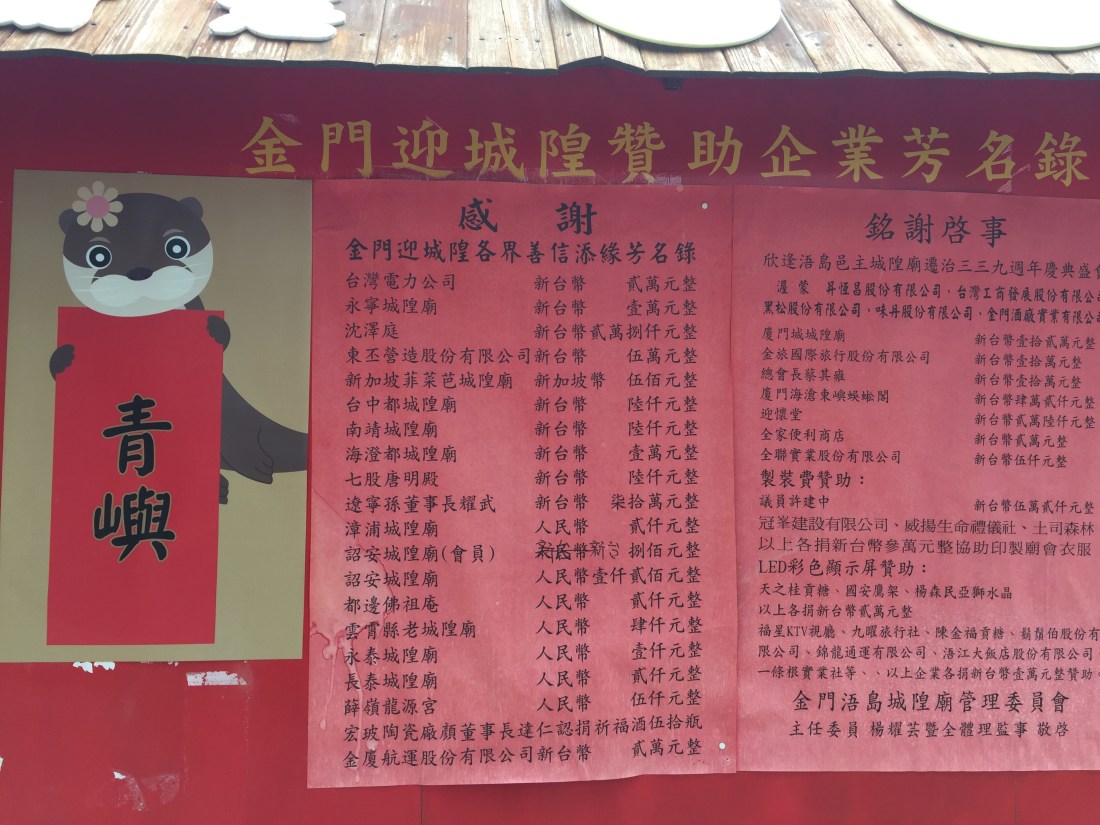
Otter name conferring contest was held alongside the temple’s 339th year of celebration showing that all lives are sacred.
One of its recent temple celebratory activities was to organise a name conferring contest for two otter pups in order to highlight the challenges faced by the Eurasian otters that share the waterways of Kinmen Island.
Stepping into this temple was like stepping back in time. I know that the furnishings in the temple and architecture have been renovated many times, but the space where my grandma and her family members would have visited is still the same.
In this space I can connect with all my ancestors who have ever prayed at this temple.
In the sunny afternoon with beams of light filtering in from the openings above the temple, I walked about and imagined what it might have been like a 100 years ago in that space where I was.
As I rested my tired legs, wafts of incense fragrance mixed with the familiar smells of joss paper offerings made me feel homey and at ease. When I touched her silver belt which I had kept in the pocket of my denim jeans, I connected with my grandma across time.
At the Protector Deity seated in the centre of the altar I gave thanks for His protection & blessings on the 7-year-old child bride who was born in Wudao in 1914, grew up to become my grandfather’s wife, became my dad’s mom, was widowed and became my grandma before passing on at 77 in 1991.